For race, concrete facts, a little luck
Saturday's deluge had swollen the Cooper River to overflowing. A wicked, unrelenting wind whipped its surface into white-capped chop. In short, it was an insane day to be out on the water.
Saturday's deluge had swollen the Cooper River to overflowing. A wicked, unrelenting wind whipped its surface into white-capped chop. In short, it was an insane day to be out on the water.
Especially in a concrete canoe.
But that didn't stop teams of college students who aspire to be engineers from racing in vessels that by definition seem guaranteed to sink.
Concrete canoe? It's an oxymoron verging on impossibility.
Sunday's rough conditions at Cooper River Park in Pennsauken merely enhanced the challenge for these creative young men and women imbued with the same can-do spirit that built the Empire State Building, Hoover Dam, and Golden Gate Bridge.
The concrete-canoe races and a student steel-bridge competition, also held at the park Sunday, were main attractions of the Mid-Atlantic Student Conference of the American Society of Civil Engineers, which was hosted by Drexel University and drew about 250 participants from 14 schools in Pennsylvania, Delaware, and Maryland.
"We're challenging engineering students to do something that seems impossible," said Marie LaPosta, 22, the conference chair and a Drexel senior mechanical engineering major. "They have to make a boat that can not only float but that as many as four people can paddle."
Student teams worked on designing and building the canoes for months. Although the students must follow certain general specifications, they had broad latitude to experiment and refine, especially with weight, hull shape, and the type of cement and mixing material.
Drexel's canoe, for instance, was made of a cement containing titanium dioxide, which sunlight converts into a stain eraser and pollution eater. "One hundred percent sustainable and recyclable," boasted Corey Day, 24, a senior majoring in structural engineering. In honor of that ingredient, the Drexel crew had christened the craft Titanic, a double-edged moniker the team hoped would not prove prophetic.
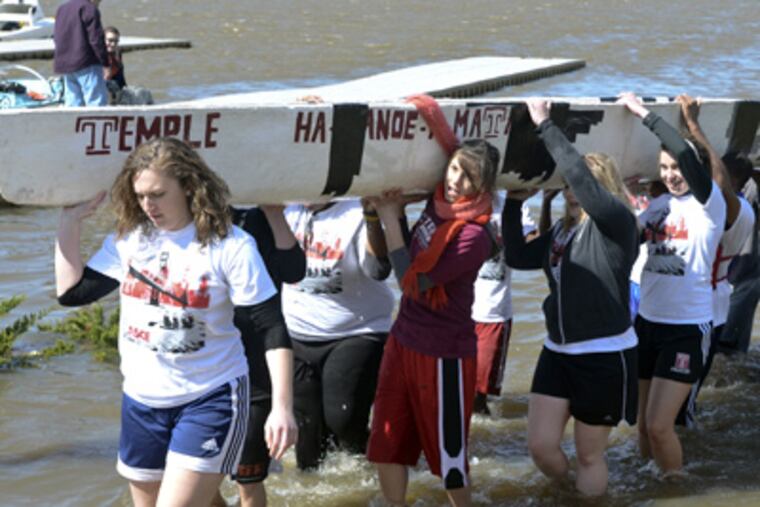
The Temple University squad was proud that its canoe, Ha-Canoe-a-Matata (a play on the Lion King song), was the lightest in school history, at 200 pounds.
"The thickness of the hull is less than one inch," said team captain Alixandria Lane, 21, a senior majoring in civil engineering. "It's all about proportioning and the type of aggregate you use."
Weight and density of the construction material are important considerations because the paramount requirement is that the vessels, even when full of water, float.
Hence the first order of business Sunday morning: the so-called swamp test. Some of the canoes were so buoyant (with aggregates that included blown glass bubbles) that teams had to struggle to push them underwater.
Temple's rough-hewn craft had "sleekness issues," conceded Ali Atif, 22, a strapping former lifeguard and designated paddler, but what it lacked in beauty, he was sure, it would more than supply in performance. "It has a good ratio between weight and strength," he said.
The races were only part of the contest. Teams were also judged on the quality of the final product, a technical paper, and oral presentation.
"That keeps it from being just a paddling contest and makes it an engineering competition," LaPosta said.
Result: It's possible to lose in the canoe races, which count for a quarter of the score, and win the overall contest.
Because of the wind and chop, the endurance race was canceled. Instead, the canoes vied to post the fastest time in a sprint up and back to a buoy anchored 100 meters away. Only one lane was used, close to the shelter of shore, and each canoe competed alone against the clock: first five teams of men, two to a canoe; then five teams of women; and, finally, five teams of two men and two women.
The river was devilish to navigate, in both directions. The brutal wind forced some canoes into extravagant zigzags. Changing course was like trying to turn around a battleship at full steam. The vessel from the Naval Academy was especially errant (ominously), while the canoes from Drexel and the University of Pittsburgh-Johnstown proved most seaworthy and direct.
In the end, a miracle occurred: In all three races, not one of the boats broke or swamped. The rescue squad had an idle afternoon.
Perhaps the most crowd-pleasing moment came even before a single paddle was dipped into the water.
Two paddlers on the University of Maryland team stripped off their baggy shorts to reveal black Speedos.
"They should get extra points just for that!" exclaimed Emily Anderson, 22, a Maryland engineering graduate and girlfriend of one of the men.
Perhaps it would have helped. When all phases of the contest were tallied, Pitt-Johnstown, last year's winner, captured first again, followed by Navy, Drexel, Maryland, and Temple.
Despite the weather's challenges, LaPosta pronounced the event a success.
"We're a lot of nerds who know how to have fun," she declared.