Annette John-Hall: Failing to nurture student chefs' hopes
Sounds like the old tablecloth snatcharoo to me. At least, that's how the nationally renowned Careers Through Culinary Arts Program (better known as C-CAP) must have felt when the School District cut funding for its acclaimed Philadelphia Cooking Competition at the eleventh hour - as if the tablecloth had been snatched out from underneath its five-course meal.
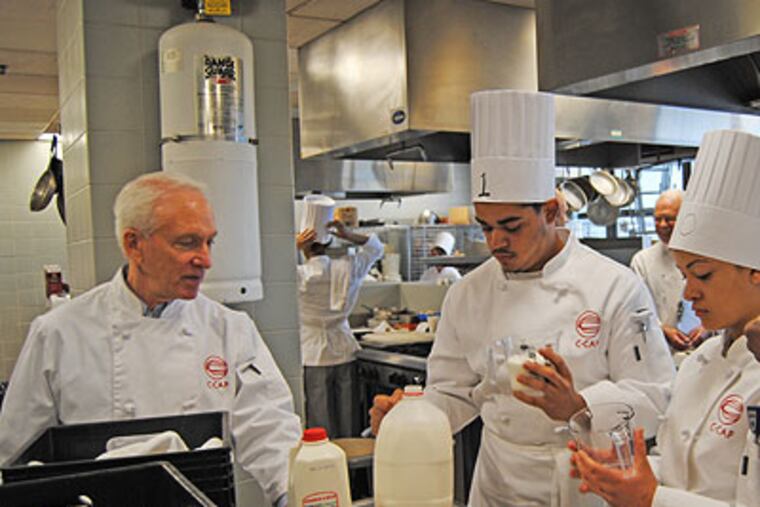
Sounds like the old tablecloth snatcharoo to me.
At least, that's how the nationally renowned Careers Through Culinary Arts Program (better known as C-CAP) must have felt when the School District cut funding for its acclaimed Philadelphia Cooking Competition at the eleventh hour - as if the tablecloth had been snatched out from underneath its five-course meal.
For the last three years, the district has gradually hacked away at a program that has transformed the lives of Philadelphia students. C-CAP founder Richard Grausman says the program received $25,000 annually under former chief executive Paul Vallas. Last year, it got $15,000.
And this year, it got a paltry $6,500 - for a program that will give $300,000 in scholarships to aspiring culinary students.
Spokeswoman Shana Kemp confirmed that the district probably won't fund C-CAP at all next year. But, hey, no big deal.
"We do not believe this will have an adverse effect on our students, because there are several partners in the city that are already providing scholarships and other services to our students," she said.
Which means C-CAP will have to find other sources to fund its competition, awards breakfast, and college support program.
This may not come as much of a surprise, but I just don't get the district's rationale.
I mean, how can it take all those scholarships off the table? And in the process grind up the dreams of students like so many carrots in a Cuisinart?
Crepes and cream
I'm talking about students like Lasheeda Perry. One of eight children born to a drug-addicted mother and a mentally ill father, Perry was living in shelters as a Frankford High student when C-CAP invigorated her life with a full-ride scholarship to Johnson and Wales University in Vermont.
Since then, Perry's culinary skills have taken her to China, Australia, and Ireland. Now 25, she's back at home and working as a pastry cook at the Four Seasons, with designs on opening her own dessert boutique.
Of her life today, Perry says, "I'm still in awe of it." She was one of the judges at this year's competition. "C-CAP has opened up so many doors. . . . I know I wouldn't have achieved any of what I have achieved right now."
Kathy Tavares, also one of many siblings and the daughter of a single mom, is hoping to get where Perry is. The Frankford senior was one of the 12 students who cooked a French meal in under two hours before a panel of esteemed local chefs at Drexel.
Students prepared a French menu consisting of poulet chasseur (roast chicken), pommes de terre château (sauteed potatoes), and crêpes sucrées avec crème pâtissière (dessert crepes with pastry cream).
Tavares' chicken was tender, her crepes sublime, and her seven-edged potatoes cut just right.
Talk about a passion and a palate.
"Kathy eats, sleeps, and drinks this stuff," says Wilma Stephenson, Tavares' culinary arts teacher, whose kids have won hundreds of thousands of dollars of scholarships from C-CAP. "She's the type of kid who says, 'If you just give me a bit of a chance. . . '."
A bitter taste
If Stephenson's name sounds familiar, it's because she starred in the award-winning documentary Pressure Cooker, which chronicled how she prepared her students for the C-CAP competition.
"I'm very sad that my kids may not have this program next year, because it means my kids won't have hope," Stephenson says.
It also means the teachers won't have skills. Part of what C-CAP does is enlist expert chefs who teach teachers the latest culinary techniques, so the teachers in turn can teach students.
"When this program works well, it's the perfect partnership between teachers and C-CAP," says Grausman, who has implemented his groundbreaking programs in more than 600 schools nationwide. "This program isn't for someone who just wants to bake cookies."
But now that the district is withholding the sugar, dreams may not be so sweet for the young would-be chefs of Philadelphia.