Fishtown remembers a Civil War veteran
George Leisenring was 26, a German immigrant living alone in Fishtown, working as a blacksmith, when President Abraham Lincoln issued a call for volunteers to defend the nation's capital.
George Leisenring was 26, a German immigrant living alone in Fishtown, working as a blacksmith, when President Abraham Lincoln issued a call for volunteers to defend the nation's capital.
Virginia had just seceded from the union. Leisenring boarded a train at Broad Street and Washington Avenue with 1,200 others on April 19, 1861. Lacking both uniforms and weapons, the regiment made it only to Baltimore's President Street Station, where a mob of secessionists attacked its train.
Leisenring, stabbed in the back and side, became the first casualty of the Civil War from Pennsylvania. "He has no relatives in this city," a newspaper article noted. "Let his proper interment be looked to."
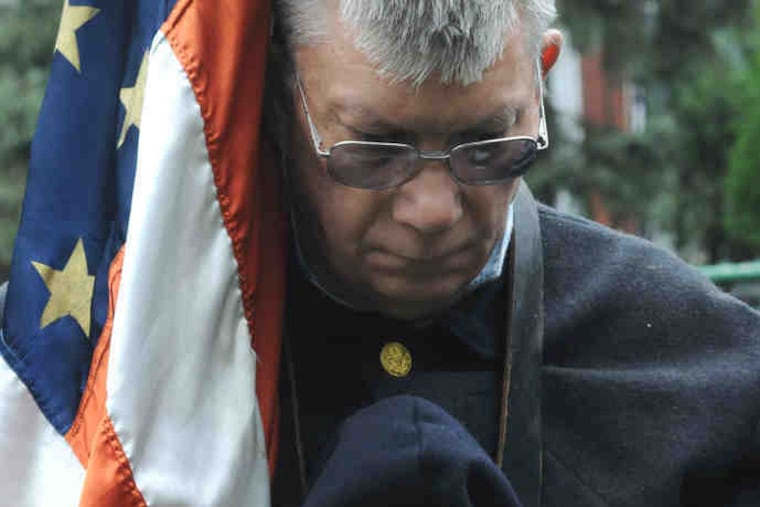
Saturday afternoon, a proper memorial to Leisenring was unveiled at the entrance to historic Palmer Cemetery in Fishtown, just across from American Legion Elm Tree Post 88.
Musket rifles were fired, flowers were laid, and Leisenring's story - what's known of it - was told. The memorial was funded by the General Meade Society of Philadelphia, led by Andy Waskie of Temple University, and the Patriotic Order Sons of America.
"He was buried a couple of blocks away, then moved to a mass grave in Delaware County," said Daniel Dailey, 36, whose shipbuilding family dates to 1795 in Fishtown and who has relatives buried in Palmer Cemetery. "That being said, he's from the neighborhood."
A marker is also planned for Fernwood Cemetery, at the site of the mass grave where Leisenring's remains were taken.
Palmer itself - bordered by Memphis, Palmer, Montgomery, and Belgrave Streets - is the only cemetery left in Fishtown, out of a dozen, and a burial ground for soldiers from every U.S. war, including John Hewson, who fought in the Revolutionary War. He died Oct. 11, 1821, at age 77. His marble grave marker has a crack in it from neighborhood kids trying to pick it up, Dailey said.
Established in 1765, Palmer is a neighborhood cemetery - nondenominational and where burial is still free of charge to people who lived in Fishtown at the time of their death. Dailey said it is the only such cemetery in Philadelphia and possibly beyond. The Penn Treaty Special Services District, funded by SugarHouse Casino, has pledged $50,000 to help fix up the cemetery.
"There are anywhere from 40 [thousand] to 60,000 people buried here," Dailey said as he walked through the cemetery, pointing out graves of veterans of the Spanish American, Civil, Korean, and Vietnam Wars and World Wars I and II. "There's no fee. You pay the gravedigger to open and close."
A few years ago, he said, they went looking to see if there was any space for new burials. "There's no more space for full bodies," he said. "We probed with a metal spike. If it hits something, it's 'Sorry, we can't do that.' "
If your family is already buried in the cemetery, you can be buried on the same plot, Dailey said. But most new burials are cremations.
As for Leisenring, after being stabbed in the side and back in Baltimore, he was taken to Pennsylvania Hospital, where he died April 22, 1861. He was buried April 24, 1861, in what was the Union Wesleyan and Harmony Burial Ground at Columbia and Thompson Streets, now Hetzell's Playground. In 1922, the bodies from Union were all removed to Fernwood.
Hans Mueller of the German Society of Pennsylvania called Leisenring an "unsung hero" of the Civil War. "Did he come by himself or come with his family? Was he influenced by the unsuccessful 1848 revolution in Germany? We're proud a young man of German origin was one of the first volunteers and made the ultimate sacrifice when his new country needed him."