Judith Bernstein Baker keeping up the fight for immigrant rights
When Judith Bernstein Baker was a child in New York City in the 1950s, she often visited her mother, a Polish-born seamstress, at work in the garment center.
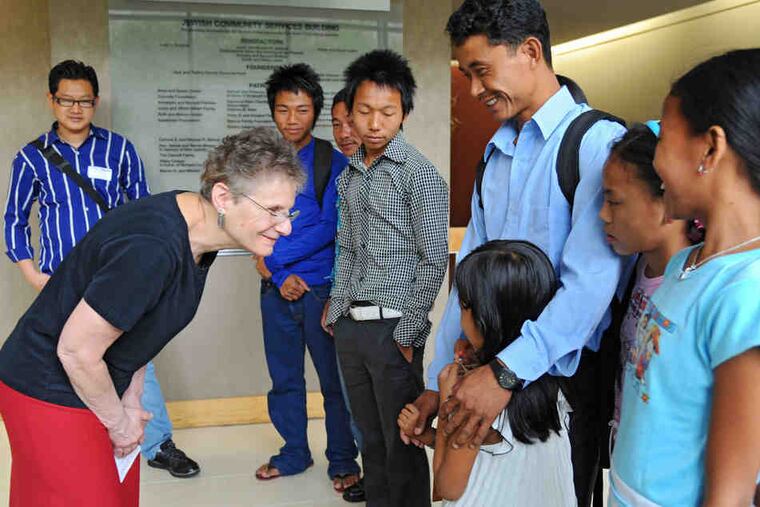
When Judith Bernstein Baker was a child in New York City in the 1950s, she often visited her mother, a Polish-born seamstress, at work in the garment center.
At first, the women who labored beside Rae Bernstein were just like her, Yiddish-speaking European Jews.
Then came waves of Puerto Rican seamstresses, followed by other Latinos, followed by Asians.
"Her shop was like a little United Nations. Every few years, there was a different new immigrant group," said Baker, who quickly absorbed an enduring truth about America's newcomers. "Where do people work when they don't know the language? They work with their hands."
Baker, now 65, grew up to be a lawyer, and for more than a decade has worked as hard with her head and her heart on behalf of immigrants as her mother did at her sewing machine.
As director of HIAS and Council Migration Service, which grew from the 130-year-old Hebrew Immigrant Aid Society, Baker heads a program that provides free and nominal-cost legal services for indigent immigrants.
A legendary spark plug among immigration groups in the Philadelphia region, she will be the guest of honor Thursday at "Celebrating the Courage of Immigrants," a HIAS fund-raiser at the National Museum of American Jewish History on Independence Mall.
"She is everywhere, doing everything, all the time," said Rabbi Linda Holtzman of Mishkan Shalom synagogue, where Baker is a congregant. "I have been pretty active on immigration issues and I don't think I've been to an event where Judi didn't appear" - either at the lectern or behind the scenes.
On a yearly budget of about $1.2 million raised from grants and donations, Baker's team of five HIAS lawyers has helped thousands of immigrants with a variety of issues, including refugees and asylees who have fled ethnic, religious, or other forms of persecution. The group has developed initiatives to help Haitians in America obtain temporary protective status following the 2010 earthquake, and has sought special visas for victims of domestic abuse and other violent crimes.
A decade ago, HIAS's clients were mostly Jewish refugees from Russia. Today, they hail from 60 countries, as far-flung as Iraq, Eritrea, and Bhutan.
"You learn about people's customs. You learn about people's bravery. . . . You realize how lucky you are," said Baker, describing what motivates her on days that often begin around 4:30 a.m.
A 1967 graduate of the State University of New York at Binghamton, Baker got a master's degree in social work from the University of Pennsylvania, worked as a tenant-union liaison for Community Legal Services of Philadelphia, and was almost 40, with a husband and two young children, when she graduated from Temple Law School in 1986.
From 1990 to 1997 she directed Penn Law School's program on public service, then joined HIAS.
"Judi is a powerhouse . . . driven by her passion for social justice," said Regan Cooper, former director of the Pennsylvania Immigration and Citizenship Coalition, an immigrant advocacy group. "A lot of it has to do with the Jewish teaching of Tikkun Olam. We have this commandment. We are all responsible to repair the world."
Jen Rock, 27, a leader in an interfaith immigrant-rights coalition called the New Sanctuary Movement of Philadelphia, marvels at Baker's "sustained commitment over so many years."
At a recent New Sanctuary event, advocates and immigrants shared stories. Baker spoke about her mother's arrival at Ellis Island in the 1920s, and how she was almost immediately deported because of an eye infection. The Hebrew Immigrant Aid Society arranged for a doctor whose treatment managed to save her.
"Judi, this little white lady, told this amazing story to this group of Latinos about her experience . . . and how she carries that with her," said Rock. "It was a really captivating moment, where suddenly the line between advocate and client was very thin."
Helen Gym of the advocacy group Asian Americans United recalled jogging down Market Street one day and running into Baker, who had just come from a train at 30th Street Station.
"She pulls me aside and we stop and talk. She gives me a whole run down" on state politics and the impact on immigration, said Gym. "It ended up being like a 20-minute stop. I am dripping with sweat. She is just exhorting action."
Sarah Paoletti, director of Penn's Transnational Legal Clinic, which represents indigent immigrants, said Baker has enormous heart.
"You are going to lose a lot of fights in the immigration world" because "the options for relief are relatively narrow," said Paoletti. At the same time, the work takes a huge personal toll because of the high stakes when an immigrant faces deportation.
While the younger leaders of the pro-immigrant movement draw inspiration from her, Baker said that she, in fact, is uplifted by them.
"This is a very hard time now. A time of harshness and of political reaction and turning the clock back," she said. "It is encouraging to see young people who want to go forward."