PHA opens new public housing in Mill Creek
City Councilwoman Jannie L. Blackwell stood at the foot of Markoe Street in the Mill Creek neighborhood, taking in the sight: 23 new two- and three-story brick rowhouses.
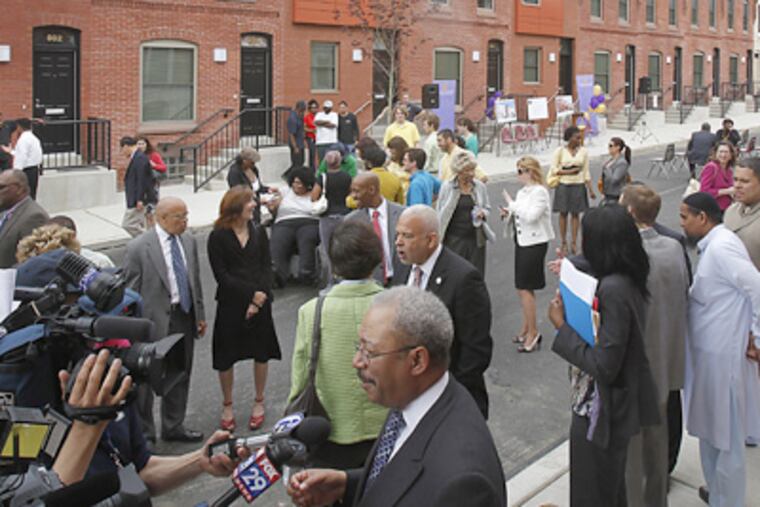
City Councilwoman Jannie L. Blackwell stood at the foot of Markoe Street in the Mill Creek neighborhood, taking in the sight: 23 new two- and three-story brick rowhouses.
Even for her, it was almost too much to believe.
"We've gone from hell to heaven," Blackwell said Wednesday before a Philadelphia Housing Authority ribbon-cutting for new homes in West Philadelphia.
Hell is all too fresh a memory for Blackwell and neighbors.
On Lex Street, four blocks to the east, six men and one woman were gunned down in a crack house on Dec. 28, 2000, the worst mass murder in the city's modern history.
In the decade that followed, PHA led a massive $200 million overhaul of the neighborhood. Michael Kelly, PHA's new interim leader, said the renovation of the 800 block of Markoe Street was "the final connecting piece" of the effort.
Two years after the Lex Street murders, PHA tore down three high-rise apartment buildings that were part of the behemoth Mill Creek public housing project.
In their place, the agency built the Lucien E. Blackwell Homes - named after Councilwoman Blackwell's late husband - a mix of 700 rowhouse rental units and affordable single-family homes for sale.
The project in the 800 block of Markoe Street added 17 renovated and six new rental homes. The cost: $7.1 million - about $309,000 a home - with most of the money coming from a federal stimulus grant.
Two of the properties are handicap-accessible and have elevators, as well as common living and cooking areas. All of the properties were designed by a local firm, Jibe Design, as "green homes," maximizing natural light and built to the highest energy standards.
As part of the overall redevelopment, PHA had said it would team with the School District of Philadelphia to build a community center, charter school, and dormitory.
That plan, however, is now on the back burner, Kelly said, as PHA revisits all of its capital plans.
The housing authority is under new control after the U.S. Department of Housing and Urban Development (HUD) pressured its five-member board to resign last March. HUD named its chief operating officer, Estelle Richman, to replace the board as its sole commissioner.
The action followed the firing in September of PHA Executive Director Carl R. Greene. The board discovered that PHA had secretly settled three sexual-harassment complaints against Greene for a total of $648,000.
Projects such as Mill Creek were the hallmark of Greene, who won national acclaim for his large-scale redevelopments.
A decade ago, Mill Creek, which stretches from Lancaster to Haverford Avenues between 44th and 52d Streets, was suffering from the corrosive effect of crime, drugs, and blight. Those problems persist, but Cynthia Walden, 65, a block captain and Mill Creek resident for 46 years, considers the neighborhood today "quieter, nicer, better."
Sherry Van Dyke, 31, is a newcomer to Mill Creek. Just last week, PHA gave her the keys to one of the new homes on Markoe Street.
She said she now could move out of her mother's home in Northeast Philadelphia.
"I've been excited all week," said Van Dyke, who has a 12-year-old daughter.
Her friend Tiffany Coleman, 29, who lives on the other side of Lancaster Avenue in the Mantua section, had to persuade Van Dyke to move to the area, given its notoriety.
Coleman told her, "It's gotten a whole lot better. It's exciting to see how the area really, really has changed."