'Arangetrams' unite Indian American families with dance
In one 30-minute dance, during which even the cock of an eyebrow is choreographed, Shruti Iyer pleaded with an ancient god.
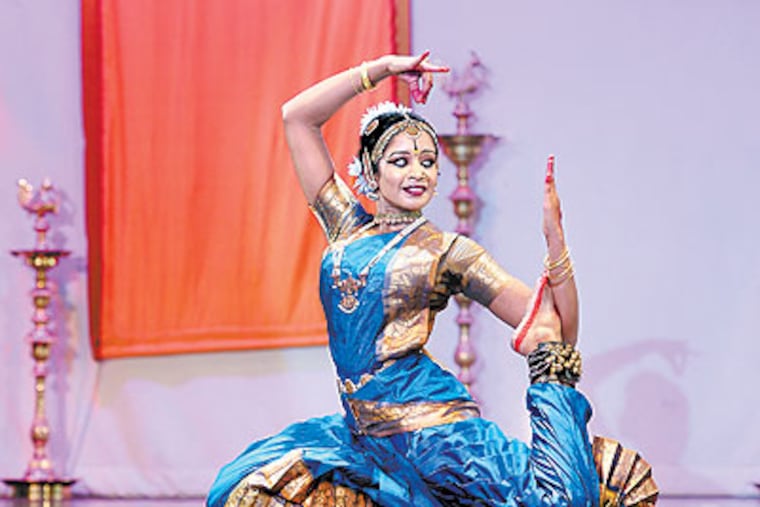
In one 30-minute dance, during which even the cock of an eyebrow is choreographed, Shruti Iyer pleaded with an ancient god.
The 17-year-old West Chester East High School graduate moved about on stage to music made by musicians from India.
"She is entering into a beautiful temple and saying, 'Show me who you are. I've come all this way to see you,' " explained Iyer's dance teacher, Viji Rao.
The number was the centerpiece of Iyer's two-hour solo debut as an Indian classical dancer. The event, called an arangetram, is the culmination of years of study and a family gathering of such importance that hundreds often attend, including relatives from overseas.
Her performance drew on a dance vocabulary of 108 postures, eight eye movements, 10 head movements, four neck movements, seven eyebrow movements, and more than 300 hand gestures.
The dancing and preparation have become a way for parents and teachers to pass down culture and tradition, particularly in families that have left India, said Susan L. Schwartz, a religion professor at Muhlenberg College in Allentown and author of Rasa: Performing the Divine in India.
Students learn not only a dance whose roots go back to 500 B.C. but also about the stories told in the choreography and the Hindu deities associated with them.
"It brings me back to my religion and history and things I probably wouldn't have learned," said Iyer, of Exton. She made her debut before an audience of 250 this month at Great Valley High School in East Whiteland Township.
Arangetrams are being held in increasing numbers as the Indian population in the nation grows, Schwartz said. From 2000 to 2010, the increase was 70 percent, to more than 2.8 million, according to the census.
The number of Indian dance teachers, dance schools, and college dance teams is also increasing. Iyer will continue dancing at the University of Pittsburgh in the fall.
Iyer has studied a classical dance called the bharatanatyam for 12 years. The dance was originally done in ancient times by women who danced for deities in temples. When India gained its independence in 1947, cultural-arts proponents began efforts to preserve the tradition, and the dance became a form of artistic training, mostly for girls, although some boys learn as well.
"I saw the older girls doing it, and it made me want to do it," said Mona Ghose, 22, of Audubon, Montgomery County, who danced her arangetram in 2007 before an audience of 350 at Plymouth Whitemarsh High School.
The bharatanatyam is a technical tour de force.
"It's a lot for a dancer to remember," said Misti Chakrabarti, 20, creative director of Penn Thillana, the Indian classical dance team at the University of Pennsylvania. "Facial expressions are integral. Eye movements, lips, eyebrows - every detail" matters.
Students attend weekly lessons for an average of six to eight years, but the classes increase as the arangetram nears.
Iyer's training, an outgrowth of her mother's passion for the dance, began when she was 5. Since then, her family's Sundays have been about little more than music and dance lessons.
Iyer's mother, Indira, never had the opportunity to take lessons. "You want to give your children something you didn't have," she said.
Indira Iyer and her husband, Sridhar, prepared for the arangetram for six months, with lots of help from family and friends. They rented the auditorium and purchased special costumes and invitations custom made in India. They hired a dinner caterer and teamed up with other families across the country to share in the cost of transporting three musicians and one singer from India, who will provide music this summer for other arangetrams in the United States.
Shruti Iyer's grandparents also traveled from India to attend.
The Iyers declined to say how much they had paid, but arangetrams cost an average of $8,000 to $12,000, Rao said.
On the day of the performance, the high school lobby was decorated with pictures of Iyer, statues of Indian gods, and rose petals on the floor sprinkled in the shape of a sacred Sanskrit symbol.
Shruti Iyer danced in four iridescent silk outfits, wearing traditional jewelry, makeup, and henna tattoos. Rao, her teacher, sat cross-legged with the musicians on the stage, beating out rhythms with cymbals while intensely watching Iyer.
The dance that is her mother's passion was no longer only that, Iyer said: "It's become something I do for myself."
To watch a video of the "arangetram," go to www.philly.com/arangetramEndText