At SlutWalk, clothes make the woman - and a point
Kate Rush-Cook donned a black cocktail dress. Mary Reilly wore a black skirt but was nearly topless, only a few tiny pieces of tape covering her breasts. Jess Kalup, in a tank top and jeans shorts, looked like she was headed for a summer picnic.
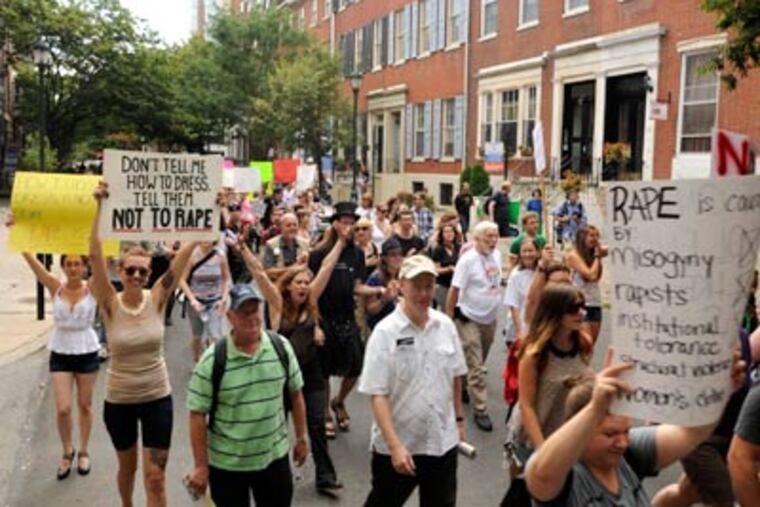
Kate Rush-Cook donned a black cocktail dress. Mary Reilly wore a black skirt but was nearly topless, only a few tiny pieces of tape covering her breasts. Jess Kalup, in a tank top and jeans shorts, looked like she was headed for a summer picnic.
Their clothing had nothing in common Saturday, but a shared experience and message brought them together for Philadelphia's first SlutWalk.
All three women had survived rape. On Saturday, they marched with hundreds of others to protest a culture that they say blames women - and not their attackers - for sexual assault.
SlutWalks began after a Toronto police officer told law students gathered for a safety talk that if they wanted to prevent rape they should not dress "like a slut."
The officer has since apologized, but a group of Toronto women organized the first SlutWalk in April - dressing in sexy outfits, or turtlenecks, or whatever they wanted - to make the point that women do not invite rape. Men (and a few women) commit it.
Since then, SlutWalk has become a global phenomenon. It has both galvanized and divided feminists, some of whom oppose getting attention by dressing as sex objects. The walks also have created a street theater that has promoted conversation about the roots of sexual assault.
Hannah Altman, who lives in West Philadelphia but attends Cornell College in Iowa, was the lead organizer of the event here.
Philadelphia's SlutWalk began at 11th and Pine Streets about 11 a.m. and wound its way through Center City to City Hall. Many participating in the protest were victims.
"I felt his hand before I saw it," Rush-Cook began as she told the crowd on Dilworth Plaza the story of her 1993 assault in York, Pa.
A stranger kidnapped and raped her but was acquitted, only to be convicted in another sexual assault in 2004 and sentenced to 20 to 40 years in prison.
For her first day in court, Rush-Cook dressed as though she were going to the office - a checked skirt, manicured nails - only to have the district attorney tell her she should dress in a more "victim-like" way. She spent the rest of the trial wearing turtlenecks and long sleeves and answering questions about what kind of underwear she was wearing the night of the attack.
She believes her attacker was acquitted, in part, because someone from the defense team overheard her and her mother joking about how she had to "dress like a librarian" during the trial.
"This is the only crime for which the victim feels they have to prove they are innocent," Rush-Cook said.
Kalup was attacked by a friend after she had too much to drink and passed out. She was stunned when people blamed her because they knew she'd had multiple partners.
Reilly, of Haddon Heights, said she was assaulted twice.
Few people had believed her the first time.
When it happened a second time, she ended up in a mental hospital, where she got therapy and started speaking out.
"I've been sexually assaulted and blamed for it," the 20-year-old Rutgers University psychology major said.
In both attacks, Reilly said, she was wearing a T-shirt and jeans. During Saturday's SlutWalk, she drew attention to that by wearing almost nothing up top and carrying a sign that read, "I wasn't dressed like this when I was raped."
Dave Ferrier of West Chester also latched onto the raunchy, dramatic theme. He wore a Superman outfit, with cape and microscopic bikini but no tights or shirt. He draped chains across his chest that held a bright green, plastic spike. The spike, he said, was kryptonite, symbolizing the problem of blaming women for assault.
"If we could take off the kryptonite, we could take off the chains," said Ferrier, who said he participated because he was shocked at how many female friends had experienced sexual assault.
Kiska and Jon Greenberg, daughter and father from Mays Landing, came to SlutWalk together.
He heard about it on the radio.
"I just got really excited about it," Kiska Greenberg, who is studying music at Hood College, said.
A friend had forced himself on her when she was in high school and for a long time she blamed herself.
Years later, a girlfriend helped her understand she was a victim.
At the SlutWalk, Kiska Greenberg carried a sign that read, "It's not my fault." She added: "I feel like rape is so accepted in our culture. This sign isn't for me. This sign is for everyone."
Her father had not heard her story before Saturday. "It's devastating," Jon Greenberg said.
Julie, who did not want to give her last name, traveled from New York to Philadelphia for the protest after she read a story about a judge who dismissed a rape claim because the victim was wearing jeans.
The judge reasoned an attacker would not be able to take off a woman's tight jeans without her help.
A man she had considered a friend in college attacked her after she passed out from drinking.
"I was wearing jeans the night I was raped, and I had to be here for myself, for the 19-year-old me," said Julie, now 41.