Latvian church mixes old and near Philadelphia
Before church, the congregation chatters in Latvian. Sveiks, a word for hello, echoes around the entry room, decorated with Latvian vases, paintings, and candles.
Before church, the congregation chatters in Latvian.
Sveiks, a word for hello, echoes around the entry room, decorated with Latvian vases, paintings, and candles.
At the Latvian Evangelical Lutheran Church of St. John in Newtown Square, about 20 members head into the hexagonal sanctuary with seven rows of pews on either side.
Sunlight pours in from the small stained-glass windows - two on each side of one long pane that extends to the ceiling. The colorful panes on the right side represent the Old Testament, and on the left, the New.
A maroon-and-white Latvian flag sits on the right side of the altar, an American flag on the left.
Old and new. Past and present.
The oldest Latvian Lutheran church in the United States - celebrating 118 years - still conducts its Sunday service in Latvian, the native language of the first immigrant members from the Baltic state. Like many churches, St. John's must grapple with low attendance and an aging membership, but the connection of Latvian roots and Lutheran religion keeps the congregation strong.
"Even if I know how to speak English, I still enjoy it more if it's in Latvian," said Ilga Veisbergs, a member for 60 years who lives 30 minutes from the church. "I could go in my neighborhood to English church, but somehow it doesn't get to your heart as close as when you hear it in Latvian."
Most of the 166 members are middle-aged or older. Ninety percent can speak Latvian, said member Silvija Mezgailis. She heads the Latvian Saturday school during the academic school year. Held in the parsonage next door, the school teaches 20 youths about culture, language, history, and geography.
Some congregation members drive for up to an hour to attend the church in Delaware County. Veisbergs, 83, came on Sunday with her daughter Linda Palmisano to the English service, held every two months.
Palmisano doesn't speak Latvian, so the English service allows the two to worship in a language both understand. About 30 people attend the Latvian service, 70 on special Sunday events, and 100 during Christmas and Easter holidays.
Founded in 1893, St. John's added English services in 1930. Worship at that time was held in a rowhouse on 47th Street in West Philadelphia, but a steady stream of post-World War II immigrants caused the membership to swell to nearly 800. In 1967, members moved to a larger church down the street, at 47th and Cedar.
"In the beginning, when immigrants came here, it was unbelievably important - a source of information," said Mezgailis, 55. "There's a spiritual piece, but also, where are there jobs, apartments, who's doing what. It was the hub of information where people met."
As U.S.-born children grew up, married non-Latvians, and moved to other cities, the church saw a decrease in attendance. No longer was the church a core in a neighborhood of Latvians. Latvian people lived all over Philadelphia and the suburbs. According to the latest census estimates, 2,500 Latvians live in the five-county area.
Now, members gather to see friends, go to monthly Bible study, and brush up on the language at a piece of Latvia in the United States.
"It's your chance to get together and speak Latvian. How many chances do you have to do that?" Mezgailis said. "Even though we're scattered physically, when people come together, there's a strong sense of community, a feeling of being tight."
The congregation moved to a small building on five acres in Newtown Square in 1992 and built a sanctuary in 2000. Today, the church still has a piece of art from the old rowhouse - a T-shape painting of Jesus created by Latvian artist Augustus Annus, said Mezgailis.
St. John's is one of 59 congregations of the Latvian Evangelical Lutheran Church in America, with churches in the United States, Canada, and South America. Membership has decreased since its peak of 17,000 in 1996 to 10,950 in 2007, according to the Association of Religion Data Archives.
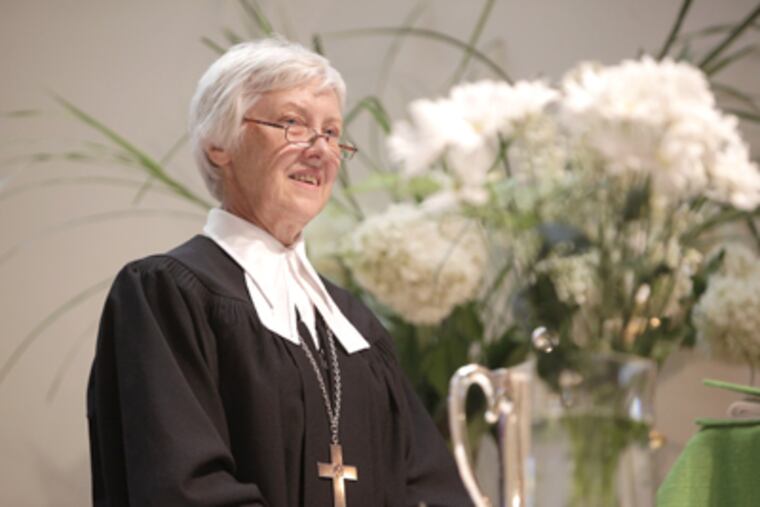
Pastor Ieva Dzelzgalvis isn't concerned about the church's funding or future. She said the church has a balanced budget, and attendance has been stable during her five years at St. John's.
"I don't worry at all. We do what we know how to do to the best of our abilities and we trust the Lord," said Dzelzgalvis, 66. "It's still alive, and people are still interested in Latvian things. That says a lot."
On Sunday, the Lagzdins sisters, Kristina, 26, and Erika, 23, were the only ones under 40 attending church. They sometimes join their father, who is a member. Kristina Lagzdins said she doesn't mind seeing her father's friends, to catch up and practice the language. But she noted the disconnect with religion and young people.
"My generation's not into church," she said. "We see each other at other Latvian events and parties."
At the English service Sunday, the organ nearly drowned out the faint voices singing the English hymns.
After church, there's brunch in the adjoining room - ham and cream cheese on bagels. Not exactly the typical sauerkraut-and-sausage Latvian cuisine, Mezgailis joked. A circle of 10 members clasped hands and said a blessing in Latvian.
"Good appetite to everybody," translated Dzelzgalvis.
Holding a bouquet of flowers as a present, Ruta Ore led the group in the Latvian version of "The Birthday Song" to celebrate Inta Vilks' birthday.
Everyone chimed in, singing louder than in church, their voices booming, smiles on their faces.
"Latvians are a singing nation," said Austra Mezaraups, 82, who got married in the church in 1951.
Veisbergs added, "We sing and sing wherever we go. We love to sing."
The small group stayed about an hour. They ate, laughed, and, most important, spoke Latvian.