Chadds Ford's Sanderson Museum strikes a community chord
Gene Pisasale can't stop talking about history. His current interest is helping to draw attention to a quirky collection of Americana packed into the rooms of a small museum in Chadds Ford.
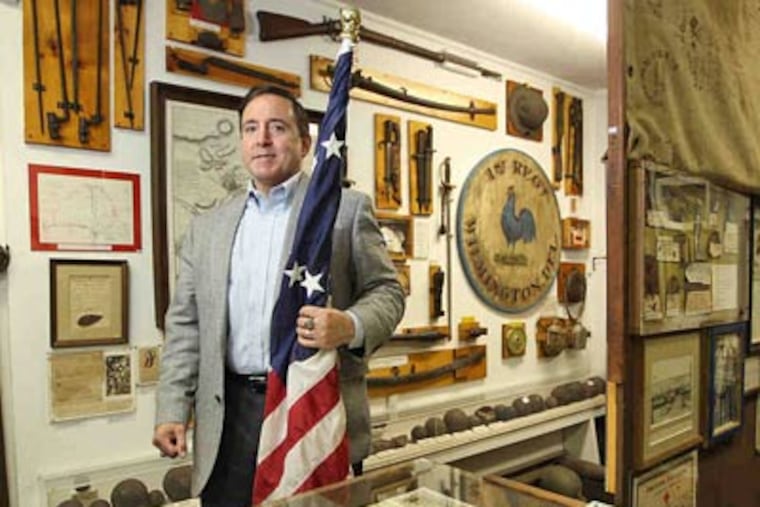
Gene Pisasale can't stop talking about history.
His current interest is helping to draw attention to a quirky collection of Americana packed into the rooms of a small museum in Chadds Ford.
"We want to preserve the history all around here, including our museum," Pisasale said. "A lot of larger museums don't have these little gems that are part of our history."
Pisasale has something to say about dozens of items at the Christian C. Sanderson Museum - a barbershop sign citing the nearby Brandywine Battlefield, a book owned by Benjamin Franklin, and a 1937 map by Andrew Wyeth noting historic sites in the area.
He launched into a near-lecture explanation of an N.C. Wyeth painting of Confederate troops marching through a Virginia town.
"It's my favorite painting in the museum," he said. "You can see one or more of the troops looking at the viewer . . . and thinking, 'You really don't know the horrors of war.' "
He also pointed to a portrait of Sanderson, a lanky schoolteacher who obsessively collected pieces of American history, ranging from a lock of George Washington's hair to a letter from the soldier who lowered the Union flag at Fort Sumter. His artifacts - unexploded Civil War munitions, cards signed by the likes of Orville Wright - are arranged tightly into every nook and cranny of the museum, a two-story frame house where Sanderson spent his latter years.
"He loved to talk about Chester County," Pisasale said. "He loved to talk about the Battle of the Brandywine, the history of America. Anything that engaged him, he tried to engage the viewer."
History buffs credit Sanderson with being a major force behind the state's recognition of the Brandywine Battlefield as a historic site.
Pisasale said he felt close to Sanderson. Formerly employed in the oil industry, then as a financial professional, he is retired and spends his days lecturing local groups about the region's past and writing mysteries involving Pennsylvania history. He has also donated proceeds from book sales to help fund the Brandywine Battlefield visitors center - now staffed by volunteers because the state cut its paid staff. To generate publicity for the Sanderson museum, he has recently been writing articles about items in the collection.
"I just love history from way back," Pisasale said. "It's one of my favorite things."
Pisasale is only one history fanatic caught up in Sanderson's legacy. The educator's lifelong mission has proved an attractor of like minds, and the little museum, just off Route 100 at 1755 Creek Rd., continues to draw supporters.
"I came, and I was just enthralled with everything that's here. I saw a little bit of myself in Chris," said Susan Minarchi, who, seven years after her first visit, is president of the museum's board.
Sanderson's collection draws roughly 1,000 visitors a year and is supported through volunteers and donations.
Devotees of the past are the reason such museums are a common sight throughout Pennsylvania, said Rusty Baker, executive director of the Pennsylvania Federation of Museums and Historical Organizations.
"You have more history, more stuff, more hoarders who collect things," he said. "I think in Pennsylvania's case, there is sort of a longing to identify with communities as they change. . . . You can talk about tourism, education, and economic impact, but it really boils down to human inspiration and objects and interacting with the past."
These days, the history obsession once embodied by Sanderson has become almost mainstream. Pisasale, Minarchi, and other locals are also members of the Chadds Ford Historical Society, and they guard the area's legacy.
"There's a spirit of the thrill of history here in Chadds Ford," said Ginger Tucker, the society's executive director. "There are many old Revolutionary War houses, and people nurture and repair them, and flush money down the drain to keep them close to the way they were two centuries ago."
That communal respect for Pennsylvania history would have pleased Sanderson.
"I think every lecture he made, before a service club or school group or whatever, he was trying to push the historic aspects of the Chadds Ford area," said Tommy Thompson, Sanderson's friend who worked to open the museum in 1967 after Sanderson's death the previous year. "I feel he accomplished his objective."