Paintbrush poised to light up Broad Street
The man who brought Philadelphia the Clothespin sculpture in 1976 sat in the shade of the Convention Center Saturday as his latest work, a 12,000-pound uplifted paintbrush, came together across Broad Street.
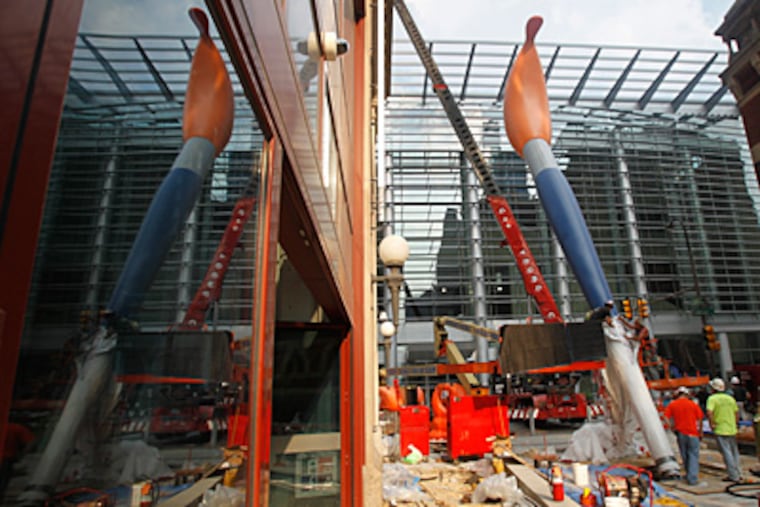
The man who brought Philadelphia the Clothespin sculpture in 1976 sat in the shade of the Convention Center Saturday as his latest work, a 12,000-pound uplifted paintbrush, came together across Broad Street.
Now 82, Claes Oldenburg watched as two men in cherry pickers delicately maneuvered the orange bristled end of the brush, which was suspended from a crane, onto its angled handle.
No one had been able to try this in the shop in California where Paint Torch was made, and Oldenburg knew it would be "very, very tricky." Still, he seemed to mean it when he said, "I'm not nervous. I trust them."
Once it was almost in place, Oldenburg seemed as entranced as the rest of the small crowd that had gathered on the sidewalk. He liked how the 51-foot-tall brush with its 60-degree angle played with the vanishing point along the not-quite-finished Lenfest Plaza and the rest of Cherry Street. He liked that it looked as if someone had jabbed the brush into the pavers on the ground.
"It's very active even though it's standing still," he said. "It's suggesting movement, which is good. That's what I like."
He still had a big decision to make. "I'm trying to decide which way the 6-foot-tall glob should face," he said. The "glob" is a dollop of paint into which the unseen artist has dipped the brush.
It was all a little bittersweet for Oldenburg, whose wife, Coosje Van Bruggen, made her first trip to Philadelphia for the Clothespin installation. Oldenburg took her to see the Pennsylvania Academy of the Fine Arts, which commissioned Paint Torch for the new Lenfest Plaza between its buildings. Van Bruggen died of cancer in 2009. Torch was Oldenburg's first work without her.
"I definitely feel her absence and try to remember what she would think or say about what's going on," he said.
The job made George Young, a big man in a bright orange vest whose job was to make the installation go smoothly, think of his father.
It was Young's job to lift the sculpture from two flatbed trucks, bring all the pieces together, and hold them there with a rod under 35,000 pounds of pressure. Young is president of George Young Co., which is named after his great-great-uncle, who won the company in a poker game from his brother in 1870. The modern George Young's father, who died in 1998 at 82, installed Oldenburg's Clothespin.
Saturday's 14-hour job was a delicate operation. Paint Torch was swaddled in white plastic. "This is made of painted resin. You have to treat it as if it's a piece of porcelain," Young said. "We can't nick it. We can't scratch it."
Paint Torch is the focal point of the $7.5 million Lenfest Plaza project tying together the academy's Frank Furness-designed museum on the south side of Cherry and the Hamilton Building, with its galleries and more studios, to the north. Set to open officially Oct. 1, it also is meant to serve as a gateway from the expanded Convention Center to the museums on the Parkway.
A section of Cherry is now closed to traffic. It has inviting curved benches topped with sustainably harvested black locust that designer David Rubin, a partner at Olin, said "receive the tush really beautifully." Ultimately, there will be a restaurant in the Hamilton Building with outdoor seating.
H.F. "Gerry" and Marguerite Lenfest gave $2 million for the project. The city gave $1.5 million. The rest is from private donations that the academy wouldn't detail. A spokeswoman wouldn't say how much it had spent on Paint Torch.
Paint Torch is made primarily of reinforced plastic. It has no base, but is anchored by three-foot-long bolts sunk in concrete. The nuts on top are torqued to 800 pounds of pressure, Young said.
The tip of the paintbrush and the glob will be lit from within by synchronized LED lights. "The idea is to have it feel like it's breathing," said Jen Lewin, a Boulder, Colo., artist, who designed the inner lighting.
Artistically, Paint Torch alludes to the creative work at the academy as well as to Philadelphia's role in spreading the light of freedom.
"I really think it will resonate with the entire city," said Bob Cozzolino, senior curator and curator of modern arts for PAFA.
Oldenburg said the glob, which is supposed to look like paint that had just been squeezed from a tube, had gone through many iterations. "It's not easy to make a glob," he said, his eyes twinkling.
Asked whether paint would really look like that after bristles brushed against it, he said, "Well, this is art."
His big decision was whether the curving tip of the glob should curl toward the dark blue brush handle or away from it.
As the evening light cooled the plaza, six of Young's workers lifted the glob and turned it 180 degrees to show Oldenburg one view, then another.
Oldenburg thought the glob looked "aggressive" when the curve aimed toward the brush. He chose the opposite, more welcoming curve. "This," he said, "invites people in because it leans back."