Glouco's departing agriculture agent reflects on the changes in farming
When Jerry Frecon became the agricultural agent for Gloucester County 30 years ago, he took a distinctive pleasure in riding the back roads of Deptford.
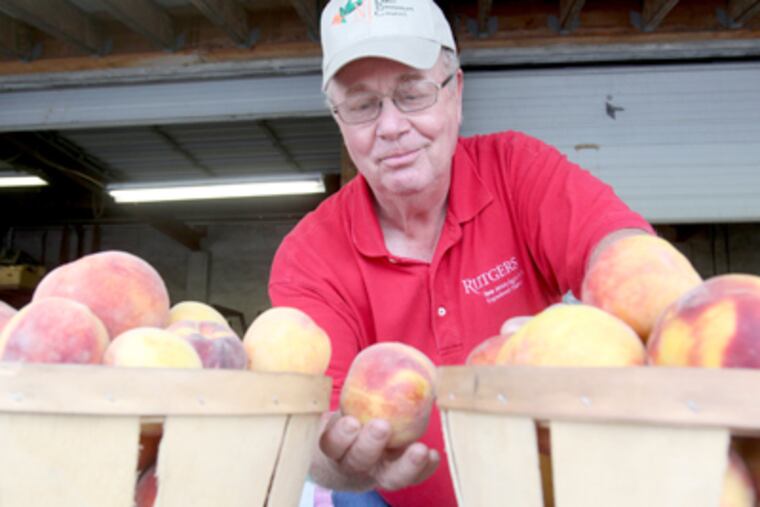
When Jerry Frecon became the agricultural agent for Gloucester County 30 years ago, he took a distinctive pleasure in riding the back roads of Deptford.
"Summer nights, you couldn't miss the smell - pig farms, with the pigs who fed on waste and garbage," said Frecon with a laugh, his New Jersey Peach Promotion Council cap a bit askew.
There are no pig farms in Deptford now, just big-box stores, said Frecon, who is spending his last year as Gloucester County's ag agent - the go-to guy for farmers and nursery owners with complaints, problems, and ideas.
Frecon, 66, has seen massive change in how farming is done in the county. When he arrived, there were about 75,000 acres of agricultural land. Now there are, at most, 50,000, he said.
Farms are smaller, too. Of the 790 that remain, 500 are smaller than 25 acres.
Before Route 55 and the huge residential developments there and on I-295, the county was a farming mecca, Frecon said.
Newfield was famous for gladiolas. In Franklinville and Elk Township, they grew asparagus - 15,000 acres' worth - most of it purchased by frozen-food manufacturers. The Campbell Soup Co. bought thousands of tons of tomatoes from local growers, and peach and apple orchards lined practically every rural road in the county.
Dairy cows grazed all over. And chicken farms seemed to be around every bend, but that industry moved almost entirely to the Delmarva Peninsula.
"Things have changed in many ways. But I really feel that, as more and more people move here, that agriculture is not forgotten," the Turnersville resident said. "Those who are dedicated to farming are finding new ways to survive."
John Hurff is one of those survivors - a fourth-generation grower of peaches, apples, tomatoes, peppers, and other vegetables in Monroeville, at William Schober Sons Inc. Frecon makes frequent trips to see his charges, and on a rainy afternoon last week, he stopped by to jaw with Hurff and take a ripe peach from one of his market baskets.
He uses the old-fashioned wooden bushel baskets, though he can no longer find them locally, said Hurff, who has them imported from Texas.
Twenty-five years ago, Frecon said, Schober - then owned by Hurff's grandfather - sold almost entirely to supermarkets, food processors, and wholesalers. The business changed as Campbell bought less and less, and California and foreign megafarmers cut their prices to get the supermarket business.
"They were forced to going retail," Frecon said. Farm stands, fairly rare in the 1980s, are ubiquitous now. Though Hurff still has a packinghouse, especially for his peaches and apples, he has expanded his market at the corner of Routes 553 and 604 several times in the last decade.
"My goal is to be 100 percent retail," said Hurff, who also sells his own peach salsa and barbecue sauce.
Like many in the county, Frecon said, Hurff also brings his wares to the growing number of farmers' markets. He does weekly turns at a half-dozen at the Shore, in Collingswood, and in Delaware County.
It is sad to see a farmer sell his land, Frecon said, but he knows farming is a tough job that many in the current generation do not want.
"We have a lot of gentleman farmers - people with other jobs who want an experience like this," Frecon said. Most are associated with the county's new wineries, he said.
But then there are guys like Evans Neale, who stopped by Hurff's farm stand for a chat.
Neale owned a 102-acre farm - mostly fruit trees, but also sweet corn, squash, tomatoes, and other small vegetables - just west of Rowan University in Harrison Township. He sold it in 2002 to Rowan, which uses it mostly as a green buffer area.
"I got to be 55 and was getting a bad back, and my children had decided to be in other businesses," Neale said.
The New Jersey Farmland Preservation Program will keep a lot of the county's remaining farm acreage agricultural in perpetuity, Frecon said. About 20,000 acres have been preserved so far - much of it, in recent years, for use as nurseries that also sell trees and greenhouse products.
In a sense, Frecon said, usage of the land has followed the local market.
"With places like Woolwich changing from fields to housing developments, people need trees and gardens for their properties," he said. "They don't need frozen asparagus."
Gloucester County continues to rank first in the state in many old-line agricultural items, including peaches, apples, and strawberries. But even those are grown and packaged in ways that have changed in Frecon's time.
At the Schober farm, he noted the difference between older and newer apple trees and pointed out a huge firewood area. The older trees were massive - 20 feet high or more, and fat. Though they produce a lot of apples, harvesting from them is labor-intensive. Pickers must go on ladders and root through branches to get the inner fruit.
"Plus, now these farmers depend on you-pick-'em customers, and you can't have customers up on ladders to get their apples, so you want smaller trees," he said. He said the firewood Hurff sells comes primarily from cutting down the old trees.
Frecon is proud that he grew up on a farm in Berks County, Pa., which his nephews still own and run. He did undergraduate and graduate work in agricultural science at Delaware Valley College and Rutgers University, then went to the Midwest for a time to work in industry.
When he was raising children, he wanted to come back to where he thought there were better schools, and the agricultural-agent job appeared. It has given him a varied life: He has taught at Rutgers, technically his employer, through its cooperative extension. He engages in research; he has developed several peach and plum varieties. And he enjoys his daily interactions with farmers and consumers.
"I just hope that the new people who come to live in Gloucester County understand what the farmer gives to them," he said.
"It's not just about food. It's preserving open space and wildlife, which in turn cuts down their taxes because that land requires few public services. It is about diversity, and now it is also about entertainment of a sort - hayrides and wine events and places to do a wedding - that you cannot do elsewhere.
"Some people come here and don't understand that a farmer wants a four-foot fence not because he doesn't like you, but because he needs to keep deer out," Frecon said. "It wasn't that way when I first came here."
And then he laughs.
"I wonder what those people would have thought about the pigs in Deptford."