Philly City Council unveils redistricting proposal
City Council leaders have unveiled a new set of boundaries for the 10 Council districts, proposing to abolish many of the irregularities in the current Council map, widely criticized over the last decade for its politically inspired contortions.
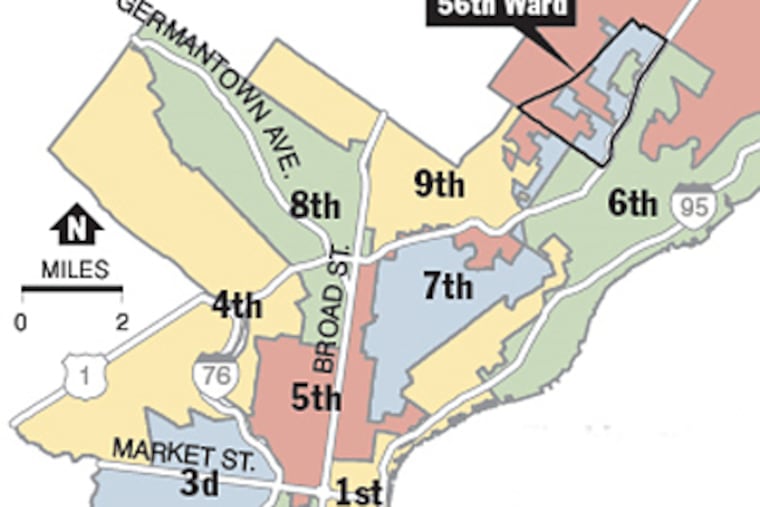
City Council leaders have unveiled a new set of boundaries for the 10 Council districts, proposing to abolish many of the irregularities in the current Council map, widely criticized over the last decade for its politically inspired contortions.
After two months of negotiations from which the public and reporters were excluded, a five-member committee organized by Council President Anna C. Verna introduced its redistricting proposal Thursday, and a rival plan with similar lines was offered by two other Council members, Frank DiCicco and James Kenney.
"At first glance . . . these look like a real improvement over the current districts," said Robert Cheetham, founder and president of Azavea, a Philadelphia-based software and consulting firm that put two of Philadelphia's districts on a list of the most gerrymandered in the country.
All 10 of the existing Council districts would shift somewhat under the proposed boundaries. Three face the most significant changes:
The Seventh District, now running nine miles from Kensington to Rhawnhurst and at several points less than a block wide, would stop in Oxford Circle, cutting its length roughly in half.
It would remain about 50 percent Hispanic, according to incumbent Maria Quiñones Sánchez, the first Hispanic elected to a district Council seat. "But it follows a much more natural trajectory of where the population is going," she said.
The Fifth District, represented by Darrell L. Clarke, would lose a tortured extension into the Lower Northeast, leaving him a more compact district running from Center City into North Philadelphia.
The 10th District, where incumbent Brian O'Neill is the sole Republican holding a district Council seat, would have to absorb more of the strongly Democratic 56th Ward. The leadership's plan has the 10th District taking about three-quarters of the ward, and the DiCicco-Kenney plan would put the entire ward into the district.
The Home Rule Charter requires Council members to draft new boundaries for districts every 10 years, within six months of getting new population figures from the census, or face suspension of their pay until the job is done. Council's deadline is this month.
Council scheduled a hearing on both redistricting proposals for Thursday. If it can agree on amendments and create a final version that day, the new map could win final Council approval Sept. 22 - just in time for Council members to receive their next scheduled paychecks.
November's general election will be based on the current Council map. The new boundaries won't take effect until the next Council elections in 2015 - though most incumbents can be expected to look after their future constituents as well as their current ones.
Each district is supposed to include roughly 10 percent of the city's population, about 152,600 people. The two pending proposals each vary by more than 13,000 people, about 9 percent, between the smallest and largest districts.
Councilwoman Marian B. Tasco, who introduced the leadership's bill, said the variations were a trade-off helping to keep some wards or communities intact.
At a hearing Tuesday night, lawyer and Republican ward leader Matt Wolfe warned Council to stay well under a 10 percent variance. He said recent case law could support a challenge to any variances that high.
The DiCicco-Kenney map was cosponsored by four other Council members, giving it two-thirds of the votes needed for passage.
DiCicco said he introduced the map because "as of late [Wednesday], there was no consensus on a map that had sufficient support."
"I offered a map I thought could kick-start, jump-start that process," he said. "Everybody can't get 100 percent of what they want. It would be nice and easy if we could carve the city out in 10 square blocks. It doesn't work that way because you literally cut through neighborhoods, people become disenfranchised."
He said that he had not seen the committee's effort, but that he didn't expect either map as introduced to be the final plan.
"There's going to be some tweaking," he said. "It is very tough, difficult, a very fluid process. . . . It might sound crazy, but I'm not entirely pleased with the map I introduced as it related to the First Councilmanic District."
Sánchez, whose district was at the heart of the redistricting negotiations, said she was pleased with the committee's map for making her district more compact.
"We couldn't make it any worse, so we decided to make it better," she said. "I think it recognizes communities of interest better."
Her present district captures the heart of Hispanic Philadelphia, but then snakes crazily up Castor Avenue into the Northeast. Latino interest groups said its composition diluted their voting bloc, and called for the new district to be 60 percent Hispanic.