Levees as savior and curse
Wilkes-Barre's flood-prevention project after Agnes seems to have diverted Lee's menace to neighboring towns.
WILKES-BARRE - It was a matter of simple math - an equation laid out more than three decades ago and an answer that brought palpable relief last week to thousands along the raging Susquehanna River.
For others, though, the sum equaled nothing less than utter devastation.
When the U.S. Army Corps of Engineers called in 1979 for raising levees in Wilkes-Barre by three to five feet after Tropical Storm Agnes, it cited the nearly $3 billion in damage that storm had caused to justify the expense. In essence, shoring up the flood-control system in the city of 42,000 in the heart of Pennsylvania coal country would cost less than would repairing houses and businesses after another catastrophic flood, engineers said.
But in a handful of smaller neighboring communities on the river's west bank - West Pittston, Plains, and low-lying Jenkins Township - the figures didn't add up.
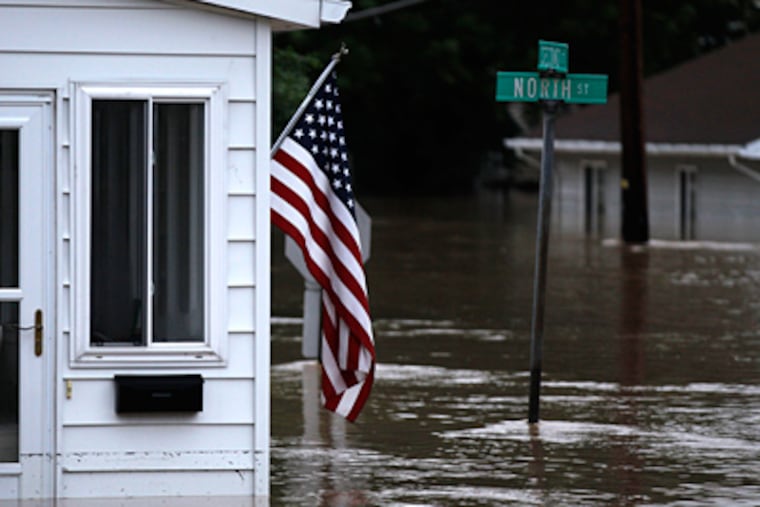
It was there Friday that agitated murky water crept to the rooftops, National Guardsmen launched rescue efforts from second-story windows, and the torrent rose much higher than anyone predicted as the remnants of another tropical storm - Lee - pummeled one of the most flood-prone regions in the United States.
Though it will take weeks to fully assess Lee's damage to the Wyoming Valley, these waterlogged, levee-less communities couldn't help but think the flood-control improvements that spared Wilkes-Barre from disaster may have caused their own.
"All that water not flowing into the city has to go somewhere," West Pittston resident Keith Englehardt said. "It came here."
As Saturday dawned, the Susquehanna's highest-ever recorded crest had receded to a manageable level. The towering aluminum Jesus that stands, arms wide open, atop the administration building at the city's King's College appeared less now as though he were seeking supplication from a higher power than he did a day before.
By afternoon, officials lifted evacuation orders for areas protected by levee walls and began a massive cleanup effort for a city that had escaped worst-case predictions.
The credit, Army Corps Col. Dave Anderson said, belonged to Wilkes-Barre's improved levee system - tested to its limits behind a 43-foot wall of water but now proved worthy of the challenge.
"It's doing exactly what it was designed to do - protecting lives and property," he said.
Locals have long known the quiet danger of the Susquehanna. They only half-joke when they describe the waterway as "a mile wide and a foot deep." And the storm that proved how deadly that combination could be was never far from the minds of residents dealing with Lee's aftermath last week.
In 1972, Agnes dumped more than a foot and a half of rain on Wilkes-Barre. The river rose to nearly 41 feet and spilled over 36-foot barriers. More than 70 people were killed, and damage estimates reached $2.8 billion.
"We will fix this, and it will never happen again," President Richard Nixon vowed, touring the devastation days after the storm. It would take more than three decades.
Despite the Army Corps' recommendation in 1979 to raise the levees and the efforts of a succession of congressmen - including aptly named U.S. Rep. Daniel Flood - funding for the project remained elusive.
"Every dollar we got came from earmarks over the years," Luzerne County Commissioner Keith Urban said. "It was never considered a priority in Washington."
Finally, in 1997 - a quarter-century after Agnes - work on the $175 million project began. Six years later, five sections of the levees through Wilkes-Barre had been heightened and 13 pumping stations refurbished to move water out of the valley and back into the river.
Next time, officials said in 2003, things would be different.
They were, West Pittston Mayor Tony Denisco said Friday - just not in the way residents of communities unprotected by levees expected.
With enhanced flood barriers now shielding Wilkes-Barre and much of the Wyoming Valley, the engorged Susquehanna spilled into areas last week that Agnes had left untouched.
Hundreds of properties in Denisco's borough sustained catastrophic damage, affecting about a quarter of its 4,800 residents.
A mile south in Exeter, water rose as high as six feet. Many residents had not bought flood insurance because their properties are beyond the flood maps drawn up based on the 1972 storm.
"This is much worse than Agnes," Denisco said.
Toni Skursky and her sons escaped the rising tide with only their cats, their clothes, and a handful of photos.
"Everyone was saying it would never come up that far," she said.
The Army Corps bases recommendations for levee systems on a ratio of potential damage to the cost of building flood-control protections. Though that calculation worked out to Wilkes-Barre's favor, the Army Corps decided against a project in West Pittston several years later, former borough Mayor Bill Goldsworthy said.
Ever since, local leaders have scrambled to protect themselves by other means. Luzerne County launched a flood-mitigation program, buying up houses on the most-threatened portion of riverfront.
Goldsworthy even advocated tearing down a closed bridge and using its scrap concrete to build a makeshift barrier. Environmental officials nixed that plan.
"We're a small community; we have some resources, but not enough to combat this," Denisco said.
By Friday, West Pittston officials had asked the Army Corps and federal legislators to reexamine their situation.
But even if federal engineers endorsed a project, it is uncertain how quickly money could be set aside.
Touring the borough Friday, Sen. Pat Toomey (R., Pa.) pledged alongside Sen. Bob Casey (D., Pa.) that he and the rest of the state delegation would make securing federal aid a priority. However, Toomey has been a staunch critic of the only way Wilkes-Barre officials were able to fund their project: earmarks.
Without the clout of Wilkes-Barre's large population or federal money to spend, Susan Levy emerged with little hope for change Saturday from the hotel room to which she'd evacuated from her Exeter home.
"Every time it rains," she said. "I worry how I'm going to get out of here."