Revel casino embraces its environment - by partnering with agencies to help preserve the shoreline
ATLANTIC CITY - With its curved, 47-story, glass-and-steel facade, the Revel casino resort is designed to "embrace" the beach and Boardwalk in a way that no building on this famous oceanfront has done before.
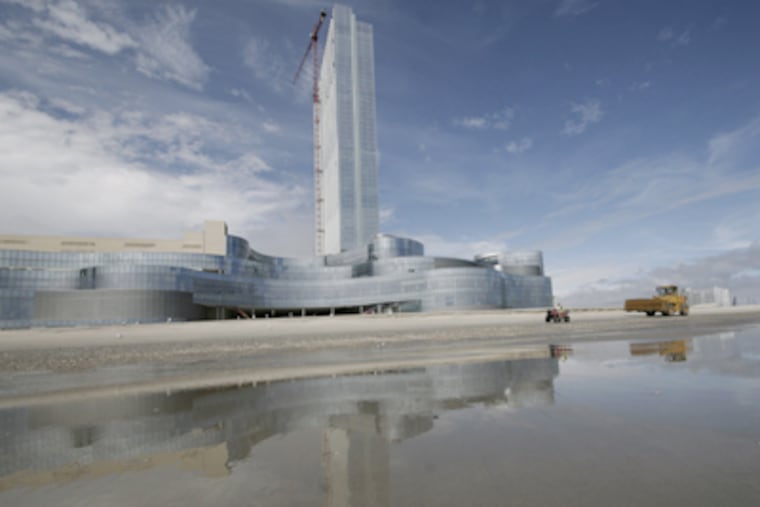
ATLANTIC CITY - With its curved, 47-story, glass-and-steel facade, the Revel casino resort is designed to "embrace" the beach and Boardwalk in a way that no building on this famous oceanfront has done before.
The $2.4 billion megacasino - the state's second-tallest structure, behind the Goldman Sachs Tower in Jersey City - envelopes the onlooker like a giant, sculpted wave.
"That was what was the concept from the very beginning," said Robert Andersen, executive vice president of project development for Revel Entertainment Group.
"It embraces the ocean and the beach in its design. But in turn," he said, "the building embraces you when you look at it."
Unlike many of the city's casinos, which isolate patrons inside windowless spaces, Revel - set to open in May - takes every opportunity to remind visitors that they are steps from the ocean. The two-plus acres of rooftop pools, cabanas, gardens, and cafes; the restaurants, lounges, hotel rooms, and even the casino - all are designed to showcase Revel's beachfront location at the Boardwalk and New Jersey Avenue.
But to do that, there needs to be a beach - one that won't wash away in a nor'easter.
In an unprecedented partnership with government agencies that restore and enhance the coastline, Revel has committed its own funds to preserving its most valuable design element.
In 2003, four years before the groundbreaking for the resort, federal and state officials launched a $68 million rebuilding of Atlantic City's eroding 2.5-mile shoreline. The project was completed over the summer.
In front of the casino, where the beach was less than 100 feet wide at low tide, there is now a 350-foot expanse of sand. A visitor would never know that, at high tide, water used to wash under the Boardwalk, completely covering the strand.
When Hurricane Irene struck, the refurbished beach held up well against the roiling sea and heavy wind, Andersen said.
In conjunction with the N.J. Department of Environmental Protection and U.S. Army Corps of Engineers, the casino is helping to finance several innovations it hopes will preserve the agencies' work.
The company hired Ian Jerome of Jerome Associates, an Absecon, N.J., environmental consulting firm, to team up with the government agencies and with marine-sciences experts from Richard Stockton College of New Jersey. Andersen would not disclose how much money Revel had put into the partnership.
Revel rises up in an area of the city known as the Inlet, named for its proximity to Absecon Inlet. With fishing schooners and pleasure boats visible as they make their way from back-bay marinas, the spot is particularly picturesque.
But like beaches at the tip of all the state's barrier islands, the location is subject to erosion by storms, Jerome said.
Without preventive measures, in some spots, sand from beach replenishments "is simply not going to stay for very long," Jerome said.
Revel has expressed a lot of concern about improving the ocean environment and the neighborhood, Jerome said.
"You don't typically find developers that want to focus on a plan that is best for the environment or the public spaces," he said.
The casino launched its maintenance strategy last winter when it paid to rebuild about 1,100 feet of the Boardwalk, with reinforced pilings and decking, in front of the site.
The next phase will be to enhance the dune created during the replenishment and double the length of two rock jetties at Massachusetts and Rhode Island Avenues.
Instead of continuing to spend money to pump more sand onto the beaches near Revel - upward of $1 million per block - Jerome said that, extending the jetties to about 300 feet would trap and eventually build up sand.
The final phase will be to build a "sill" of sand on the seaward side of nearby historic Garden Pier. It will run about 700 feet north to the jetty at Massachusetts Avenue and is designed to quell severe wave action that could pull sand from the beachfront, according to experts.
Revel's hands-on approach to its environmental needs stems not only from a business perspective, but also from wanting to be a good neighbor to Atlantic City, Andersen said.
Revel will be Atlantic City's first casino to open since 2003, when the Borgata Hotel Casino & Spa ushered in an era of world-class amenities.
With revenue flagging because of the economy and increased competition from neighboring gaming markets, some analysts contend it may be Atlantic City's last new, huge casino - at least for a while.
"This is a time when everyone in business realizes if you're going to get something done," Andersen said, "we all have to roll up our sleeves and be willing to pitch in."
For a video report on the Revel casino's beach building, go to www.philly.com/revel
EndText