Traffic down on Delaware River bridges after DRPA toll hikes
Higher tolls have meant less traffic on four Delaware River bridges linking Philadelphia and South Jersey.
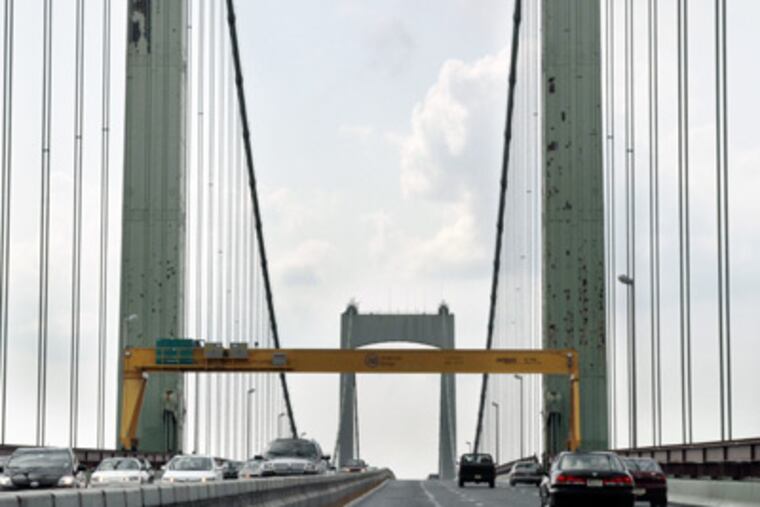
Higher tolls have meant less traffic on four Delaware River bridges linking Philadelphia and South Jersey.
Since tolls increased by $1 - to $5 per car - on July 1, traffic has been down about 4 percent on the Ben Franklin, Walt Whitman, Commodore Barry, and Betsy Ross Bridges, said John Matheussen, chief executive of the Delaware River Port Authority, which operates the bridges.
Rising tolls and tough economic times have driven traffic to the lowest level in more than a decade. It is projected to dip to 50 million vehicles this year. The peak was 55 million in 2007.
Traffic was down about 1 percent in 2010 from 2009, after falling 5 percent the year before.
It had been rising on the four bridges each year since 2000 until tolls were increased by $1 for cars in September 2008 to $4.
The additional $1 increase in July further reduced traffic. Bridge traffic was also hurt by storms in August and early September.
However, ridership is up on the PATCO commuter rail line, which is a subsidiary of DRPA. Higher gasoline prices and Philadelphia attractions such as a winning baseball team have helped boost rail ridership, despite a 10 percent fare increase July 1, Matheussen said.
"As long as the Phillies keep winning, we see good numbers," he said.
PATCO ridership was up about 4.4 percent through August over the same eight months last year, an increase of about 300,000 passengers, chief financial officer John Hanson said. About seven million people took trips on PATCO through August.
Some drivers apparently have taken their toll money from the DRPA bridges to the nearby Tacony-Palmyra toll bridge operated by the Burlington County Bridge Commission. The toll there has remained $2 for a decade.
Since July 1, traffic on the Tacony-Palmyra is up about 9 percent over the same period last year, according to the bridge commission.
The DRPA finance committee got an update on the agency's financial condition Wednesday.
The increase in PATCO rail riders, coupled with lower-than-expected expenses, has helped whittle down the subsidy that PATCO requires each year from DRPA, Hanson said.
Through August, the subsidy was $10.4 million, about 23 percent less than the anticipated $13.6 million.
Overall, for the first eight months of the year, DRPA was running about $8.2 million ahead of projections because of higher-than-budgeted revenue and lower expenses, Hanson said.
The agency's operating budget for the year is $265 million, including $128 million for DRPA's annual payment on its $1.4 billion debt.
The finance committee on Wednesday again deferred any decisions on what to do with $29 million in unspent economic-development money.
DRPA board vice chairman Jeffrey Nash, who is chairman of the finance committee, said Wednesday a second committee meeting may be held later this month to tackle that.
DRPA repeatedly has put off a decision on what to do with the money.
Most of the $29.2 million was designated for specific economic-development projects over the last two years but it has not been contractually obligated for those projects.
Economic-development spending over the last 13 years has been a source of much controversy - and considerable expense - for DRPA.
The agency has spent about $500 million for such things as concert halls, sports stadiums, museums, and monuments, contributing to its $1.4 billion debt and prompting criticism from Gov. Christie and others over its spending priorities. More than 40 percent of commuters' tolls on DRPA toll bridges now go to pay principal and interest on those debts.