Irene ripped USS Radford, sunk for a reef off Cape May
When the old Navy destroyer was sunk off Cape May Point in August, it was already bedraggled. Holes had been cut in the hull, paint was peeling, and brass, bronze, and other metals had been stripped.
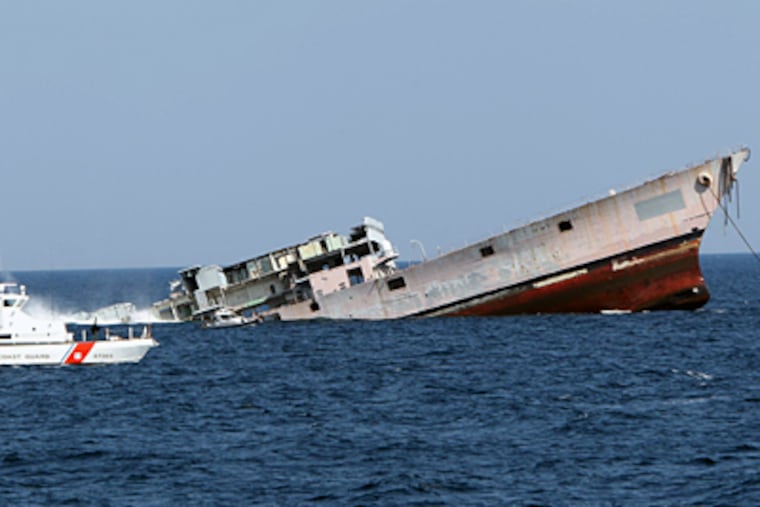
When the old Navy destroyer was sunk off Cape May Point in August, it was already bedraggled. Holes had been cut in the hull, paint was peeling, and brass, bronze, and other metals had been stripped.
But the Arthur W. Radford - the longest vessel made into an artificial reef on the East Coast - took a turn for the worse when Hurricane Irene barreled through on Aug. 28.
Divers who have visited the wreck say they were stunned to find the 564-foot ship broken in two and the larger section carried from the bow.
The unsupported position of the hull, coupled with Irene's powerful storm surge, apparently caused the breakup.
"The large main section, from the bridge to the stern, is still upright and actually moved about 200 feet," said Ted Green of Salisbury, Md., a diver and charter-boat captain who visited the site before and after Irene. "What's also remarkable is that it didn't tip over."
Divers have profiled the 100-foot bow on a depth sounder. It appeared to have fallen over, said Green, 51, who hoped to confirm that finding on a dive Friday.
After serving in the Persian Gulf War and peacekeeping operations off Lebanon, the Radford was just settling into its role as an artificial reef when Irene struck.
Its breakup could enhance its appeal to divers and fishermen, who are expected to leave tourism dollars at hotels, restaurants, retailers, and scuba shops in New Jersey, Delaware, and Maryland, all roughly equidistant from the site, state officials said.
The Radford is 29 miles from Cape May Point and Ocean City, Md., and 26 miles from Indian River Inlet, Del. Its wheelhouse is about 70 feet below the surface, and its keel is 130 feet down.
"I'm pleased that the main part of the ship is still upright," said Jeff Tinsman, artificial reef administrator for the state of Delaware. "That's the main aspect for a dive attraction.
"World War II ships that have been hit by mines are sometimes in two pieces," said Tinsman, who also is a diver. "It may add interest to the whole thing to have a jagged front end."
The Radford was sunk on Aug. 10. After its stern dropped, it went down in about a minute. Struts attached to the back dug into the ocean floor and helped prevent the ship from rolling on its side. Then the bow lifted and slipped beneath the surface.
Two days later, Green and other divers surveyed the site and found the Radford's hull supported in only two places - at the bulbous area of the bow and about two-thirds of the way back.
By Aug. 19, a crease had formed on the deck at the base of the wheelhouse. Another crease and some tearing were visible on each side of the hull, Green said.
"It was only a matter of time before it would break," he said.
A diver with him, Nick Caloyianis, filmed the developing crease.
"We were worried," said the Catonsville, Md., film producer and photographer. "The ship did not sit flat. . . . You could swim under the stern and [part of] of the bow. It had stress on it as soon as it hit the bottom."
When Green and other divers returned to the site last week, about a month after Irene, they were shocked. Most of the ship was in a new location parallel to the bow.
"It's a graphic picture of the power of a hurricane," Tinsman said. "Hurricanes can take plate steel and break it off like a pretzel."
They've damaged subway cars that make up other artificial reefs, he said.
The bridge end of the Radford has "scoured into the bottom about five feet," Green said. "This bodes well for it staying upright."
Caloyianis planned to do more filming on Friday.
"I didn't think a Category 1 [hurricane] could do that," he said. "You can only imagine the maelstrom underwater when it broke apart."
The Radford required months of preparation to assume its new role. Efforts were made to make the vessel diver-friendly. Sharp edges were rounded off and doors removed.
"It will absolutely still be a draw to divers," Green said. Charter vessels "won't anchor on the bow. They'll anchor on the highest point of the ship," the portion that was carried away.
Over time, the Radford will be covered with algae and become a home to marine life.
"Most ships sink accidentally in a storm," Caloyianis said. Before it was made into a reef, the Radford "was made safer by having many openings. Now that it's broken apart, you can swim all the deck levels more easily. It's even more diver-friendly now."