Junior ROTC program motivates Delsea students
Michael Torrence sported dreadlocks down to his waist in July when he showed up at his school's Army Junior Reserve Officer Training Corps office.
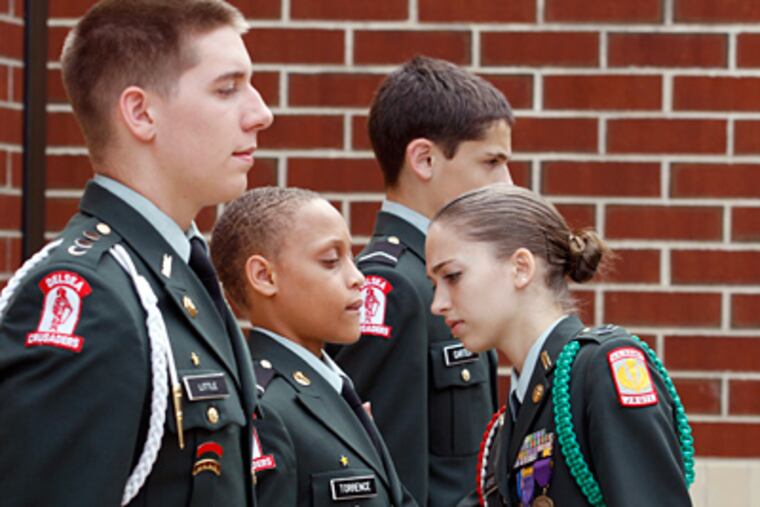
Michael Torrence sported dreadlocks down to his waist in July when he showed up at his school's Army Junior Reserve Officer Training Corps office.
The Sicklerville teenager had been been growing his hair for five years, and suddenly faced a choice.
"I told him, 'You've got to cut them off' " to join the program, said Lt. Col. Dane Woytek, senior Army instructor at Delsea Regional High School in Franklinville.
"He came back the first day of school, and they were gone," Woytek said.
Now a cadet private looking smart in uniform, Torrence, 14, says JROTC has helped him become "more disciplined and responsible."
Delsea's nationally recognized JROTC program has become part of the school culture. Of its 1,200 students, nearly 15 percent are Crusader Battalion cadets. Most have no interest in pursuing a military career, and many don't come from military families.
"The discipline helped me," said Cadet Capt. Marcus Williams, 18, of Newfield, who wants to become a surgeon. "They encourage us to be on the honor roll.
"They started cracking down on me, and I focused on my studies. I've got all A's and B's," said Williams, a senior and member of the track-and-field team. "Once you join, it's addictive. If you don't have the grades and discipline, you pick them up."
Cadets who previously had trouble studying and getting up for school rise at 5 a.m. for drill practice. They surprise their families by getting haircuts, picking up trash on school grounds, and taking part in community parades.
Met with suspicion by some educators when it started in 1995, JROTC has become a major asset, Delsea officials said. The program has lifted SAT performance and improved students' behavior through a carrot-and-stick approach.
Community work and academic and athletic achievements are rewarded with medals, ribbons, and promotions in rank. Poor grades, suspensions, and failure to don the uniform can result in expulsion from the program.
This year, the Crusader Battalion was accorded the program's highest award, the Honor Unit of Distinction, given to only 10 percent of the country's 1,650 programs. Twenty-three New Jersey and 28 Pennsylvania schools have JROTC.
"For those kids not attached to a core group - whether athletics, arts, and drama - this program gives a sense of belonging," said Paul Barardelli, the school's principal.
"When I was a student at Villanova University from 1985 to 1989, I was on the football team. That was my fraternity, my core group," said Barardelli, who supported the introduction of JROTC at Delsea when he was a special-education teacher there.
ROTC provides that same belonging, "along with pride and discipline, that resonates across the school and that adds to the academic atmosphere," he said.
The program tends to have more dropouts as students learn to drive and start dating. This year's 172 members - more than a third of whom are female - include 49 freshmen, but only 20 seniors. Those who stay are focused: Fourteen of the cadets who graduated in June enlisted in the armed forces.
Not everyone approves of JROTC's presence on high school campuses, where students are at an impressionable age.
"Every public school student needs a good basic education and can then make decisions about the military. There are plenty of ways to learn leadership and discipline," said Darlene Gramigna, director of the Truth in Recruitment program at the American Friends Service Committee in Chicago.
"We don't think military life is a needed part of public education," Gramigna said.
Recruitment is not the goal at Delsea, Woytek said. Of the students who join JROTC, "very few enter the service," he said.
The program, which has 286,000 cadets nationwide, "promotes college first and foremost," said Brenda Gainey, chief of the JROTC Second Brigade, who oversees programs at 115 schools in New Jersey, Pennsylvania, New York, Connecticut, Maine, Massachusetts, Rhode Island, Vermont, Germany, and Italy.
"If students choose the military, we just make sure they are aware of the military [college] scholarships available," said Gainey, who works at Fort Dix.
JROTC's impact at Delsea and in the community is clear, officials said. Cadets put in 4,382 hours of service during the last school year.
"If there's a problem with a student [in the program], we can come to the JROTC instructors" to straighten it out, assistant principal George Passante said.
The cadets "don't want to be dressed down," said Woytek, 62, of Riverside. "We track them and talk to them. There are standards."
In a class this week, Woytek greeted his freshmen with a booming voice: "Good afternoon, cadets!"
"Good afternoon, sir," they responded.
"Get your notebooks out," Woytek said.
"Do you have a pencil?" one of the cadets asked.
"Do you think I'm Staples?" Woytek shot back.
The cadets must wear their uniforms every Wednesday and at events. After failing do so twice, they are put on probation and letters are sent home. They are "disenrolled" after a third infraction. That has happened to four students in four years.
"We become disciplinarians, but with a caring attitude," Woytek said. "We have few problems with the kids."
Many parents can't believe the transformation of their sons and daughters, said First Sgt. Ed Walls, an Army instructor in the program.
"They say, 'I can't get them to clean their room and get up for school. You've got them cleaning up a parking lot at 6 a.m.,' " said Walls, 59, of Hammonton.
"We encourage them, we counsel them, we stress Army values," he said. "We preach graduation, stay off drugs, and go to college."
Lt. Col. Samantha McBride, the battalion commander, isn't necessarily planning on a military career. The senior, from Franklinville, wants to go to college and become a veterinary technician.
"I've become a lot more outspoken and picked up leadership qualities," said McBride, 17. "I always had relatively good grades, but they improved, too. I believe I'm more mature and more goal-oriented."
The cadets sacrifice their time to earn decorations that cover their uniforms.
The clinking of medals can be heard when Cadet Maj. Joshua Hameier walks into the JROTC office. He has received awards for athletic and air rifle competitions, color guard participation, the National Honor Society, and other achievements, including his work in community and school events.
Hameier, who also is a cadet flight sergeant in the Civil Air Patrol, has been accepted at Embry-Riddle Aeronautical University in Arizona and has applied for a four-year ROTC scholarship. He hopes to become an Army helicopter pilot.
"I've wanted to join the military ever since I was in eighth grade," he said.
For Pvt. Michael Torrence, JROTC is a means to an end. "I wanted to go into the CIA or FBI, and I thought military service would help," he said.
But that meant the dreadlocks had to go.
At first, his mother, Ben'Nette Torrence-Watkins, 36, didn't want him to join - and didn't want him to cut his hair. She relented when she saw how important JROTC was to him.
"He was so excited," she said. "I've seen a huge change in him. He's more mature. He takes things more seriously."
For the new cadet, there was only one downside to his decision: "My head felt cold."