So far, Pine Barrens withstanding beetle onslaught
Nothing seemed to stand in their way last year, as they marched across South Jersey like an invading army, leaving denuded pine trees in their wake.
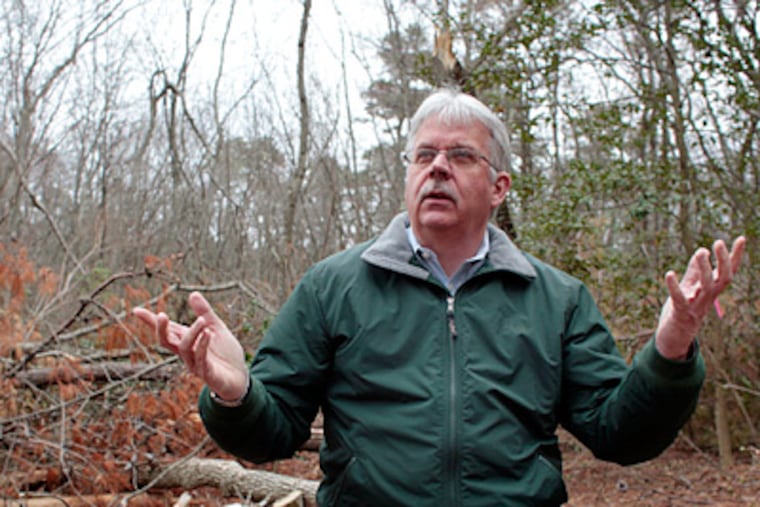
Nothing seemed to stand in their way last year, as they marched across South Jersey like an invading army, leaving denuded pine trees in their wake.
The exploding population of Dendroctonus frontalis - the Southern pine beetle - killed 14,000 acres of pines in 2010 and was expected to destroy at least that many in 2011.
But when state officials checked recently, they were surprised. Only half of the anticipated damage had been inflicted.
What happened?
A voracious predator, the checkered or clerid beetle, had gobbled up many of the pine beetles, helping to reduce their number.
There were other factors. Record rainfall over the summer and fall strengthened the trees, allowing them to resist insect damage.
Also confronting the pine-eating beetles was a bluestain fungus that inhibited their colonies, experts said. And there were hungry woodpeckers, too.
"Bottom line? This is good news for the Pine Barrens," said Larry Hajna, a spokesman for the state Department of Environmental Protection. "We will be going into the spring with a lot less acreage affected by Southern pine beetles."
Certified forester Bob Williams first spotted the invader in Millville, Cumberland County, in 2001, while clearing a farm field overgrown with pines. About 30,000 acres have been affected since then.
The oblong-shelled pine beetle, about the size of a grain of rice, has been found in Cumberland, Cape May, Salem, Ocean, Burlington, Gloucester, and Camden Counties. It has not shown up in significant numbers in Pennsylvania.
In New Jersey, "I've been seeing hundreds and hundreds of tiny infestations," said Williams, vice president of forestry operations for Land Dimensions Engineering, a Glassboro firm that manages tens of thousands of private forested acres.
"No matter what happens this winter, all of them have the potential to erupt," Williams said. "They're seed populations that can explode again."
The beetles infest all pine species, but prefer pitch, shortleaf, pond, and loblolly. They have been found from New Jersey to Texas and from Arizona to Honduras.
"It may be too early to know if the current Southern pine beetle outbreak in New Jersey is over, or if the beetles are just regrouping," said Ronald Billings, manager for forest health with the Texas Forest Service. "Most outbreaks tend to last three to four years before they decline from natural causes.
"Less is known about the Southern Pine beetle dynamics at the northern extent of its range, that is, New Jersey," he said.
The insect finds trees and leaves a trail of pheromones for other beetles to follow, experts said. Egg galleries are constructed around the trunk, then beetles and larvae feed on the cambium, the soft part under the bark, and cut the tree's resin canals. Pines take on yellow and red hues before turning brown and dropping their needles.
But the Southern pine beetle has enemies.
The checkered beetle "is a big player in population dynamics," said Matthew Ayres, professor of biological sciences at Dartmouth College in Hanover, N.H. "They're extremely efficient predators."
Ayres said the clerid beetle follows the pine beetle's pheromone trail, then eats adults and larvae. The checkered beetle population increases depending on its food supply.
Adding to the pine beetle's woes is a tiny mite that carries bluestain fungus, which impedes growth of another fungus that the insect larvae eats.
"Unless we have a cold snap this winter like we haven't had in New Jersey for 10 years or so, the expectation is that there will be at least as many Southern pine beetles as last year, maybe more," Ayres said.
"If the temperature drops to zero degrees, half the population will die," he said. "If it drops to minus 7 degrees, expect 90 percent of them to die."
So far, winter has been mild - and temperatures are expected to remain above normal.
Last year, the pine beetle encountered a different weather problem: Heavy rain made the trees less susceptible to insects.
During the drought conditions in 2010, stressed trees were less able to use sap as a defense against invading insects.
The pines "were stronger last year," Hajna said. "That was one of the big reasons for reducing" the beetle population.
Sometimes, the insect can be its own worst enemy by "killing so many trees that it depletes its resources," Ayres said. "You could have people driving through the Pinelands, and wondering why it's called the Pinelands."
Cutting down trees infested with Southern pine beetles is the most important way to suppress outbreaks, Ayres said.
But that "requires aerial surveys . . . and getting loggers to go out and cut down the trees," he said. "The infrastructure for doing that doesn't exist in New Jersey."
The future of the beetle is largely up to Mother Nature, forester Williams said.
"We know they're here and conditions are ripe for them to do their thing again," he said.