New Jersey man turns campaign stint into software success
Aharon Wasserman was frustrated by the sheaves of papers he received every night. As deputy field director in the Georgia office of Barack Obama's 2008 presidential campaign, the Cumberland County, N.J., native's job was to collate daily canvassing reports, crunching data on issues such as who got registered and who was likely to vote.
Aharon Wasserman was frustrated by the sheaves of papers he received every night.
As deputy field director in the Georgia office of Barack Obama's 2008 presidential campaign, the Cumberland County, N.J., native's job was to collate daily canvassing reports, crunching data on issues such as who got registered and who was likely to vote.
One evening, the 21-year-old Rutgers University junior, who had taken a leave to join the campaign, grabbed another young staff member, Justin Lewis, "who wasn't so good at knocking on doors, but was pretty good at programming," Wasserman recalled recently.
Together they spent 20-hour days devising a social-media tool - a "game-changer," the nonpartisan New Organizing Institute has called it - that maximized efforts by the campaign's field offices and led to the prodigious get-out-the-vote initiative that proved key to Obama's success.
After the election, Wasserman, Lewis, and several other former Obama workers repaired to the Bridgeton home of Wasserman's parents to refine the networking software into a commercial product, NationalField, whose clients now include Kaiser Permanente, the United Kingdom's National Health Service, the Sierra Club, and the AFL-CIO.
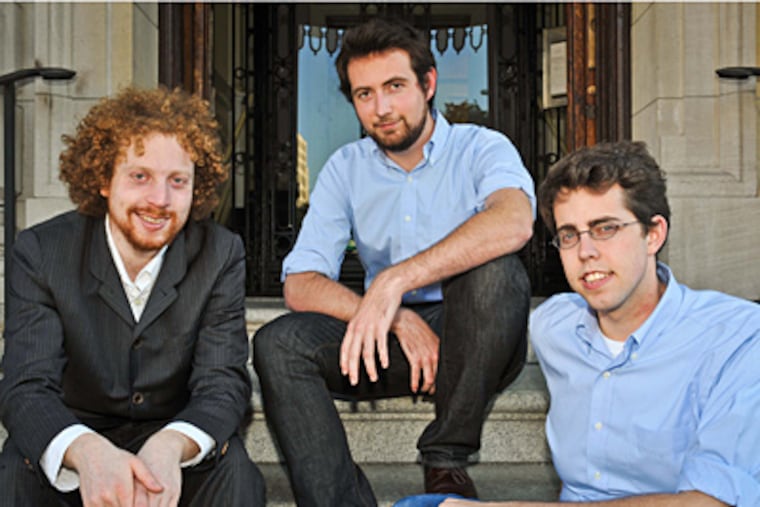
For their achievement, Wasserman, Lewis, and another NationalField partner, Edward Saatchi, last month were named to Forbes magazine's "30 Under 30" list of technology leaders, on a par with Lady Gaga and LeBron James in their respective categories.
When Wasserman was a student at Friends schools in Mullica Hill and Philadelphia, his strength was not in technology or business, but in acting and writing, say his former teachers.
"Tevye in Fiddler on the Roof, and Fagin, and the most sophisticated Tom Stoppard stuff, it was always Aharon in the lead," said Doug Brophy, his principal at Friends Select in Center City, from which Wasserman graduated.
"What really resonated about him was his empathy, his self-awareness, and how to approach people in the right way. He had the gift of being the best listener to his peers and the best voice from his peers to the administration," Brophy said.
At Rutgers, Wasserman - who also spent time growing up in Woodbury and Greenwich - thought he would learn to write sitcoms. He managed to get a comedy-sketch show, 30 on the Banks, on the campus TV station.
"But, frankly, I got a little bored there," he said. When an uncle said a second cousin was hosting a fund-raiser for primary candidate Obama in New Hampshire, the two of them drove up.
It was November, and snowing, Wasserman recalled. "The Secret Service couldn't get [Obama's] car out, so he stayed longer and got off his stump speech, answering questions off the cuff," he remembers.
The kid was impressed. Within days he had left school, and he's never gone back. Wasserman was sent to Ohio and Maryland as a campaign volunteer, then recruited to the paying deputy-director job in Georgia.
"When he and Justin came up with NationalField, it changed my life," said Alex Lofton, who was the campaign's Georgia director.
"It revolutionized canvassing and interaction for the campaign. Aharon really knew, from his great skill at personal relationships, how to get people to communicate," Lofton said.
NationalField was later voted most valuable tech tool of the 2010 elections in a competition sponsored by the New Organizing Institute.
Essentially a reverse Facebook, NationalField creates social networks for members of closed groups - sometimes people on the same level, sometimes from various levels of an organization. For the campaign, Wasserman said, it let higher-ups and the rank and file know how many doors workers had knocked on, the difficulties and successes they encountered, and what was going on with staffs in other cities.
"There had been nothing like it," according to Lofton. In some cases it tripled the efficiency of canvassers, he said, citing the Ohio primary, in which an unprecedented 30-plus percent of registered Democrats turned out thanks to grassroots efforts. Virtually all of the new voters, he said, were Obama partisans.
Postelection, Wasserman said, the Democratic National Committee - where Lofton had gone to work - indicated its interest in the software. He and his collaborators settled in at the Wasserman family kitchen table.
NationalField "incubated at our house," said Wasserman's father, Keith, a public relations executive. The group worked nearly round-the-clock for five months.
Eventually, the DNC contracted Wasserman and his partners, who moved to Washington in 2010 and set up NationalField there. The company had $1 million in revenue in its first year and now has 17 employees.
Because of its creators' connection to the Obama campaign, many NationalField clients, such as the Sierra Club and AFL-CIO, might be categorized as "progressive." But Wasserman said most of the company's customers are not nonprofits and there is no political litmus test, though he expects Obama's 2012 bid will use NationalField.
Wasserman's teen years were unconventional. His parents wanted to move back to Bridgeton, where they had been high school sweethearts, and sold their Woodbury house quickly, before they had a new place lined up. The family moved in with Betsy Riley-Wasserman's parents on a 70-acre farm in Cumberland County's Greenwich Township just as some of her 10 siblings and their families also needed a place to stay.
"We all seemed to like [living together] and did it for three or four years," said Wasserman, who became close to the nine cousins who passed through.
His mother, senior vice president of human resources and organization development for the Mercy Health System, would drive him to Friends Select on her way to work.
"Immediately when he came here in ninth grade, he was the leader," said Wasserman's English teacher and adviser, Wendy Buckingham. "He was creative at everything, and just knew how to get the best out of everyone.
"When he left, I told him, 'Remember me when you're president.' It's come close, right?" Buckingham said, laughing.
He still has that "sitcom dream," Wasserman said. "But right now I see [NationalField] as a half-hour drama, and I truly am working on the script. . . .
"Who knew that day we drove to New Hampshire in the snow it would turn out like this?"