Tanner painting finally to be shown in Philadelphia
The painting was instantly seen in Europe as so profound, so dignified, so good, that the French government, eager to purchase, practically tore it off the walls of the Salon du Champs-Élysées.
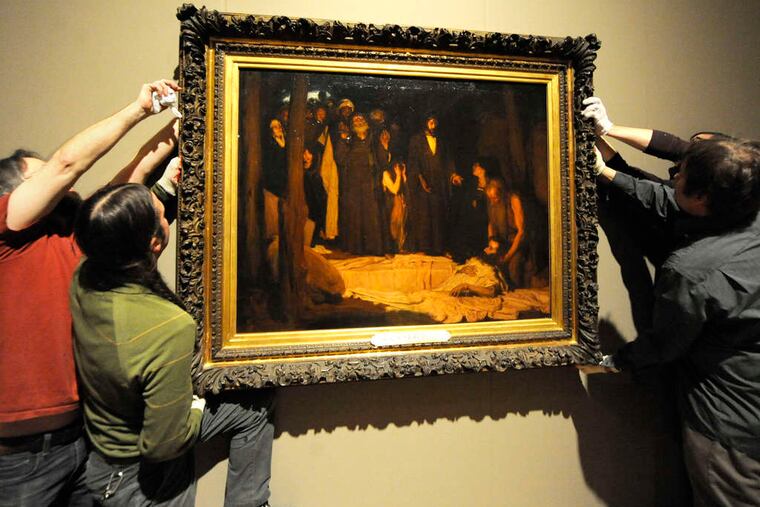
The painting was instantly seen in Europe as so profound, so dignified, so good, that the French government, eager to purchase, practically tore it off the walls of the Salon du Champs-Élysées.
That was in 1897.
Henry Ossawa Tanner's The Resurrection of Lazarus immediately entered the collection of the Musée du Luxembourg and then the Musée d'Orsay - a treasure belonging to the French people.
But the painting never appeared in Tanner's homeland, never crossed the Atlantic to the United States, never traveled to Philadelphia, where the artist studied intermittently at the Pennsylvania Academy of the Fine Arts under the tough gaze of Thomas Eakins.
Until last week.
On Wednesday evening, Lazarus arrived in Philadelphia from Paris in a great green crate. On Friday morning, in a ground-floor gallery of the academy's Hamilton Building, where a Tanner retrospective will open Saturday and continue through April 15, the crate's sides were unbolted, the foamcore pads were removed, and, for the first time, American light fell directly on the American masterpiece.
Anna O. Marley, the academy's curator of historical American art, clasped her hands in expectation. Gale Rawson, senior registrar, leaned forward.
"We've looked at images so long as we prepare for the exhibition, when they come out of the crate, it's like Christmas," Rawson said. "Anna says it's like seeing an old friend."
Marley, curator of the exhibition, which is the first comprehensive retrospective of Tanner's career in 20 years, likened the moment to "30 Christmases."
The painting, she noted, won a great prize at the 1897 salon, which propelled Tanner to the heights of cultural celebrity.
"This painting, after it won the prize, was spread across the New York Times, it was in the Chicago newspapers, it was written about all over the country," she said. "It was so celebrated."
Even so, Tanner made only a few brief visits back to Philadelphia and America after achieving such fame. He remained an expatriate, living largely in France for the next four decades until his death in 1937.
Tanner was a sensitive and deeply religious African American who sought refuge in Europe from the racial indignities rampant in his homeland.
Marley directed attention to the original back of the painting. There, near the edges, are stickers from the 1897 salon (Lazarus was Painting 259) and a label from the Musée du Luxembourg, which identifies Tanner simply as an artist of the "école Americaine" - the American school.
"I love that," Marley said. "And that's what Henry Tanner loved. 'In Paris,' he said, 'I'm Monsieur Tanner, American artist. In the United States, I'm Mr. Tanner, Negro artist or black artist.' "
Tanner was the soft-spoken son of an outspoken bishop in the A.M.E. Church. The family moved to Philadelphia when he was about 10, and in 1879 he began studies at the academy as its first black student.
He attended off and on for several years, leaving in 1885. That race played a role in his decision seems clear, though he never spoke about specific racial experiences at the school or in Philadelphia.
A classmate, however, illustrator Joseph Pennell, described an incident in which academy students tied Tanner to an easel and left him "crucified" in the middle of Broad Street. In his memoirs, Pennell used an offensive epithet to describe Tanner and asserted, "There has never been a great Negro or a Jew artist in the history of the world."
Such incidents and attitudes scarred Tanner, who wanted nothing but to pursue his art and have that art judged on aesthetic, not cultural or racial, grounds.
He found Europeans far more willing to look past race and consider his art on its own terms. Rather than face this daunting issue every day, he made his life in Europe.
He also focused on religious subjects, his efforts drawing many critical comparisons to Rembrandt.
The Dutch painter has been invoked many times by writers in the daily and art press in discussing the small Lazarus painting, which measures 37 by 48 inches.
But Tanner is his own man, as Marley made clear, despite superficial similarities in palette and subject.
The exhibition, "Henry Ossawa Tanner: Modern Spirit," contains more than 100 works, including little-known sculptures. A dozen paintings have never been shown in a Tanner retrospective, an academy spokeswoman said.
Concern about the fragility of Lazarus kept the painting in France for years, Marley said. But the academy agreed to conserve and stabilize it and the French agreed to lend. After Philadelphia, the show travels to Cincinnati and Houston.