Glendora student's war book reaches across a generation
Growing up, Joe Gilch often wondered about the young man whose portrait hung on the wall in his family's Camden County home.
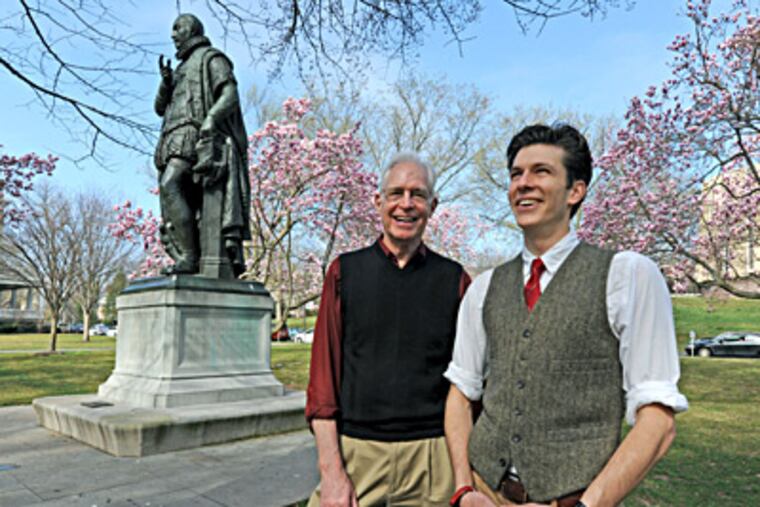
Growing up, Joe Gilch often wondered about the young man whose portrait hung on the wall in his family's Camden County home.
The man was Joe's uncle Jimmy Gilch, who wrote more than 80 letters to friends and relatives while serving in Vietnam before being killed just before his 21st birthday.
"I was probably 6 years old when my grandmother used to read me the letters," said Gilch, who grew up in the Glendora section of Gloucester Township. "I got really involved in the mystery of it."
Jimmy Gilch's death in 1966 was a painful and rarely discussed memory for the large Gilch clan. But Joe Gilch was eager to find out what had happened to the Army private. In middle school, he read profusely about the Vietnam War, and eventually he contacted his uncle's commanding officer.
Wary of his unearthing tender details of their brother's death, some of Gilch's aunts suggested burning the letters. Instead, his grandmother gave him the correspondence, which he stored in a shoe box under his bed.
A decade later, Gilch - a Rutgers University graduate student who bears a strong resemblance to his uncle - is cowriting a book that combines Jimmy Gilch's story with a broader political and social narrative of the Vietnam War era.
Through Jimmy's letters and interviews with those who knew him, the project - tentatively titled Everyman in Vietnam - is a personal account that distinguishes itself from most other works about the period, said Rutgers history professor Michael Adas, Gilch's mentor and coauthor.
Other works "don't have the immediacy of being there and talking about what is happening every day," said Adas, 69, who has written on 20th century military conflicts, colonialism, and the history of technology. "You can only get that through letters."
As an undergraduate, Gilch was not always so focused on his academic pursuits.
"I was majoring in psychology . . . and I thought, 'I just don't want to do this,' " said Gilch, 23. " 'I don't want to learn about the frontal cortex.' "
In spring of his freshman year, Gilch enrolled in Adas' seminar on war in the 20th century, where he presented his uncle's letters and their concurrent history to the class. Jimmy Gilch's story fascinated Adas, who was working on a book contrasting the Vietnam conflict and World War I.
"He's not a hero," Adas said of Jimmy, who dropped out of Triton Regional High School and was drafted in August 1965. He was assigned to the First Battalion, Fifth Infantry Regiment, and stationed outside Cu Chi.
"He does his duty," Adas said. "He's just an ordinary kid dealing with the war, and that story is almost never told."
Adas became Gilch's informal adviser and invited him to do research for his book in which he hoped to integrate Jimmy's letters. Under his tutelage, Gilch's grades began to improve and he rediscovered his passion for history.
Then life got in the way. A talented runner, Gilch had received an athletic scholarship to Rutgers after graduating from Triton. An injury caused him to lose his financial aid and his mental footing.
"There were times when I'd go to bed crying. I'd just think, 'What am I doing here?' " Gilch said.
Psychologically defeated, he stopped meeting with Adas. Their research was suspended until spring 2010, when they bumped into each other on campus and Gilch explained his troubled state.
Adas invited him to revisit Jimmy Gilch's letters, which he had left with the professor during their two-year silence. They quickly abandoned the World War I comparison and focused their research on Vietnam and Jimmy Gilch.
The project transformed Gilch, then a junior. He brought his grade-point average from a 1.8 up to a 3.4 by the time of his graduation in January. His senior thesis, also about his uncle's Vietnam experience, won him two major university prizes. He is now pursuing his master's degree in history.
Adas and Gilch - who write separately, then meet to review each other's work - have completed roughly two chapters. Gilch provides his uncle's story, and Adas the historical and political context. They envision the book as a mass-market offering, not a textbook, and hope to send a draft to literary agents by fall.
The differences in their "education and age level don't really make a difference," Adas said. Gilch "learns very fast, and he's very open to criticism, and I am, too. We're very honest with each other."
Unlike his prolific mentor, Gilch is still looking for his voice as a writer.
"Probably the best advice I've gotten from anybody is, don't force writing," he said. "If it takes you two hours to write a paragraph, take it."
In examining his uncle's letters, Gilch found an imperfect narrator.
"It was hard at first," he said. "How am I going to write a story about a man that I never knew? How can I be his voice?"
Though Jimmy was at first excited about doing his patriotic duty, he became disillusioned. When he arrived in Vietnam in February 1966, he was assigned to move villagers out of their huts before U.S. bombing raids.
By summer, Jimmy was purposely getting in trouble on the base to avoid the missions. He would have rather been on kitchen patrol or clean the unit's latrine.
"It became a survival tactic," Gilch said. "Toward the end, he would say it was not a winnable war."
But Jimmy never delivered the sort of antiwar statement that would have encapsulated Gilch and Adas' message, that the Vietnam conflict damaged many of those who fought it.
His letters just before he died, when his armed personnel carrier was bombed in July 1966, were more tales of drinking in the foxhole with friends than transcendent ponderings.
Upon further reflection and research, the professor and student concluded that Jimmy's lack of introspection was a coping mechanism common to those in combat. He was preparing for the possibility that he would be killed.
"They just shut down because they know they just can't get out of it," Adas said. "They don't want to disgrace their families and be unpatriotic, but [they] just can't be there" emotionally.
For Gilch, uncovering his uncle's story has been a healing experience.
"Not only is there a coming-of-age story and a war story, but there's this dramatic humanistic side to Vietnam that you don't normally see when you watch movies," he said.
"It's almost a crazy, spiritual thing. I feel like this ancestral person is with me at all times."