Gathering at Eastern State Penitentiary remembers Dr. King's "Letter From Birmingham Jail"
The words, about 7,000 in all, were scribbled in the margins of newspapers and on other scrap paper. They did not show the soaring rhetoric he would use in a famous speech in Washington just months later.
The words, about 7,000 in all, were scribbled in the margins of newspapers and on other scrap paper.
They did not show the soaring rhetoric he would use in a famous speech in Washington just months later.
But some say the Rev. Dr. Martin Luther King Jr.'s "Letter From Birmingham Jail" – a sharp, at times line-by-line rebuke of arguments white clergymen made denouncing King's tactic of nonviolent protest – marked a pivotal moment in the civil rights movement, swaying clergymen to become more and more involved.
On Sunday, those words were read at a historic Philadelphia prison, 50 years after King wrote them and a day before the federal holiday honoring the civil rights leader.
King spent eight days in jail in April 1963 for protesting in the streets of Birmingham, Ala. – one of the most segregated cities at the time – during the heart of the civil rights movement and just four months before he delivered his "I Have a Dream" speech in Washington.
Historians say King wrote the Birmingham missive as an open letter, knowing it would be published.
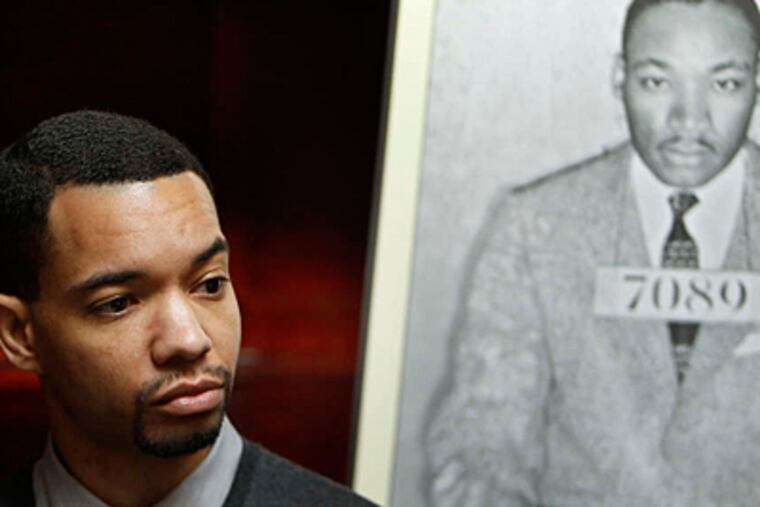
Inside what was the synagogue at Eastern State Penitentiary on Sunday, local actor Dax Richardson read portions of the letter to an audience of 40. (The Fairmount Avenue prison was abandoned in 1971 and was designated a historic site in 1994.)
Richardson spoke calmly, explicitly not trying to portray King in order to avoid a "gimmick," said Sean Kelley, the site's senior vice president.
In addition, Richardson said, "to portray Martin Luther King is an overwhelming thing to do."
Flanked by pictures of King as prisoner No. 7089 and a disturbing image of firefighters using hoses to attack blacks, Richardson read some of the most powerful passages from King's famous letter, including his principle that "injustice anywhere is a threat to justice everywhere."
Members of the audience also read passages, and a Temple University graduate student discussed the letter's historical context.
King wrote that nonviolent protest was necessary to "create a situation so crisis-packed that it will inevitably open the door to negotiation."
Anthea Butler, an associate professor of religious studies at the University of Pennsylvania, said in an interview that King's call for nonviolent protest put a "different slant on Christianity."
"It's about protesting, period," said Butler, who is teaching a class about King and Malcolm X. She said King intended for his letter to show that "it's right to fight an unjust law in the Christian tradition."
King also explained his advocacy for civil disobedience, writing that "one has a moral responsibility to disobey unjust laws," which he said were "out of harmony with the moral law."
Gaylord Gray, 58, said he attended the reading to honor King. He said he had not read the letter before and was struck by King's courage.
The prison will hold readings Monday at 11:30 a.m. and 2:30 p.m.