No place like a home for some sick veterans
Army veteran Carl L. Ferrell had lived with strangers before. He was sent, at age 9, to an orphanage because his parents were too poor to care for him.
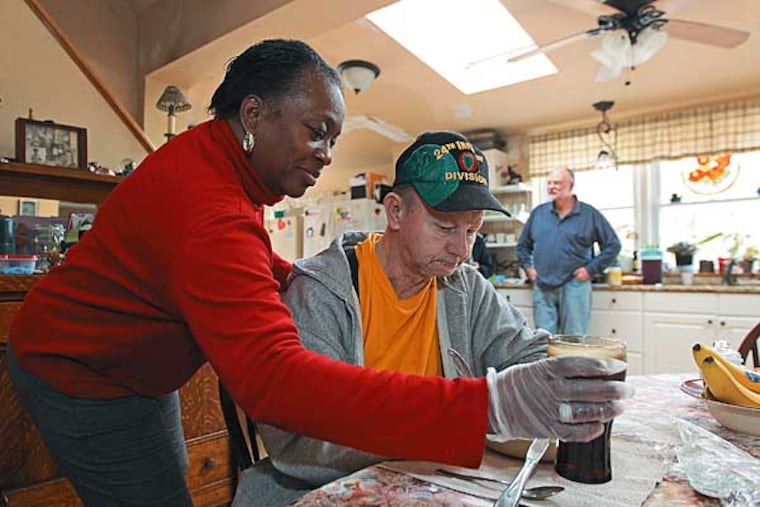
Army veteran Carl L. Ferrell had lived with strangers before.
He was sent, at age 9, to an orphanage because his parents were too poor to care for him.
In his 50s, Ferrell moved into a group home in Coatesville because he had little family left to help him manage his bipolar disorder, anxiety attacks, and heart condition.
With its budget-breaking rent and lousy food, the last place "wasn't so hot," said Ferrell, 68.
So he turned to the Coatesville Veterans Affairs Medical Center to find a better place. Ferrell found a home with Ron and J. Elizabeth Boger of Aston.
"It's 100 percent better," Ferrell said.
Ferrell and the Bogers are two of the medical center's first participants in a program that finds local residents to take in chronically ill veterans who might otherwise end up in a nursing facility.
The Medical Foster Home program is a nationwide initiative of the U.S. Department of Veterans Affairs.
"The opportunity for veterans to connect with people is priceless," said Ferlin Charles, coordinator of the Coatesville program. "Some haven't connected in a family setting for years."
So far, 80 hospitals in 40 states offer the program, with plans to expand it to 22 more hospitals.
VA medical centers in Coatesville, Lebanon, and Philadelphia are among those that offer the program. In New Jersey, the VA New Jersey Health Care System also provides the service.
Coatesville has placed five veterans; Philadelphia, one; and Lebanon, three. In New Jersey, at least three veterans have been placed.
Some facilities have approved families waiting for veterans. Others are seeking families willing to make the commitment.
"As rewarding as it is, it's a daunting responsibility," Charles said.
Families are expected to provide round-the-clock care to veterans who can never be left alone, not even for a run to the Wawa.
The families provide three meals a day, snacks, and transportation to appointments. They make sure the veterans take medications, keeping daily medical logs. For their efforts, the families are paid from $1,500 to $3,000 a month for each veteran. Participating veterans must be eligible for VA services. Families can house up to three veterans.
Payment is determined by the amount of care the veteran requires. The veterans pay the family with funds from their own resources, their family's, or government benefits.
Although the program is less costly than placing a veteran in a VA nursing facility, said Jim Hammond, social work services chief at the Philadelphia VA, the motive behind the program is to provide a homelike atmosphere for veterans.
To make sure that the program's families provide a safe and nurturing environment, VA medical centers maintain strict oversight and offer support.
Families must undergo FBI background checks, submit income statements, and train in CPR. Their homes are inspected by hospital staff and fire department personnel.
Also, families some time must make architectural changes to their home, such as adding a ramp or widening doorways.
For, the Boger household - which includes 18-year-old son Jacob, and lab mix Diamond - that meant adding grab bars in bathrooms and widening doorways.
Boger had worked for years in property management, but was unemployed when his family decided to apply for the program. He had the time, and with a five-bedroom house, they had the space.
"I'm 54 years old, and this is the first time I've been able to say that I love something so much, I'd do it even if I didn't get paid - but I do," Boger said.
Three veterans live with the Bogers, and each has a single room. Ferrell moved in 18 months ago, after a screening process that has the veterans meet with the family and visit several times to see whether they are compatible.
Ferrell, who never married and has no children, was stationed in West Germany, where he was shot while patrolling the Berlin Wall. When he came home, he worked in a film library and at odd jobs. He lived mostly with relatives until he moved into the group home.
"I like the people here, I like the food. I like the company," Ferrell said after eating a lunch of tuna salad in the kitchen. "They are like family."
Contact Kristin E. Holmes at 610-313-8211 or kholmes@phillynews.com.