Loud music, tinted car windows: New policing in Camden
Officer Adam Fulmore pulled over the Honda CRV on South Collings Road in the Fairview section of Camden on Friday. The driver wasn't wearing a seat belt, and an air freshener hung from the rearview mirror, obstructing her view.
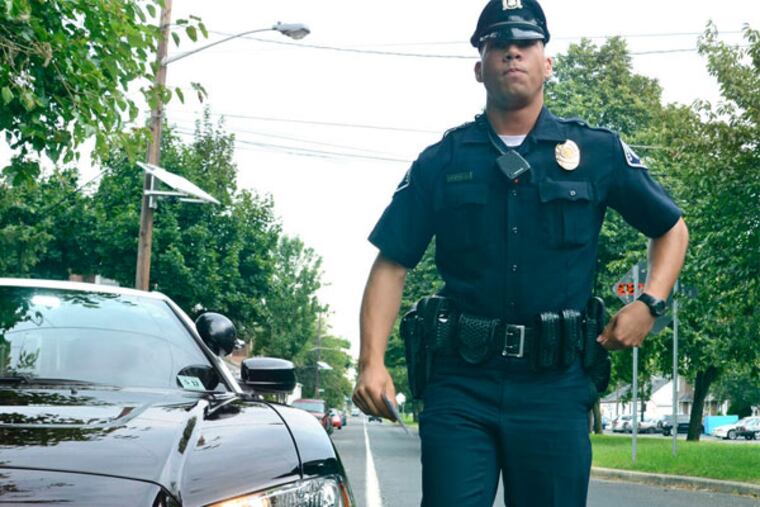
Officer Adam Fulmore pulled over the Honda CRV on South Collings Road in the Fairview section of Camden on Friday. The driver wasn't wearing a seat belt, and an air freshener hung from the rearview mirror, obstructing her view.
Fulmore, a 20-year-old rookie with the new Camden County police that began patrolling the city nearly four months ago, let the driver leave with a warning. The vehicle was carrying members of a Philadelphia church group on their way to a water-park outing in Clementon.
"He was a perfect gentleman," said passenger Sylvia Whitlock.
But about a month earlier, Denise Dixon, 47, said the new force made "an enemy out of me" when her car was towed from her block. Police told her that evening that her registration had expired two weeks earlier.
She said she had to spend half of her mortgage money to retrieve the car.
In Camden, a city beset by shootings and drug dealing, some are puzzled by - and some welcome - the attention the new force has been paying to offenses that some have long stopped perceiving as offenses.
Residents have been cited for playing music too loudly, or for driving with a missing license plate.
Tackling so-called quality-of-life infractions isn't a new approach in Camden, or in policing.
The "broken windows" theory involves a laser focus on small, quality-of-life issues to establish order, build community allies through interaction, and thus head off serious crime.
Asked if the strategy includes "stop and frisk" - a tactic used most prominently and controversially in New York - Camden County Police Chief Scott Thomson said: "Our policy is to only detain people when we have reasonable, articulable suspicion that a crime has been, is being or about to be committed."
Complaints of overzealousness draw a cautionary note from Joe Cordero, a former East Orange police director hired to help create Camden's new county-run force. He said it's tough to find the right balance of when to be lenient and when to be firm.
"The guide is a simple one: Treat people how you want yourself and your family to be treated," he said. "That means not assuming everyone in a crime-challenged community is a criminal. Once people perceive you to be more of a problem than the crime, then you've lost the battle."
George L. Kelling, a retired director of the Police Institute at Rutgers University's School of Criminal Justice in Newark, helped develop the "broken windows" philosophy in the early 1980s.
"The first thing order does is it reduces citizen fear," said Kelling, now a consultant for the Manhattan Institute for Policy Research. "That means citizens can start to reclaim public spaces."
Former New York Mayor Rudolph Giuliani embraced the approach in the 1990s and credited it for a dip in crime; critics said crime was already dropping nationwide.
Thomson is not a skeptic.
"When folks are driving around with their radios blaring . . . drinking alcohol out on a public corner or urinating in the mouth of an alleyway, that is the time officers need to be . . . taking action to cease and desist that type of behavior," Thomson said.
"What broken windows has proven is that people that are committing the most egregious crimes are also committing the lesser offenses as well."
When asked about Dixon's case, Thomson said unregistered vehicles must be towed.
"It's the law," he said. "It's not allowed to be on the street. If it's unregistered, its generally uninsured as well."
Dixon, a Cooper Landing homeowner, said mechanical trouble had forced her to leave her vehicle parked near an intersection. Someone called police and told them the car was stolen and abandoned.
She was sleeping at home after an overnight hospital stay for shortness of breath when a neighbor awoke her to say her car was being towed.
Dixon said she showed the officers her insurance and license and tried to show them her medical records.
Carlos Molina, 34, left with a favorable impression of the new policing strategy after Fulmore pulled him over Friday for failing to wear a seat belt.
Molina slipped the belt on as Fulmore approached, but then acknowledged he wasn't wearing it while driving.
Fulmore gave Molina a lesser citation - for obstructed view because a necklace was hanging from his rearview mirror.
"He cut me a break; I can't be mad at him," Molina said. "He's doing his job." But he said he didn't recall ever being stopped before in the city for not wearing a seat belt.