Colorful display of shells at museum show
Les Ocasio got hooked on shells as a child when his father was collecting them for a university in Puerto Rico. For shell dealer Sue Hobbs of Cape May, the spark was when her mother took her to the beach with a field guide.
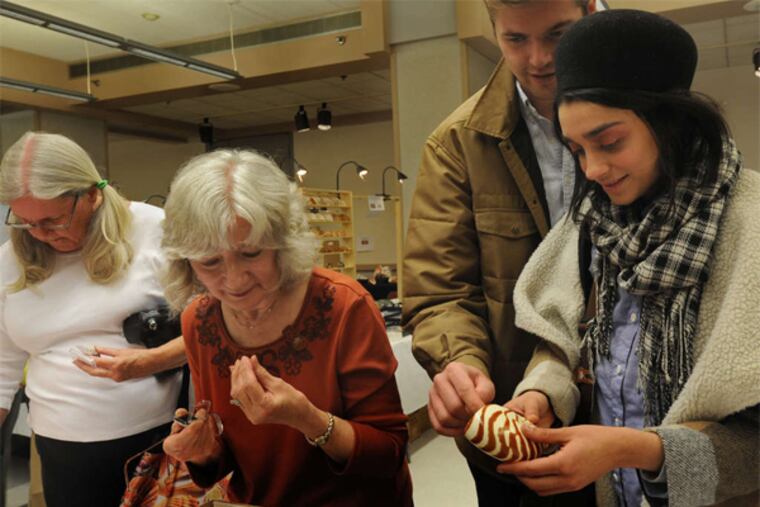
Les Ocasio got hooked on shells as a child when his father was collecting them for a university in Puerto Rico. For shell dealer Sue Hobbs of Cape May, the spark was when her mother took her to the beach with a field guide.
And then there is Paul Callomon, who started gathering shells at 9 and now manages the third-largest collection in the world.
It was a common characteristic among those attending day one of the Philadelphia Shell Show on Saturday. The passion starts early and runs deep.
"To me, they're like gems," said Ocasio, who lives in the Montgomeryville area.
Dealers, hobbyists, and casual museum-goers crowded around curvaceous displays from the ocean's depths, ogling table after table topped with more bright colors than a candy store.
Pink- and orange-striped sea urchins that looked like creations of a master pastry chef. Lemon-yellow file clams as large as Ping-Pong paddles. Flamingo-pink land snails from the Philippines.
The two-day affair, which continues from 10 a.m. to 5 p.m. Sunday, is being held at the Academy of Natural Sciences of Drexel University. Hosted by the Philadelphia Shell Club, it is said to be the largest shell show in the Northeast.
The academy is a fitting locale, as it has close to 10 million shells in its own collection, behind only the Smithsonian and a museum in Paris, said Callomon, the collection manager.
Museum-goers took behind-the-scenes tours of the academy's collection with Callomon, and also gazed at extensive offerings from hobbyists and private dealers.
Dealer Randy Allamand of Sebring, Fla., is one of the few who scuba-dives for the shells he sells. Sometimes he even goes down in a submarine built by a friend who attached a shell-gathering net on one end.
A mailman by day, Allamand began as a shell collector and eventually had so many he realized he could supplement his income - in some cases quite nicely.
On Saturday, Allamand said he sold one for $2,500 - a creamsicle-colored spiral specimen called Bayerotrochus midas.
"You start getting so many shells, you might as well start selling them," Allamand said.
Jason Fisher of Springfield, Delaware County, attended with his wife and three daughters, who seemed entranced by the live-animal portion of the show.
The eldest, 7-year-old Lily, did not flinch as a mud crab was placed on the back of her hand by Andrew S. Wilson, a traveling exhibitor from Virginia.
"It wasn't very ticklish," she said afterward.
On the first floor, visitors watched as museum naturalist Christine Danowsky dissected a squid, removing its ink sac and the internal, cylindrical shell known as a pen.
"Squid love office supplies," Danowsky joked.
Yazmeen Norris, 8, of Lancaster, wrote her name in squid ink and also got to touch its fleshy innards, announcing that it felt "like a cold shrimp."
Entrance to the show is included in regular academy admission: $15 for adults, $13 for seniors and children ages 3 to 12. It is free for those under 3.