Mt. Holly Gardens residents welcome long case's end
A group of middle-aged and elderly homeowners gleefully passed around a picture of a three-story brick-front townhouse, admiring its modern appearance and the inclusion of a garage.
A group of middle-aged and elderly homeowners gleefully passed around a picture of a three-story brick-front townhouse, admiring its modern appearance and the inclusion of a garage.
A gloom that hung over them for a decade - after Mount Holly Township decided to bulldoze their postwar-era rowhouses and redevelop their impoverished neighborhood - had finally lifted.
"I'm excited. I just can't wait until this finally goes through and I get my house," said Beatriz Cruz, referring to a redevelopment project that until now would have forced her and her mostly Latino and African American neighbors out. They had refused to move even after the town threatened eminent domain and ripped apart their houses and sidewalks as others relocated.
Last week, Cruz, an accountant, and a small group of neighbors got together to discuss an out-of-court settlement reached just before the U.S. Supreme Court was set to hear their housing-bias case. It was their first meeting after the Nov. 15 agreement was made final.
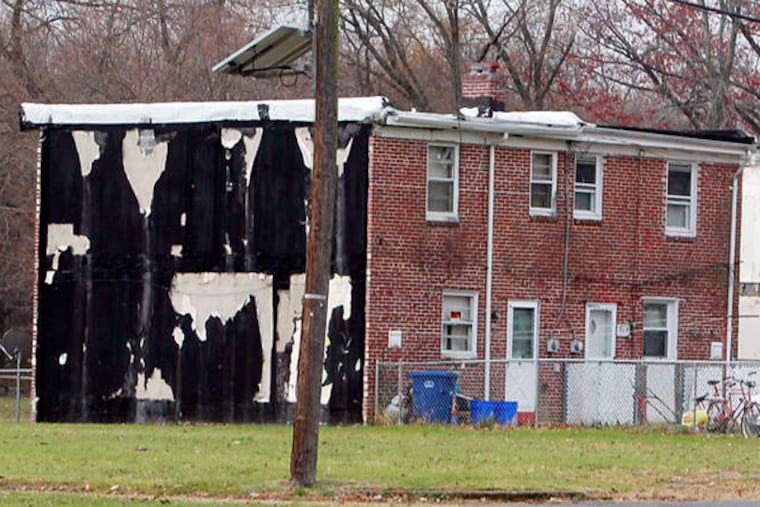
Under the settlement, Cruz will be able to stay in the neighborhood where she and her husband, Santos, have lived for 22 years. The couple and 26 other families in the Mount Holly Gardens contended that the town's decision to replace their rowhouses with market-rate townhouses that they could not afford was discriminatory. The 320-unit neighborhood - now pruned to 60 scattered and solitary rowhouses and boarded-up eyesores - had been the largest minority section in the working-class Burlington County town.
The agreement calls for 20 remaining homeowners to get new townhouses or "replacement homes" expected to be financed through a mix of township, state, county, and federal funds, and private donations. An architectural rendering of the proposed townhouses is part of the 111-page settlement and shows two- and three-bedroom units with brick facades, bay windows, and covered front porches with pillars.
TRF Development Partners, a Philadelphia-based nonprofit that specializes in financing and redeveloping troubled neighborhoods, will oversee the project. The replacement homes will be included in a cluster of 44 townhouses on the 30-acre Gardens tract.
"All parties worked together for a common goal, the good of the township, and for a fair and equitable arrangement which allows the homeowners who wish to remain" in the Gardens to stay there during and after the redevelopment, said town solicitor George Saponaro, a lead negotiator in the deal. He was brought into the case when a new mayor and council were elected, starting in 2010, after making campaign promises to settle the thorny case.
The townhouses will be valued at $170,000, or just under market rate, and will be built near 300 condominiums that Keating Urban Partners of Philadelphia plans to build and to sell for more than $200,000. The redevelopment will also include about 100 new apartments, which are already underway, and a small strip shopping center, Saponaro said.
In return, the residents will sell their rowhouses to the township so land can be cleared for the project. This will allow the stalled project to proceed, unhampered by contentious litigation that had reached the highest levels of the state and federal courts.
'Why start over?'
Since the replacement houses will be worth more than twice the appraised value of the small brick rowhouses in the Gardens, the residents have agreed to assume a flat $20,000 no-interest mortgage for the upgrade, payable when they sell the townhouse. Any existing mortgages will also have to be paid off, as spelled out in the deal.
Many of the homeowners are seniors or longtime residents who had either paid off their mortgages or were close to doing so. Cruz said she had only eight years left on a 30-year mortgage and would have been strapped with a new one after the town initially offered $28,000 for her three-bedroom home. "We're not rich. I would have loved to stay in my own house. Why start over?" she said.
The rows of replacement houses will be blended into the rest of the project, says Sean McCloskey, TRF Development Partners' president. "As you drive into this community in the future, this [part] will just be like another street," he said. "We all want to move into place where we fit . . . where we don't stick out."
The deal also calls for the town to pay a total of $691,000 to buy out seven homeowners who have decided to relocate, three tenants, and three former homeowners, and for other expenses.
Saponaro said the town was negotiating with the landlords of 30 rowhouses to acquire those properties as well.
Kevin Walsh, an associate director of Fair Share Housing Center in Cherry Hill, a nonprofit legal agency that fights housing discrimination, said he and Adam Gordon, a center lawyer, had acted as mediators to get the case resolved. "This was a balancing of the township's interests and the residents' interests," he said.
The downturn
Township officials had touted the redevelopment as a way to remove blight and crime, but the economic downturn and the legal battle had slowed the project. The settlement was reached as the case headed for a Dec. 4 hearing before the U.S. Supreme Court. The case was widely anticipated because the conservative high court had agreed to rule on a long-debated civil rights issue: whether minorities can sue for housing bias without having strict proof of intent.
In this case, the U.S. Court of Appeals for the Third Circuit in Philadelphia ruled that the township did not intentionally discriminate against the residents, but it said that the residents had a right to a trial to show the redevelopment would adversely affect minorities. The town appealed that decision.
Saponaro said the settlement would make Gardens residents whole and also protect the township of 10,000 from assuming too much debt. The settlement includes no admission of liability. The negotiated compromise ends litigation that had cost the township more than $1 million.
Saponaro said the township invited TRF to oversee the building of the 20 replacement houses and 24 below-market-rate units for qualified first-time home buyers because of its expertise in redevelopment projects. TRF will appeal to investors and apply for public funds to finance the project. So far, it has raised money to pay $1.8 million to acquire the land for the 44 townhouses.
Saponaro said the township would also contribute $300,000 toward the cost of building the first four units, which are expected to be completed in 2014. The remaining 16 are slated to be built in phases during the following three years.
"We believe in God and knew this would work out," Cruz said, adding that she was delighted to be staying. "Giving up was not a choice."
856-779-3224 @JanHefler