Pa. gas prices set to rise Wednesday
Expect to pay more at Pennsylvania gas pumps starting Wednesday, as the first wave of a series of tax increases takes effect.
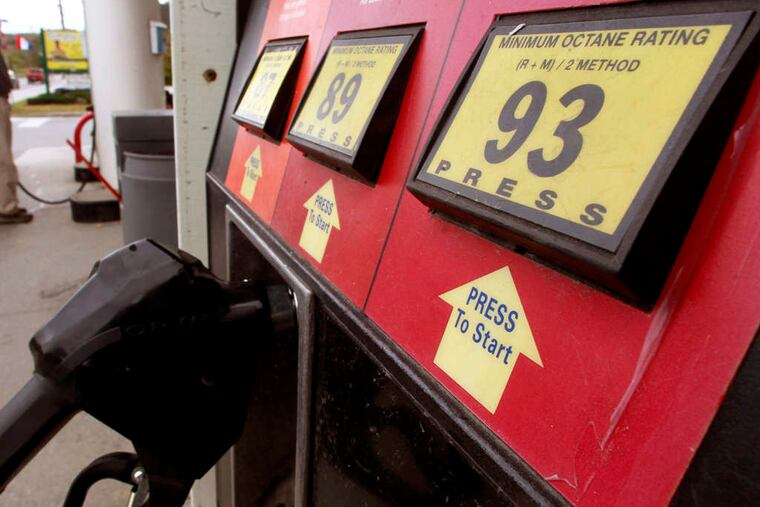
Expect to pay more at Pennsylvania gas pumps starting Wednesday, as the first wave of a series of tax increases takes effect.
"Fuel companies will determine how much of the tax increase to pass on to consumers," said state Department of Transportation spokesman Richard Kirkpatrick. "If entirely passed on, the change would be about 9.5 cents a gallon."
By early 2017, the new tax rate could add more than 25 cents a gallon, pushing Pennsylvania's gas taxes higher than any current levies in the nation, according to American Petroleum Institute figures.
California is now No. 1, with 53.2 cents a gallon in state taxes. Hawaii, New York, and Connecticut are the only other states with levies higher than Pennsylvania's imminent 41.8. By early 2017, Pennsylvania will be collecting at least 58 cents a gallon.
The current national average is about 31 cents a gallon for state taxes, not counting the federal 18.4 cent bite.
The new revenue will directly fund much-needed repairs and improvements to Pennsylvania highways and bridges, and is part of a comprehensive transportation package that will also greatly help mass transit, Kirkpatrick said.
"It's a huge benefit for helping us rebuild our system," said Francis Kelly, SEPTA's assistant general manager for public and government affairs. Increased revenue from such sources as tolls and motor vehicle fees - though not from gas taxes directly - should grow to $340 million a year for SEPTA five years from now, he said.
Comparisons with other states are somewhat unfair, Fitzpatrick said, since many pass along transportation costs in other ways, such as higher fees, fines, and other taxes.
"Pennsylvania's vehicle registration fees are among the lowest in the nation, with 39 states charging more. Also, 31 states charge more for the cost of a driver's license," according to a PennDot news release.
The increase will be tough, though, for drivers not to notice, especially if they visit other states.
For years, gas prices in neighboring New Jersey have averaged about 15 to 20 cents a gallon less than in Pennsylvania, because of much lower state taxes - 14.5 cents a gallon, less than any other state except Alaska, according to API statistics.
On Tuesday morning, the average gallon of regular in Pennsylvania was selling for $3.48, 10th-highest among the 50 states, according to AAA's Daily Fuel Gauge Report.
If the full 9.5 cents is passed along on New Year's Day, Pennsylvania would move up to No. 7. Add all 26 cents from the multiyear series of increases, and the result would top every state this side of Hawaii.
New Jersey was 23d Tuesday morning, at $3.33 a gallon.
In five years, after the series of tax changes has been implemented, the cost will be about $2.50 a week for a fairly typical driver - someone who drives 12,000 miles a year in a vehicle that gets 24 miles per gallon, Kirkpatrick said.
For a household with two regular drivers, that amounts to about $260 a year.