Teacher's avocation: Crafting surfboards
School let out for the summer Thursday in Cherry Hill, and middle school teacher Luke Alvarez made the usual 50-mile trek to his home in Ocean County.
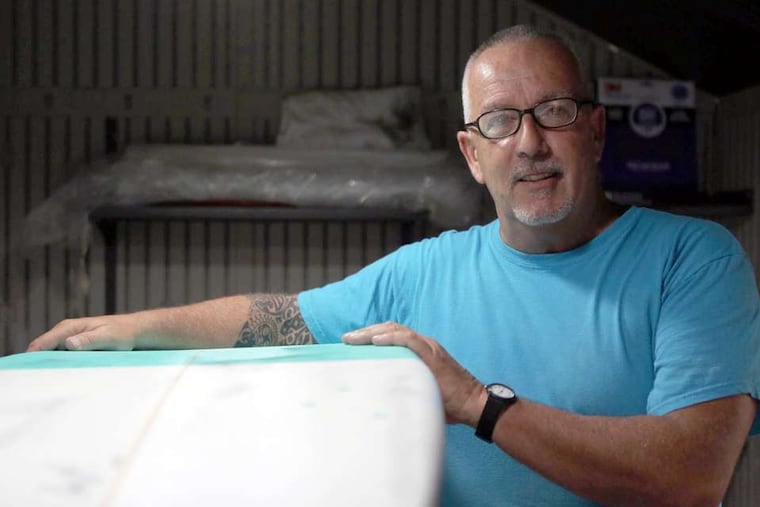
School let out for the summer Thursday in Cherry Hill, and middle school teacher Luke Alvarez made the usual 50-mile trek to his home in Ocean County.
But unlike a lot of teachers, he'll take almost no summer break. Instead, he'll be hunched over in his home shop with the tools he'll use to shape and sand, shape and sand, over and over until he gets it just right.
It's the zen of making a surfboard. And after four decades, he's a master of the craft.
"I know it sounds cliched," said Alvarez, "but I do it because it's a ton of fun."
Alvarez, 57, owns Generic Brand Surfboards, which he operates in two small shacks behind his home in Tuckerton Beach.
He shapes, glasses (coats), and sells his custom-made boards to local residents and referrals, or anyone looking for an affordable and customized surfboard ready for paddling wherever the surfer prefers to "rip."
Alvarez began making surfboards in 1971 in Red Bank, Monmouth County, where he experienced firsthand the "long-board to short-board revolution."
During this period, from roughly the late '60s to early '70s, pro and amateur surfers were looking to ride shorter boards. This new design of surfboards, Alvarez said, brought with it new techniques of surfing - and more surfers.
At the time, he was just a "grom," or "young, inexperienced surfer," and he couldn't afford to buy a new surfboard.
Instead, Alvarez and his friends would go around town looking for long boards that had been left out for trash collection. They would then take the finished board and try to shorten it by cutting into the fiberglass.
"The brilliant teenagers we were didn't realize that all that fiberglass would become airborne," said Alvarez. "Our arms would itch for days, but once we got down to that blank that was underneath, we had a lot of material to work with."
This allowed the amateur shaper to get to the surfboard blank, allowing him to shape the long board into a short board by using simple tools from his grandfather's auto-body shop.
Alvarez would buy fin boxes for the surfboards from a local boating supply store and, when he had enough money saved from his paper route, fins from a surf shop in Monmouth Beach.
He was just getting his toes wet. Over the years, he has shaped hundreds of boards, and his self-taught skill has given him a "good eye for shaping."
Alvarez obtained a bachelor's degree in business administration in 1980 and went on to work in consumer packaging, a field that relocated him several times in states nowhere near a coast.
But the teaching gene runs in his family, and he went back to earn a bachelor's degree in teacher education from Richard Stockton College in 2005. He has been teaching full-time in Cherry Hill for three years.
"Now, I get to work with kids," said Alvarez, "and kids are way more fun than adults."
Since Alvarez has summers off, it gives him more time for surfing and shaping boards. During the summer, he also teaches children how to ride the waves, with a family-friendly surf camp he started eight years ago - Aloha Surf Camps LBI in Beach Haven.
Alvarez not only has taught locals how to surf, but has also immersed his three children in the sport. The family lived in a bungalow miles from the beach for 11 years, but Alvarez was able to teach them all to surf by age 4.
"Their mother is an ER nurse, so I ended up with the kids all day," said Alvarez, who is divorced. "I'd say, 'Let's go to the beach,' and they didn't have a choice."
Now grown, son Tyler and daughter Samantha are both instructors at the surf camp, and Tyler is also a shaper at Generic Brand Surfboards. Alvarez's eldest daughter, Jacquelyn, lives in Colorado and is a guest instructor when she visits.
Although he has help from his children, Alvarez does a majority of the work making the customized boards right in his backyard.
He uses two shacks, one for sanding and the other for glassing the boards. In the "shape shack," he sands surfboard blanks to the specs of the customer, a job that requires practice so as to not sand too much of the board away or puncture holes in the blank.
Sanding takes about 21/2 hours. Next is the glassing process, which takes anywhere from six to seven days and requires working in a moisture- and dust-free shack.
During this time, the artwork for the board is done. Alvarez creates some artwork by hand, but he orders other specific graphics requested by customers from Headline Graphics in Cardiff, Calif. They provide high-quality fabrics with graphics that can be applied during the glassing process.
Frank Kowelowski, a Tuckerton Beach volunteer firefighter, said that Alvarez provided quality work and a customized board that you couldn't get anywhere. He is waiting for a long board with a Maltese cross, a symbol of fire companies. Kowelowski lost a lot in Hurricane Sandy, so having a customized board with symbolic meaning is important to him.
Alvarez said that the "Jersey surf-scene" had grown and that it could change anyone's life, whether they are young or old, amateur or pro.
That is why his company's message is affordability and being "generic" instead of having a name-brand board with a price tag to match.
Alvarez doesn't discredit the high-end boards, but he knows the sport can get expensive. He tries to help all who want to learn to surf, so they can start to get the experience.