New Cherry Hill senior rabbi connected to predecessor
Rabbi Steven Lindemann stepped into a tall shadow when he became senior rabbi at Cherry Hill's Temple Beth Sholom in 1992.
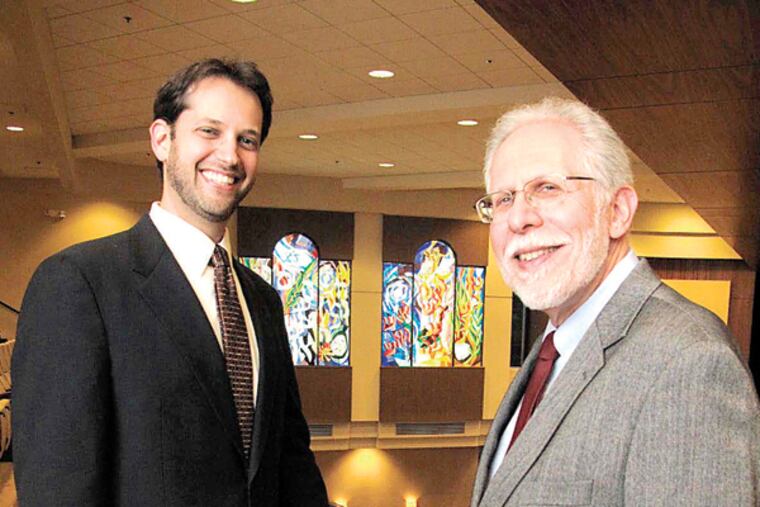
Rabbi Steven Lindemann stepped into a tall shadow when he became senior rabbi at Cherry Hill's Temple Beth Sholom in 1992.
"I was 44," he recalled last week, and his predecessor, Rabbi Albert Lewis, "had been here 44 years. He started this congregation the year I was born. And he had a very distinctive teaching style."
Leadership stays on at this giant Conservative synagogue. Yet now, after 22 years as Beth Sholom's senior rabbi, Lindemann finds himself in the role of the new tall shadow.
On Nov. 2, he stood smiling at the bimah, or liturgical platform, of the synagogue's modern sanctuary as his young assistant, Rabbi Micah Peltz, formally succeeded him as just the third senior rabbi in 74 years at this big, prosperous congregation.
"You have been my partner and my friend from the day you came here seven years ago," Lindemann, 66, told the 35-year-old Peltz at his installation. "I hope to be as good a partner and friend to you as you have been to me."
"You have taught me how to be a rabbi," Peltz replied, then told the congregation that Lindemann's presence had been "the biggest reason I came here in the first place."
Those might seem the expected encomiums at any succession ceremony, no matter how strained. But spend an hour with the two men on a weekday afternoon, and the affection and rapport between them is palpable. They laugh endlessly at one another's jests, one leans forward and nods eagerly as the other speaks, and they finish each other's ideas.
"You don't always find the perfect person to continue after you," said Lindemann, whose trimmed gray beard is nearly identical to Peltz's shadowy brown one.
"But when you do, you do everything you can to make sure that person does exactly that. That's when you make the move."
Although active and in good health, Lindemann said Thursday, he wanted to ensure that Beth Sholom kept Peltz, a University of Michigan alumnus whom the synagogue hired directly after his 2007 ordination at the Jewish Theological Seminary in New York.
"This never would have happened without Rabbi Lindemann's generosity and trust," Peltz said. "So it's his fault." The rabbi emeritus laughed.
Further evidence of their shared ease is the fact that Peltz has chosen to keep his smaller office. Lindemann, who will continue to teach and co-lead services with Peltz and Cantor Jen Cohen, still occupies the cluttered, book-lined office across the hall that once had been Lewis', who died at 90 in 2008.
Four years before Lindemann arrived, Lewis led the congregation's decision to move its synagogue from Haddon Heights to its expansive new home on Cherry Hill's east side, where many young Jewish families were then settling.
It was, by all accounts, an astute move. By the time Lindemann took over in 1992, Beth Sholom had grown from about 550 families to more than 900.
A larger-than-life bronze bust of the larger-than-life Lewis, who had served as president of the Rabbinical Assembly, the international organization of Conservative rabbis and as vice president of the World Council of Synagogues, sits in the hallway connecting Peltz's and Lindemann's offices.
Asked as they sat together in Peltz's office what was the greatest challenge now facing Beth Sholom, Lindemann gestured to his friend.
"Let him answer," he said. "He's the senior rabbi."
Peltz smiled.
"The central challenge moving forward is the interconnected world," he said - a world "already much different than when I came here in 2007."
"People are able to carry phones with apps that let them form a minion," or the quorum of 10 required for certain prayers, said Peltz. "Or they google a Jewish term that they once would have asked a rabbi."
Even more disconcerting, he said, a recent Pew Forum poll reported that about 22 percent of American Jews between 18 and 35 "do not self-identify religiously" as Jews, a rate similar to Christians of the same cohort.
"But there's a need to be in community that's not being met for a lot of people in the world today," said Peltz. "Well, fostering relationships was always key to congregational life. So how do we do that now?"
One way for Beth Sholom, whose membership now numbers about 775 families, is to continue the interactive Torah discussions that Lewis brought decades ago to Saturday shabbat services.
"Rabbi asked questions between the alyiot," or Torah readings, he said, "and invited the congregation to answer. People would stand up and introduce themselves. It's a way for people to get to know one another.
"Surprisingly, it's not a common practice, but it's what we do here, every week. It's the centerpiece of shabbat morning."
The congregation also has a busy Jewish education program for prekindergarten through 10th grade, and its campus on Kresson Road is busy seven days a week, said Lindemann. "On any night, you could have a Talmud class, an Israeli dance class, a men's club and a 'cook-for-a-friend,' " where congregants make meals for the elderly.
Congregational membership offers an antidote to the "alone together" ethos of modern life, said Peltz, who is married with three young children. "It's a place to to think about our relationship with God and study the ancient texts through a modern lens.
"It's also a place to share life together: for good times and sorrows. But for that, people have to walk in the door and be willing to be engaged."
Asked what advice he would give his young protege, Lindemann thought for a moment.
"This may not be very Jewish," he said, "but what we're doing is a marathon, not a sprint. Nothing happens with sudden changes and quick responses. It happens because we work at it day after day. So enjoy each day."
Asked what advice he would like to give to Lindemann, Peltz did not hesitate.
"Don't leave!" he said. And the two rabbis laughed and laughed.