At Philcon, discussions of sci-fi sexism and true geekdom
Speaking in a small room at the Crowne Plaza hotel in Cherry Hill, Orenthal Hawkins addressed a group of 25 people, but he directed his comments to the world at large, particularly those who may have certain perceptions about the people who go to science-fiction conventions.
Speaking in a small room at the Crowne Plaza hotel in Cherry Hill, Orenthal Hawkins addressed a group of 25 people, but he directed his comments to the world at large, particularly those who may have certain perceptions about the people who go to science-fiction conventions.
"Are you passionate about the things you love?" asked Hawkins, an information technology professional. "Then you're a geek."
Hawkins spoke Saturday morning at a panel about what makes a "true" geek and about sexism among creators and fans of science-fiction stories and video games.
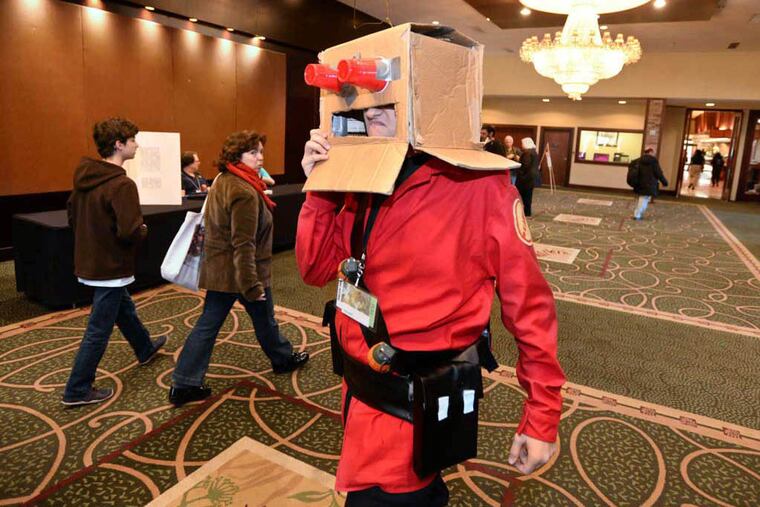
It was one of dozens of panels at Philcon, the Philadelphia Science Fiction Society's 78th annual three-day celebration of literature, television, movies, comics, gaming, costuming, and other topics that spark the passion of fans of science fiction, fantasy, and horror.
Philcon, which usually attracts between 800 and 1,000 people over the weekend, calls itself the longest-running conference of its kind.
Raequel Solomon, 37, of Upper Darby, who has been going to Philcon since 2000, attended the panel on sexism in science fiction.
"We can have fun, but with the issues we have, we do need to have serious conversations," said Solomon, a dispatcher for a copying company.
She summed up a problem she has with a certain mentality within the genre, saying some people want "green chicks" to be sex objects, but they "don't want green chicks written by black chicks."
Panels at the convention included "Common Medical Mistakes in Science Fiction," "Designing a Legal System for Your Invented World," and "A History of Corsets and Other Undergarments." The convention also hosted panels on "Stereotypes in Fandom," and "Mary Shelley, the Mother of Science Fiction."
Danielle Ackley-McPhail, an author, editor, and designer from Stratford, N.J., has been in the publishing business for 20 years and created the Bad-Ass Faeries series of anthologies. She said going to conventions such as Philcon meant exposure and networking opportunities, especially for women like her working with small publishers.
Saturday afternoon, she and a group of seven other women gathered in an executive suite on the sixth floor of the hotel to read excerpts of their books, which include tales of mutants, space opera, and urban fantasy.
The group reading was put together by Broad Universe, an international organization that promotes works of science fiction, fantasy, and horror written by women.
Another panel discussed new authors people should be reading.
"Maybe not all white male writers," said Lafayette Hill author and editor Deborah Stanish, who was on the panel.
She works for Uncanny Magazine, an online science fiction and fantasy publication that includes translations of works in other languages.
Anne Gray, a systems design engineer who lives in York, Pa., was also on the panel. She recently served as a diversity coordinator at a science-fiction convention in Detroit. Gray, who has been attending conventions for 22 years, said attracting new people is important.
The convention was a first for Janneiry Martinez, a freshman at Woodrow Wilson High School in Camden, who came dressed as Daryl Dixon, a character from TV's zombie-filled hit The Walking Dead. Martinez purposely ripped her pants, smeared paint on her body, and made the character's iconic wings on the back of her vest from bed sheets.
"My costume idea was taking a guy character and making it into a girl character," the 15-year-old said. "It looks cool because you've never seen a girl character like this."
She hoisted her crossbow.
"Girls can be strong," she said.
Rebecca Robare, a neuroscientist and research analyst who was on the sexism panel, talked about types of sexist behavior against women in the genre.
"I think that we're sitting here having this conversation," she said, "is a good sign."