Two synagogues to celebrate unity and diversity
Rabbis Debra Bowen and Jon Cutler lead congregations that diverge from mainstream Judaism - in very different ways. Cutler shepherds a small Warrington congregation that meets on alternate Fridays. His synagogue aims to be a place where being Jewish is not tied to a conventional menu of ritual and requirements.
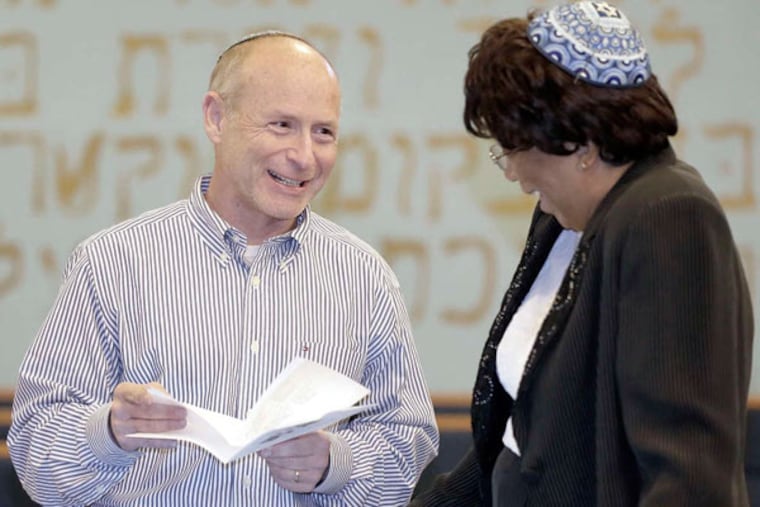
Rabbis Debra Bowen and Jon Cutler lead congregations that diverge from mainstream Judaism - in very different ways.
Cutler shepherds a small Warrington congregation that meets on alternate Fridays. His synagogue aims to be a place where being Jewish is not tied to a conventional menu of ritual and requirements.
Bowen's congregation is largely African American. It was founded by her mother and until recent years worshiped off the radar at a synagogue that was once a church building in West Oak Lane.
In what observers say is a sign of growing diversity in the American Jewish community, the two will join forces Sunday afternoon for a special event.
The rabbis - friends for 15 years - will lend their unconventional voices to a joint concert that marks not only the birthday of the Rev. Dr. Martin Luther King Jr., but the 50th anniversary of the civil rights marches from Selma to Montgomery.
The last in that series of 1965 protests led by King involved a group of clergy including Rabbi Abraham Joshua Heschel, the prominent Jewish theologian and philosopher.
Heschel marched arm-in-arm with diplomat and Nobel Peace Prize winner Ralph Bunche and the Rev. Fred Shuttlesworth, both African American activists, across the infamous Edmund Pettus Bridge, which had earlier been the site of the violent "Bloody Sunday" confrontation.
"Our theme is the unity of African American and white Jews walking across the bridge together - as one," Cutler said.
The collaboration underscores that the Jewish community is becoming more inclusive, said Rabbi Elisa Goldberg, copresident of the Board of Rabbis of Greater Philadelphia.
"It's clear that we are stronger when we celebrate all the different parts of who we are," Goldberg said.
About 20 percent of those affiliated with Judaism in the United States are of multiracial descent, said Diane Tobin, founder of Be'chol Lashon, a San Francisco-based group that advocates for inclusiveness and diversity in the Jewish community. Be'chol Lashon is Hebrew for in every tongue.
An estimated nine million Jews reside in the nation - a figure contingent on a definition of being Jewish that considers religion, genealogy, and affinity for the faith.
The number of nonwhites within that population may be even larger than 20 percent depending on how race is defined, said Lewis Gordon, founder of the Center for Afro-Jewish Studies and a professor at the University of Connecticut.
At a time when synagogue affiliation rates are plunging and intermarriage increasing, Cutler urges a big-tent view of the faith that welcomes congregations like Bowen's and aggressively reaches across racial and ethnic lines.
Cutler, whose congregation is called Darkaynu (Hebrew for our path), discovered Temple Beth El 15 years ago when his brother began attending the Philadelphia synagogue along Lowber Street. Cutler joined him for a service.
"It was lively, musical, and you really felt the spirit of Judaism," Cutler said.
The congregation was founded in 1950 by Bowen's mother, Louise Elizabeth Daily, the daughter of a Baptist minister who had worked as a housekeeper for a Jewish family.
Daily started a prayer group in her house, but soon began feeling an affinity for Judaism. She began studying with Rabbi Sidney Greenberg and gradually divested her growing group of its Christianity.
The congregation has its own kosher butcher, catering services, and mikvah (ritual bath).
Until recently, Temple Beth El practiced inconspicuously, a custom that did not require congregants to defend their "authenticity," Bowen said.
Bowen said the question they are often confronted with is "Are you really Jews?"
"Who am I to say they are not Jewish when they have cast their lot with the Jewish people?" said Cutler, a Navy reservist and military chaplain.
Eventually, Cutler, who teaches a class on diversity in Judaism at Gratz College in Melrose Park, began taking his students to Temple Beth El. Cutler's and Bowen's synagogues began holding joint programs.
In 2009, Temple Beth El received its first Torah from Israel. Two years later, Michael Oren, then-Israeli ambassador to the U.S., visited the synagogue during a ceremony that included hundreds of African American Jews from around the country including Rabbi Capers C. Funnye Jr., who is Michelle Obama's cousin.
Recently, Bowen joined the Board of Rabbis. She has visited the White House twice, and the synagogue's young people now participate in Birthright, an organization that offers free trips to Israel for Jewish youth.
These are signs of acceptance, Bowen said.
Other signs are evident in the larger community, a result of Jewish activism, Gordon said.
"Jews of all racial backgrounds are fed up with the segregation of Jewish people from each other," Gordon said. "That is not to say all is good," but things are changing, he said.
At the 1 p.m. concert Sunday, Cutler's Darkaynu and Bowen's Congregation Temple Beth El will sing songs that represent their differences and similarities.
Darkaynu's members will offer an eclectic contemporary mix, and Temple Beth El will go for heart-stirring soul.
Naomi L. Adler, chief executive of the Jewish Federation of Greater Philadelphia, calls the match appropriate in light of the holiday and a shared civil rights history.
At the end of the concert, the synagogues will close the gathering with a signature of the movement. They will sing "We Shall Overcome" - together.