Fears for early American Naval crew still buried in Libya
SOMERS POINT, N.J. - Their homecoming has been long awaited. Every time the remains of Navy Master Commandant Richard Somers and the crew of the USS Intrepid get the attention of leaders in Washington, world events intervene.
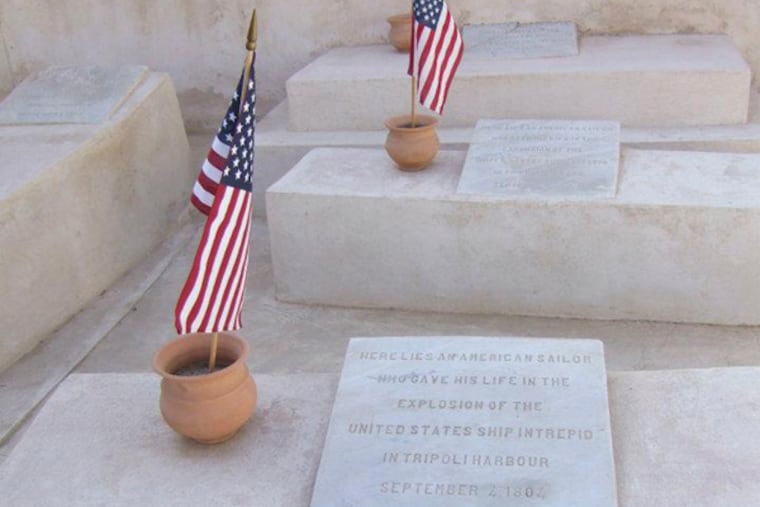
SOMERS POINT, N.J. - Their homecoming has been long awaited.
Every time the remains of Navy Master Commandant Richard Somers and the crew of the USS Intrepid get the attention of leaders in Washington, world events intervene.
More than 200 years ago, the seamen sailed their explosives-laden vessel into Libya's Tripoli harbor to strike a blow against a pirate fleet and died when the ship blew up.
They were the first identified Americans killed in combat to be buried abroad, and their return was strongly sought by the Somers family - to no avail.
The location and recovery of Somers, who was educated in Philadelphia, and his 12-man crew was eventually ordered by President Franklin Delano Roosevelt in 1938, then abandoned when World War II broke out.
Other missed opportunities - including a brief window after the death of ousted Libyan strongman Moammar Gadhafi in 2011 - followed.
Now, Somers' descendants, local officials, authors, and historians have stepped up efforts to bring the sailors home as the threat from Islamist extremists mounts.
Radicals killed U.S. Ambassador Christopher Stevens at Benghazi, Libya, on Sept. 11, 2012, desecrated the graves of dozens of British Commonwealth soldiers at Tobruk the same year, and have systematically tried to eliminate all Western influences in the war-torn country.
"We should always bring our sailors and soldiers home," said Michael Somers, 42, of Berlin, a paramedic who is a second cousin to Richard Somers seven times removed.
"We don't leave our dead overseas," he said. "We bring them home."
The unrest and chaos in Libya have made the effort all the more urgent, said John Barry Kelly, who is related to Richard Somers as well as to Commodore John Barry, the Revolutionary War naval hero.
The country has two rival governments backed by various militias battling each other, and terrorist groups - the Islamic State and Ansar al-Sharia - looking to capitalize on the confusion.
"I encourage the return [of Somers and the crew] because of the turbulence over there and uncertainty involving the vandalism of the graves," said Kelly, a maintenance division purchasing agent for the National Park Service who has worked at Independence National Historical Park in Philadelphia for more than 40 years. "We need to bring these heroes back here."
This month, a letter seeking help from Washington was sent to Defense Secretary-designate Ashton Carter, and last month, another went to Defense Secretary Chuck Hagel.
"Only you have the authority to order the emergency repatriation of the remains of these men," historian William E. Kelly Jr., 63, of Browns Mills, wrote Carter. "A repatriation ceremony on the deck of the [carrier] USS Intrepid in New York could show the world that we still fight tyranny for the same things these men died fighting for - liberty, justice, democracy, and the veneration of our honored dead."
The radical Islamists are "not a new enemy, as we have been fighting them for over two hundred years and should engage them in the same way as our forefathers did against the Barbary Pirates forefathers," wrote Kelly, author of a Somers Point history, Three Hundred Years at the Point.
Before Stevens' death, the ambassador tried to help bring the Intrepid crew home and once took part in Memorial Day ceremonies next to the graves of the sailors in the tiny walled Old Protestant Cemetery overlooking the Tripoli harbor, said Somers Point Mayor Jack Glasser.
"We really hope the government will get behind this and back us," said Glasser, who wrote a letter seeking help from the chief of U.S. Naval Operations. "As mayor of the city of Somers Point, where Richard Somers was born, it's really beyond me; we rely on the U.S. government.
"I can't believe we haven't done this," he said. "This is an American who died fighting for his country in its early stages of being.
"Military service members shouldn't be endangered trying to recover the remains," he said. "But when the situation stabilizes, we need to send people in."
Somers Point, named after the naval hero's great-grandfather, celebrates Richard Somers Day every September and has erected a memorial to him adjacent to City Hall and the Atlantic County Library.
If Somers is returned, he could be buried there, in Arlington National Cemetery, or at the Naval Academy in Annapolis, Md., Glasser said. "The Navy might consider these sailors lost at sea, but they are really in a foreign land," he said.
The remains of naval hero John Paul Jones were returned in 1905 - at the direction of President Theodore Roosevelt - from an unmarked crypt under a Paris street. Jones was buried at the Naval Academy chapel in Annapolis.
"If it's possible to find Richard Somers and the others and if the geopolitics allows, then probably they should be brought home," said Chris Dickon of Portsmouth, Va., author of The Foreign Burial of American War Dead. "I say that because the power of remembrance and people wanting to memorialize war dead is a powerful human thing."