Region is a link in monarch butterflies' survival trail
Their critical food source - native milkweed - isn't a weed but a native perennial plant. For the delicate and colorful monarch butterfly, the leaves offer food for its larvae and the bright flowers produce nectar for the adults.
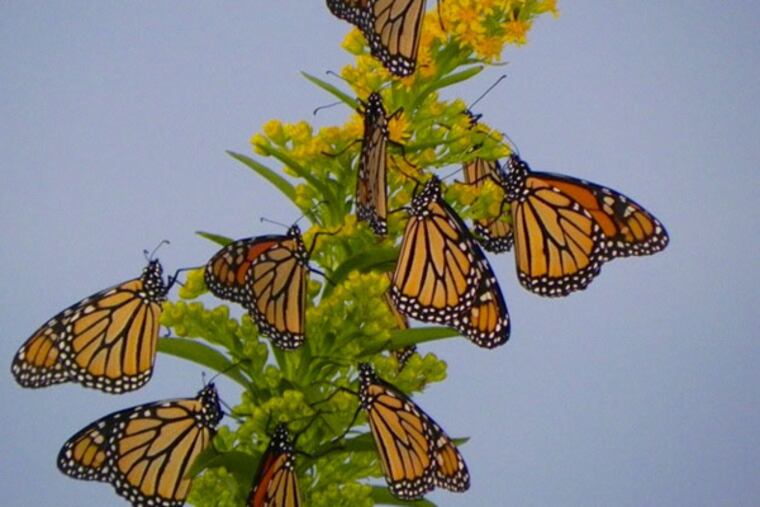
Their critical food source - native milkweed - isn't a weed but a native perennial plant.
For the delicate and colorful monarch butterfly, the leaves offer food for its larvae and the bright flowers produce nectar for the adults.
But milkweed has been nearly eradicated across large portions of the country, threatening the butterfly's annual 2,000-mile transcontinental migration from Canada to Mexico.
Monarch numbers have declined in New Jersey and Pennsylvania in recent years, and dropped by 90 percent over the last 20 years at their final destination.
To help restore the population, the U.S. Fish and Widlife Service has pledged $3.2 million - $2 million to restore 200,000 acres of habitat and $1.2 million for a monarch conservation fund.
By building and encouraging others to build milkweed and nectar plant waystations, federal and local wildlife officials hope to strengthen links of the migration chain, which, in turn, is expected to increase the number passing through New Jersey and Pennsylvania.
"We can save the monarch butterfly in North America, but only if we act quickly and together," said Dan Ashe, director of the Fish and Wildlife Service, said in a statement.
The agency has signed a cooperative agreement with the National Wildlife Federation to bolster conservation efforts, especially in the planting of habitats.
"Restoring monarch populations will require a true team effort including individuals, businesses, schools, communities, religious institutions, non-Proft organizations, and government agencies," said Collin O'Mara, president of the federation.
"If we all work together . . . we can ensure that every American child has a chance to experience amazing monarchs in their backyards," O'Mara said.
An affiliate of the National Wildlife Federation, New Jersey Audubon, has been pushing for the passage of three state bills intended to help monarchs better survive as well as additional measures to benefit other pollinator species.
One of the monarch bills would establish an "Adopt a Monarch Butterfly Waystation" to provide resources and coordination for planting milkweed on public lands and parks.
Another would establish a "Milkweed for Monarchs" program, focusing efforts on drainage basins that could provide ideal growth opportunities for milkweed, and a third measure would designate May as "Milkweed for Monarchs" month.
"The more milkweed, the more areas you have for monarchs to breed," said Dick Walton, director of the Monarch Monitoring Project, a program of New Jersey Audubon's Cape May Bird Observatory. "The breeding population determines how the whole population is going."
The migration flyway through the central part of the country has been affected by insecticides and fertilizers used in agriculture, while the eastern flyway along the Atlantic Coast has been more affected by development, Walton said.
"Butterfly population decline is an important indicator of ecosystem health," said New Jersey Assemblyman Timothy Eustace (D., Bergen and Passaic), sponsor of several bills focused on monarch butterflies.
"Drastic reductions in certain species of bee and bat populations have demonstrated there are unforeseen consequences to a single species decline, and this legislation lends a helping hand to monarchs," he said.
The food source is the key to monarch comeback. "By making milkweed more available on public lands, parks, roadsides, and in private yards and gardens, monarchs will have a better chance for long-term survival," said New Jersey Audubon conservation advocate Megan Tinsley. ". . . New Jersey is a key component of the monarch's Atlantic Coast migration.
"The monarch is historically a part of our landscape, and by raising awareness of their plight and making an effort to provide their critical food source, this species can remain a backyard and seaside treasure," she said.
But monarchs can "only travel as far as they can find a milkweed patch," said Miles Grant, a spokesman for the National Wildlife Federation.
"If you break one link in the chain, then the trip is too long between milkweed patches and the butterflies won't make it," he said. "They're not finding as much milkweed as they need."
Next month, the federation is launching a program called "Butterfly Heroes" where anyone, children or adults, can sign up to be a hero and receive a free package of native milkweed seeds. "People can actually save this species," Grant said.
Though there are "fewer islands of life - with food and protection - we can help re-create those islands," said Phil Wallis, executive director of Pennsylvania Audubon.
The $2 million announced by the Fish and Wildlife Service for habitat projects will help provide milkweed on more than 200,000 acres while also supporting 750 schoolyard habitat and pollinator gardens.
Much of those funds will focus on the I-35 corridor from Texas to Minnesota, the monarch's primary migration corridor.
The $1.2 million from the Fish and Wildlife Service has been directed to a new National Fish and Wildlife Foundation Monarch Conservation Fund and will be matched by private and public donors. It will provide the first dedicated source of funding for monarch conservation projects.
It will be "a key component of the effort to revitalize monarch butterfly populations and the important native plant species on which they depend," said Jeff Trandahl, executive director of the National Fish and Wildlife Foundation.