Montco coroner: 50 years of speaking for the dead
In his 50 years as a forensic pathologist, there are some cases that stick in Walter I. Hofman's mind. Like the time he was called to examine a seemingly lifeless body and noticed the man's finger moving.
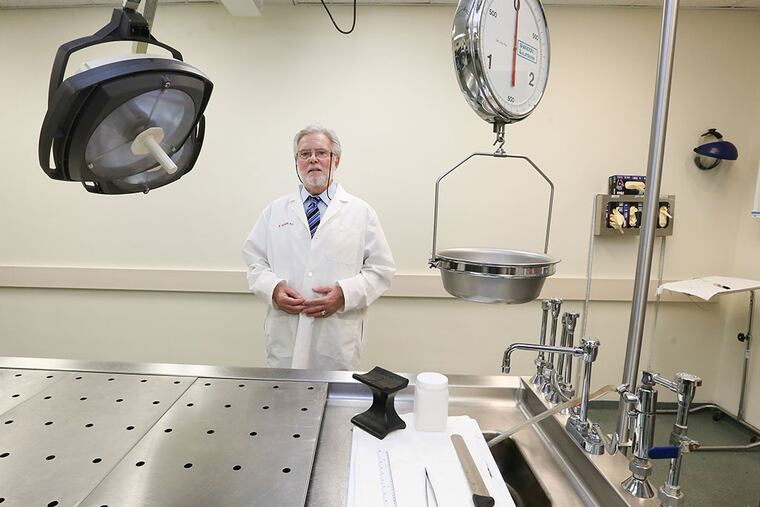
In his 50 years as a forensic pathologist, there are some cases that stick in Walter I. Hofman's mind. Like the time he was called to examine a seemingly lifeless body and noticed the man's finger moving.
"He lived another four, five, six days in the hospital," Hofman recalled last week. "But it goes to show you, simply because someone's lying there and there are maggots on them," it doesn't mean they're dead.
Hofman's tenure as Montgomery County coroner will end this year; he announced last week that he would not seek a third four-year term. At 78, he will continue his pathology work as a consultant, spend more time on the lecture circuit, maybe even write a book.
He certainly has enough interesting stories to tell. From Baltimore to Philadelphia, from New Jersey to Montgomery County, Hofman has investigated some of the region's most gruesome, puzzling, and high-profile deaths.
In April, it was a chainsaw murder-suicide in Lower Moreland; in December, a predawn shooting rampage by a former Marine who killed his ex-wife and five of her relatives.
In 2012, Hofman halted the rumor mill by ruling that Cardinal Anthony J. Bevilacqua had died of natural causes the night after a judge declared the archbishop could be called to testify about the church's handling of clergy sex-abuse allegations.
The coroner has seen firsthand "the dregs of society," and refuted murder charges against parents whose toddler appeared to have starved to death. (It turned out she had a rare disorder that prevented her body from absorbing nutrients.)
At times, Hofman has clashed with law enforcement and other medical examiners. In 2011, he reopened the 20-year-old autopsy file of a 5-month-old baby. Using the original examiner's notes, Hofman came to the opposite conclusion: It could not have been an accident. A year later, the baby's former nanny got 10 to 20 years for third-degree murder.
That case, Hofman said, vividly illustrates that autopsies are not an exact science, despite what popular TV crime dramas may portray.
"A death certificate is nothing more than a medical opinion," he said. "It's not written in stone."
When Hofman took office in 2008, he said, he examined every cause of death from the previous year, and "changed 50 of them. And I was being very generous."
Given the gravity of the coroner's duty - determining why, when, and how a person died - and the room for error, Hofman has advocated to change Pennsylvania's system of electing coroners.
In New Jersey, Philadelphia, and Allegheny and Delaware Counties, medical examiners' offices are run more like public health departments - not row offices won at the polls. In Pennsylvania's other 64 counties, any registered voter can run for coroner.
Hofman is the only elected coroner in the state who is certified to conduct autopsies himself. He said he would prefer to see the position removed from politics and be subject to certification requirements.
"It's unfortunate. You can't run as an independent, you have to be affiliated with a party," Hofman said. But after all these years, he said, the system will change "only if turkeys can fly."
Must be independent
Since Hofman dropped his campaign last week, Democrats have been interviewing candidates to run in his place.
Phil Mandato, a Republican anesthesiologist running for the seat, said he had not given much thought to whether the position should be removed from politics.
Mandato got in the race, he said, after hearing that there was room for improvement "running the office effectively and efficiently." He said he would focus on finalizing death certificates faster, collaborating with law enforcement, and addressing the epidemic of heroin and other drugs in the commonwealth.
Hofman said he has had a good working relationship with law enforcement and is a member of the county's drug-overdose task force.
But when it comes to lab work, Hofman said, medical examiners must be independent. If that means keeping a prosecutor waiting for answers or a family refusing to accept his ruling of a suicide, so be it.
Ultimately, he said, "I speak for the dead."
Most county coroners have a background in medicine, law enforcement, or the funeral industry, and take on the coroner position as a part-time administrative job. In Montgomery County, it pays $79,160 a year.
In the early years, Hofman said, he personally handled about 20 percent of the county's autopsies, but his share has dropped significantly in recent years.
Hofman, of Lower Merion, said he enjoyed the investigative nature of pathology, even though it wasn't his intent when he went to medical school in the early 1960s in Basel, Switzerland.
"I had no interest in surgery. Boring. I had no interest in internal medicine. 'Harry, did you take your pills?' 'No.' 'Why not?' They don't taste good.' 'Harry! You're worse off today than when you came in!' "
"I went to medical school to become an obstetrician. I learned how to deliver using the best forceps God created," he said, holding up his hands. "I discovered handling the babies is delightful. But you also have to take care of the crazy parents."
It was during his residency in Boston that Hofman saw an autopsy being performed, and decided to make his career on the opposite end of the life cycle.
"It is a morbid business," he conceded. "Was there a reason this particular person [died] at this particular time? This is the kind of information that is important for researchers, epidemiologists, and, most importantly, for next of kin."
In the middle
At times, those interests can be in competition - and coroners may find themselves in the middle.
A bill in Harrisburg last year that would have cleared the way for more organ donation generated a backlash from the state coroners' association. Some elected coroners argued that releasing donors' organs would interfere with their work.
Hofman rejected that, saying he has been working with donor agencies for 40 years.
"We have people waiting five years, 10 years, for organs. And most of the ones that come through the office could be salvaged," he said. "It requires a lot of cooperation from multiple agencies. . . . But today, with rare exception, you can release almost everything."
State Rep. Pamela A. DeLissio (D., Phila.) said that bill drew a huge amount of heat in the House and became, for her and others, an education in how coroners usually work in Pennsylvania.
"I said, 'What the hay is a difference between a coroner and a medical examiner?' Well, the difference is a medical examiner is certified, and a coroner - you could be one, I could be one," she said. "Part of me was just appalled that this position even exists."
Changing the elected-coroner system doesn't appear to be on the legislative radar, and even if there were an effort to tighten the qualifications, there aren't enough board-certified forensic pathologists to go around.
"There are less than 1,000 of us across the country," Hofman said. "There aren't enough of us. And most of us are getting older."
610-313-8117@JS_Parks
MontcoMemo