3 synagogues, 2 traditions, 1 school
Joining a nascent national movement, three synagogues are joining forces in Elkins Park to tear down walls separating students - and religious traditions.
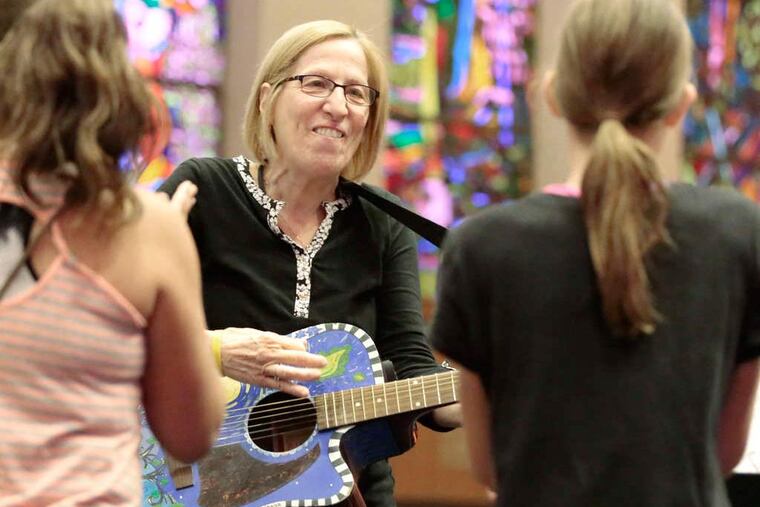
Joining a nascent national movement, three synagogues are joining forces in Elkins Park to tear down walls separating students - and religious traditions.
Two Conservative synagogues and one congregation from the liberal Reform tradition have formed one religious school on Old York Road, becoming among the first in the country to take such a step.
It is a move that challenges the synagogues to compromise while still preserving tradition, all in an effort to adapt to an evolving Jewish community whose connection to matters of faith often differs vastly from that of previous generations.
Called JQuest B'Yachad (which stands for Jewish Quest Together), the initiative, which started last month, has merged pre-K through sixth-grade programs at Congregation Adath Jeshurun, Beth Sholom Congregation - two conservative synagogues - and Reform Congregation Keneseth Israel.
The synagogues - less than a mile apart - bring together 420 years of history and tradition, 34 school staffers, and 215 children.
"This is a collaboration to expand because we thought we could be better together and attract families looking for something different," said Rabbi Stacy Eskovitz Rigler, director of the new joint education program.
The schools offer part-time, supplemental Jewish education for students who attend public and private secular schools.
Similar mergers have occurred in only a few Jewish communities, including in Pittsburgh and Columbus, Ohio.
Demographics often are a part of the motivation, said Rabbi Philip Warmflash, executive director of Jewish Learning Venture in Elkins Park, which develops education and community-engagement programs. Warmflash helped the three synagogues plan the merger.
Enrollment at the three individual schools had been relatively flat, Warmflash said. Synagogues and churches have long been struggling with declining membership.
"Everyone is trying to figure out how to respond," said Rabbi Erin Hirsh, who supervises a professional development program in Jewish education at Gratz College in Melrose Park. Hirsh's 9-year old daughter is a student in the new joint program.
But Rigler, along with Rabbi Rachel Kobrin of Adath Jeshurun and Rabbi Andrea Merow of Beth Sholom, maintains that the merger is not a "red flag" response to a dire set of circumstances.
The Old York Road corridor is in a diverse neighborhood with a large Jewish population that has eroded over the years, but Kobrin says she is seeing a rebirth, with new families moving in, bringing new excitement.
The school is part of that, the rabbis say.
The twice-a-week classes are using a project-based learning approach to Jewish education, which replaces the traditional lecture method used in most schools.
"We all had a model that hadn't changed in 50 years - a teacher standing in front of a class," Merow said.
It is a model that might have alienated some parents, who may have wondered why they should subject their children to something they themselves didn't enjoy, Hirsh said.
Jenn Cheifetz, an Abington event planner who has two children in JQuest B'Yachad, says she "never loved" her days at Hebrew school.
"We went because we had to," Cheifetz said.
Youngsters at JQuest B'Yachad learn about a Jewish concept through participation in student-driven projects in subjects such as music, yoga, art, and cooking.
They might create an art installation for a museum exercise, or write a poem that turns into a play.
Organizers also are navigating a merger while still aiming to preserve identity and tradition. Students from both traditions spend most of their time learning together - but sometimes they separate.
Conservative and Reform synagogues have different tracks for teaching learning Hebrew, with JQuest B'Yachad's Conservative students staying in class longer. Four weekends during the year, the school won't meet jointly, but return to their respect synagogues for programming.
Other synagogues in the region are watching. Several are considering a merger, Warmflash said, but he declined to identify the congregations.
At JQuest B'Yachad, about 50 percent of the school's students belong to Keneseth Israel (950 families); and about 25 percent each to Beth Sholom (725 families) and Adath Jeshurun (550 families).
Tuesday classes are held at Keneseth Israel; Sunday sessions at all three synagogues on a rotating basis.
Tuition varies depending on the synagogue, and financial assistance is available. The school's annual $389,000 budget is divided among the synagogues, with each paying a percentage based on its share of student enrollment.
On Tuesday, Keneseth Israel was abuzz with students finding their way to their elective classes, where each would apply the theme of Simchat Torah, a holiday that celebrates the cycle of reading the Torah.
But later, at separate services, the Reform students helped change Torah covers because their observance of the holiday ended Monday. The Conservative students observed the day by unrolling the Torah because their observance of the holiday didn't end until Tuesday.
At the end of the school day, Cheifetz says, her daughters come home excited about what they've learned and created.
"That speaks volumes," Cheifetz said about a school that she says aims to "create a really holistic view of what it means to be Jewish, and to live a Jewish life."
610-313-8211