In Society Hill, a Revolutionary War minister emerges from a stump
On a blood-soaked battlefield in colonial New Jersey, a lone preacher stood tall, attempting to bring solace to his embattled compatriots.
On a blood-soaked battlefield in colonial New Jersey, a lone preacher stood tall, attempting to bring solace to his embattled compatriots.
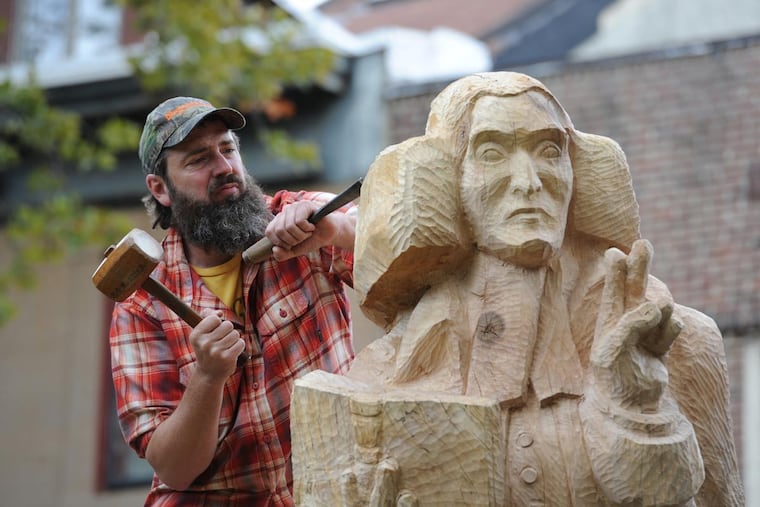
This is the pose that master sculptor Roger Wing chose for a monument at Old Pine Street Church to honor the Rev. George Duffield, a Revolutionary War preacher, co-chaplain to the Continental Congress, minister to the Pennsylvania militia, and editor of the first American Bible.
Duffield led the institution at Fourth and Pine Streets that was known as the Church of the Patriots, thanks to his fiery sermons preaching no taxation without representation.
"Patriot seems to be the only word to describe him," said Wing, 47, a Powelton Village resident, who has been carving wood for almost 30 years.
Wing is fashioning an eight-foot-tall likeness of Duffield from the stump of a Norway maple planted nearly a century ago in the church yard. In one hand Duffield carries a Bible in this representation, while the other hand is outstretched, as if in blessing.
Carving is a subtractive process, Wing said. "Everything gets taken away, nothing gets put back. It's a constant quest for the form. You always have to move forward, there is no backtracking."
Wing began with a scale model and then transferred the proportions to the maple, first using a chain saw to remove large blocks, and then using smaller and more delicate tools as the work began to take shape.
"I always look at the work with the wood as collaboration," he said. "I am trying to exert my will and create the form that I imagined, but the tree is always pushing back."
That push and pull has taken Wing and his wood about six weeks to become complete. The church is planning an event for the near future to introduce the sculpture to the public.
While Duffield served alongside Bishop William White as co-chaplain to the Continental Congress, he is not as well known today as White. Church historian Ron Shafer explained:
"Duffield wrote very little during his lifetime. He was a gifted speaker, and therefore, when he would speak, he would put down key words, and was learned enough that he could go from one to the other to make a powerful sermon."
He was notorious enough in his time that King George III placed a 50-pound bounty on his head - dead or alive.
Duffield and White were also heavily involved in the editing of the Aitken Bible of 1782, the first American Bible, whose printing was authorized by the Continental Congress after British goods were banned during the war.
Though Duffield is buried within the church rather than in the churchyard, his likeness in battlefield pose is fitting. On those grounds are interred 285 veterans of the Revolutionary War, men who likely heard Duffield's fiery battlefield sermons in person.
While Wing focuses on wood, his repertoire includes works made from marble and ice as well.
Wing said he was honored to be working in Philadelphia, with its storied history of wood carving, beginning with the sculptor William Rush.
"He began by carving ship's figureheads and ended up carving the early statesman of this country, our founding fathers, in wood and painted to look like marble," Wing said. "I feel like I am kind of going in reverse - I am carving our founding fathers in wood, and maybe I'll end up carving ship's figureheads."