On taxes, 'a perfect storm' in Gloucester Township
As the Democratic National Convention got underway amid pledges to "help working families," members of actual working families were assailing the all-Democratic Gloucester Township Council for authorizing a nearly 12-cent hike in the municipal tax rate.
As the Democratic National Convention got underway amid pledges to "help working families," members of actual working families were assailing the all-Democratic Gloucester Township Council for authorizing a nearly 12-cent hike in the municipal tax rate.
"I don't know how long we can stay here. We're not going to be able to afford it," Jessica Marchese, a 28-year-old teacher who is married to a police officer, told council members Monday.
"My pay is not increasing," Marchese, a resident of the Broadmoor section, added. "Taxes are going up and property values are going down."
During nearly three hours of frequently heated, sometimes hostile, and occasionally heartbreaking public comments, the 200-plus people in the audience showed little patience with the explanations emanating from the council dais.
The council approved the tax increase on April 25, at a meeting attended by a handful of people.
The new bills also reflect higher rates set by the county and the township and regional school districts - "a perfect storm," one township official said.
Township residents recently received notices advising them of the dramatically higher quarterly tax payment due Aug. 1.
"I could lose my house," Lynn Surman, 70, said, her voice breaking as she addressed her elected representatives Monday for the first time in her life.
The retired merchandiser later told me the annual tax bill for her modest ranch home in the Blenheim section - "I moved in right after the Phillies won the pennant in 1980" - will go up about $750, to more than $6,000.
Audience members like Surman didn't want to hear about taxpayer-funded improvements in policing, parks, pothole patching, and other programs, or a $650,000 annual savings from shared services with other towns.
"I work two jobs, and I haven't gotten a raise in seven years," longtime Glendora resident Frank Albano, who faces an $800 annual increase, told the council.
The fact that the municipal tax rate did not increase in three of the last seven years - and actually fell by one cent in 2015 - was of little interest to folks in the audience.
They were not mollified to hear that the township accounts for only 27 percent of their total annual property-tax bill. The other taxing entities account for the remainder, and collectively represent another 15-cent increase.
"It's like a perfect storm, because everybody went up," township business administrator Tom Cardis told me.
"It's painful," he added. "I live in town, too."
Many of the residents who addressed the council described Gloucester Township as declining, with abandoned properties and "heroin houses" all over the place. Several said they hoped to move out as soon as possible.
The council "is disrespecting working people. They treat our money as if it were their own," said Ray Polidoro, chairman of the Republican organization in the township, where no one from the party has been elected to council in five years.
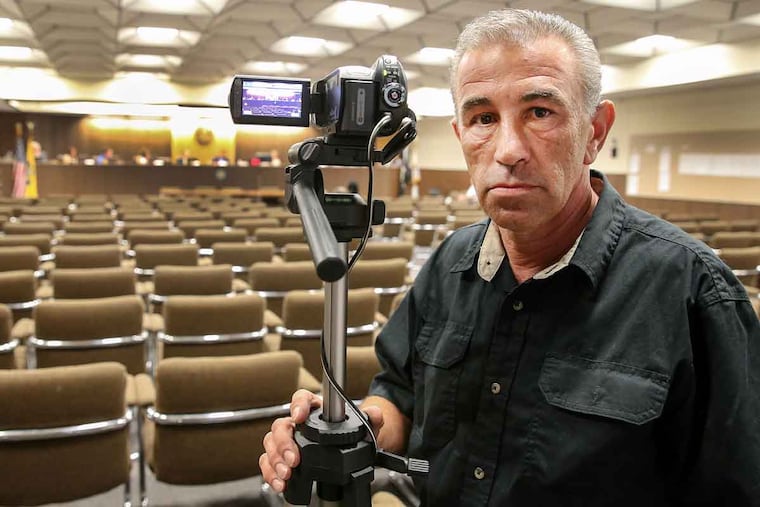
The current council's approach "is an ideology of taxing and spending," said Polidoro, who regularly attends council sessions, and records and uploads the proceedings (gloucestertownshipnews.com).
"Not only do they buy things they can't afford, they borrow money to do it."
Others in the audience wondered why the township can't seem to live within its means, like they must do.
"When my husband and I don't get an increase in pay, we have to tighten our belts," Sandy Brooks, a Glen Oaks resident for 17 years, told the council.
"I don't understand why the government keeps doing all these things to make it a wonderful township even though they don't have the money," the 56-year-old floral designer said.
With the tax increase, "even if I get more hours at work," Brooks told me, "I feel like I'm giving it to the township."
While most of the speakers at the meeting were respectful, a small number heaped abuse on Orlando Mercado, the resolutely composed (if sometimes inaudible) council president.
And one fellow's suggestion that the council would need a Plexiglas barrier to protect itself from those "who want to deal with you in a different way" was, to say the least, unhelpful to the cause of tax relief.
Mayor David Mayer, who was not present at Monday's council meeting, defended his administration's decisions in a recent interview.
He said initiatives such as buying an armored vehicle for the police department, providing turf fields at recreational facilities, and assigning public works employees to pick up litter are investments in the community's quality of life.
That's a worthy goal. And Democrats in Gloucester Township, like their counterparts at the Wells Fargo Center this week, certainly do like to spend money on quality-of-life improvements.
But if residents are hurting, angry, and vowing to move away, how about considering less expensive ways to improve the quality of life in Gloucester Township?
Like allowing taxpayers to keep more of their money.
"I guarantee you there are places [in the budget] to look," said Pete Heinbaugh, a retired accountant who ran for the council in 2015 on the GOP ticket.
"Not enough questions are being asked."
And those 200-plus taxpayers in council chambers Monday evening deserve answers.
856-779-3845@inqkriordan