Scientists watch as chimps make tools and go hunting
Chimpanzees in West Africa made wooden tools resembling spears and used them to hunt other primates, the first time such behavior has been observed in a species other than man, scientists reported.
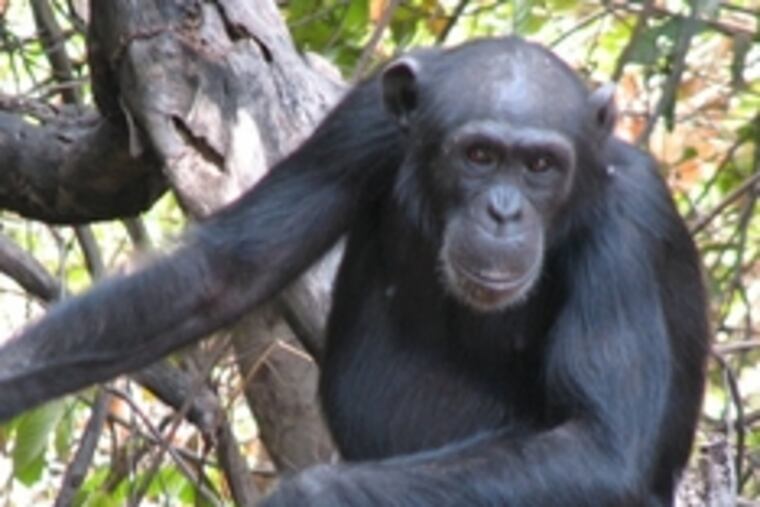
Chimpanzees in West Africa made wooden tools resembling spears and used them to hunt other primates, the first time such behavior has been observed in a species other than man, scientists reported.
Ten chimpanzees in Fongoli, Senegal, were observed using the spears in an attempt to kill or disable smaller species in hollows in trees. A total of 22 attempted hunts were seen, and 26 different tools were made, according to the study published Thursday in the online edition of Current Biology.
Just one hunt was successful, and the prey was eaten quickly.
"It's not uncommon to have chimps use tools. But to use them in the context of hunting" is nearly unheard of, said Jill Pruetz, an Iowa State University anthropology professor who led the research team.
In their paper, Pruetz and Paco Bertolani of the University of Cambridge wrote that "tool construction entailed up to five steps, including trimming the tool tip to a point." The tools were used "in the manner of a spear, rather than a probe or rousing tool."
The main targets of the hunts were small, tree-dwelling primates called bushbabies.
Chimpanzees have been observed in the past using a range of tools to extract insects from nests and to open up nuts. Only one other instance has been recorded of a chimp using a tool to hunt mammals: a Tanzanian female that employed a branch to get a squirrel.
The scientists said their discovery would help shed light on tool development by humans.
"The multiple steps taken by Fongoli chimpanzees in making tools," they wrote, "involve the kind of foresight and intellectual complexity that most likely typified early human relatives."
The 10 chimps observed using tools to hunt were split evenly between males and females. One of each was an adult; the rest were adolescents, juveniles and infants, apparently exploiting a niche ignored by stronger, higher-ranking adult males.
All used the same technique: jabbing their spears down several times into tree cavities, sometimes using more than one tool.
The single observed kill was made by an adolescent female. Only after immobilizing her prey did she break off the hollow branch in which the bushbaby was sheltering - probably, the scientists said, because the lemur-like primates move rapidly and opening the nest earlier could have allowed an escape.
The hunter consumed her prey without sharing it with other chimpanzees.
David DeGusta, an assistant professor of anthropological sciences at Stanford University, lauded Pruetz's work because of the rarity of studying chimpanzees outside Gombe, where renowned researcher Jane Goodall did her work. He said it is hard to get animals accustomed to human presence and willing to carry on naturally.
"The more populations that are studied, the more we learn about how their behavior can vary," DeGusta said.
Pruetz's Iowa State graduate students are continuing to observe other emerging patterns among chimpanzees in Senegal.
"In a million years I never would've predicted that I would've seen [hunting]," Pruetz said. "I'm going to plug along and see what unfolds."