Oversize - and hungry - squid invade West Coast
ABOARD THE NEW DEL MAR - A long night scouring a deep, dark ocean is proving uneventful - until the luminous red dots begin drifting across the sonar screen.
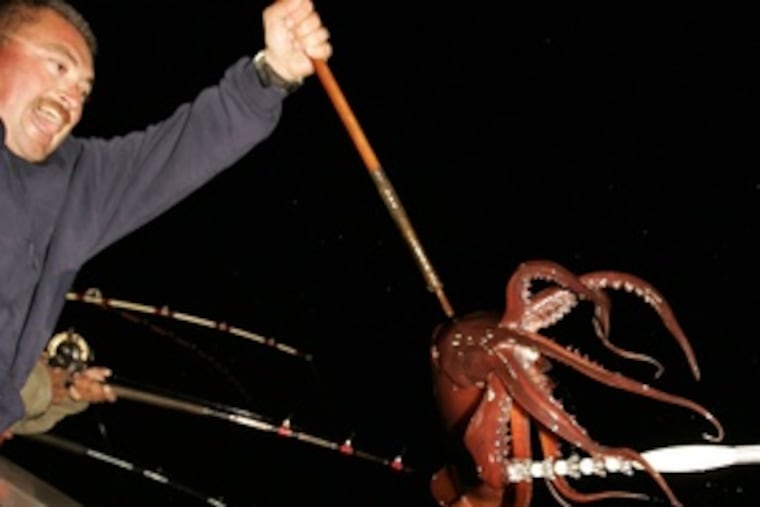
ABOARD THE NEW DEL MAR - A long night scouring a deep, dark ocean is proving uneventful - until the luminous red dots begin drifting across the sonar screen.
Banter in the wheelhouse suddenly stops, and grubby fingers point to the dots clustered along the bottom, as if trying to locate the enemy.
On deck, a fisherman lurches forward as his rod dips seaward. Another fisherman is jerked against the rail, then another.
"What else can it be?" says Ricky Carbajal, captain of the vessel New Del Mar, which is pitching in a brisk wind, five miles beyond California's Palos Verdes Peninsula.
It can only be the same bizarre denizen that has been turning up in large numbers throughout Southern California waters: Dosidicus gigas, a.k.a. Humboldt, or jumbo, squid.
It is a colossal cephalopod that reaches 7 feet long, can weigh more than 100 pounds, and jets through the water at speeds reaching 25 m.p.h.
It has probing arms and tooth-lined tentacles, a raptor-like beak, and an insatiable craving for flesh - any kind of flesh, even that of humans.
It shows up briefly off California every four or five years, spurred by a warm current or some other anomaly, providing a boon for sport-fishing businesses.
But amid this latest influx, to points as far north as Bodega Bay, there is a deepening concern among scientists that Humboldt squid are entrenching themselves off California, and may expand northward, eating their way through fisheries as they go. The same thing is happening in the Southern Hemisphere, where squid are being blamed for depleting the hake fishery off Chile.
The first verified capture off Alaska occurred three years ago. A year later, mass strandings made news in British Columbia, where wolves on outer island beaches were seen gnawing on rubbery squid carcasses.
Strandings and the subsequent deaths of squid, such as those along Orange County, Calif., beaches in March 2005, have historically preceded infestations of local waters. In other words, these peculiar beings, which have a lifespan of less than two years, seem on their way to establishing residence along the length of the eastern Pacific.
The reasons for the phenomenon have not been pinned down, although gradual ocean warming, pollution, and overfishing of large predators are suspected factors.
Nor is it known what the ramifications might be. But there is already proof that the squid are ingesting small rockfish, anchovies, sardines, and much smaller market squid, which is the type prized as calamari.
In fact, very little is known about Humboldt squid, because they spend most of their lives at depths of 650 to 3,000 feet.
But when they rise, they can provide some big surprises.
Four divers found that out when they tried to document the squids' behavior in the Sea of Cortez 17 years ago. While a nondiving passenger battled to land a 14-foot thresher shark on rod-and-reel, Alex Kerstitch of Arizona and three friends submerged in the nighttime sea, carrying cameras.
The divers settled near the dim fringes of the boat's lights. They could see the weary shark being pulled toward the boat. Below, dozens of squid began flashing iridescently, red-white-red.
The flashing is carried out via millions of chromatophores within the skin, opened to reveal red, closed to reveal white; it is believed by some scientists to be a means of communication.
A 5-foot squid flung itself onto the shark and tore an orange-sized chunk from its head. Another squid zoomed forth, tentacles clasped before its beak, and snatched a long needlefish, leaving in its wake a trail of blood and scales.
The frenzy built, and Kerstitch, as the lone diver shooting still photographs, with no bright movie lights to deter the predators, was set upon.
A squid grabbed his right swim fin and pulled downward. He kicked it away but another grabbed his head. The cactus-like tentacles found his neck, the only part of his body not covered with neoprene.
He bashed the squid with his dive light, far less bright than the movie lights, and it let go, but it swiped both the light and the gold chain he'd been wearing.
Another squid wrapped its tentacles around his face and chest. Kerstitch dug his fingers into its clammy body.
It slid down and around his waist and pulled him downward in pulsing bursts. Then it suddenly let go, but made off with his compression meter.
For whatever reason, the attack ceased, and Kerstitch got to the surface dazed and oozing blood from neck wounds, thankful to be alive.
The incident became legendary among divers, the first of many painful but, so far, nonfatal encounters by divers with Humboldt squid.
Nobody has estimated the number of squid currently off Southern California, but given that they have shown up in great abundance simultaneously off San Diego, Orange County, Catalina Island and Palos Verdes, it could easily be in the millions.