Hunting sunken ship off Fla.
The expedition's catalyst was a retired sailor's story of viewing some cannons underwater.
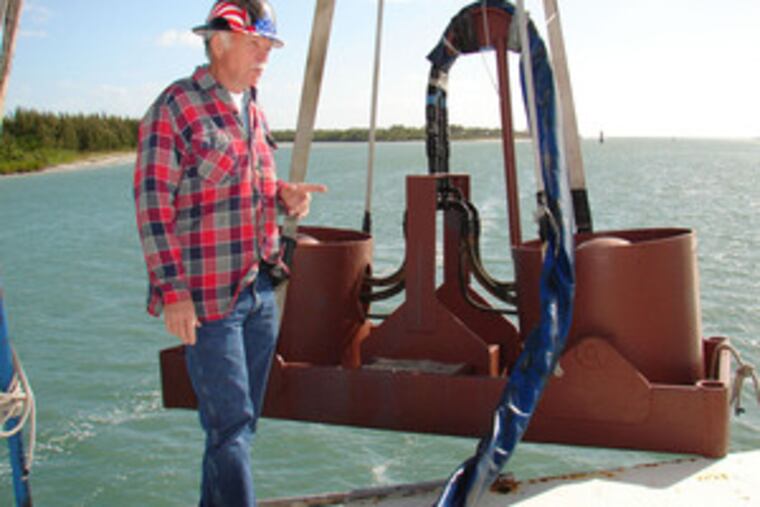
HUTCHINSON ISLAND, Fla. - The boat is rumbling, and the coffee is hot and sweet.
It's the only way to hunt for treasure - or so says Doug Pope.
Pope has spent the last few weeks on a 71-foot treasure-recovery boat called the Polly-L. He is hoping to find a Spanish galleon that may have wrecked off the coast of Hutchinson Island in 1715.
"This could be the real deal," Pope says, clutching the 17th-century Spanish coin he wears around his neck. "The research says a shipwreck should be there."
The research wasn't what first lured Pope to the site. Instead, it was a seemingly outlandish tale told by Dave Jordan, a retired sailor claiming to have discovered cannons in the water as a child.
The history checked out, and so Pope, a seasoned treasure hunter, checked in. He met up with Jordan, and the two got started.
Their dreams evoke those of famed treasure hunter Mel Fisher, who famously struck it rich when he discovered the wreckage of the Spanish galleon La Senora de Atocha off the Florida Keys.
Jordan's story starts in October 1978. He was 15 and a novice surfer.
One day after school, a friend invited Jordan to Tiger Shores Beach to catch a few waves. At first, Jordan hesitated; a Nor'easter had passed through the night before, and the water was choppy and cold.
"But for some reason," Jordan recalled, "I put on a wet suit, and went along anyway."
While he was surfing, a huge wave sent him crashing beneath the surface. There, in 15 feet of water, the storm had cleared out much of the sand, revealing a row of thick, black tubes.
"I swam down and grabbed on to one," he said. "I thought to myself, 'Man, these are cannons.' "
Jordan swears he kept his discovery a secret.
Move ahead to 2003.
Jordan was living in North Carolina and about to end a long career in the Navy. To celebrate his retirement, Jordan's wife suggested they put a flagpole outside their home.
Jordan said he would prefer a cannon. Then, he told her why.
Later that week, Jordan and his wife decided to try to salvage the cannons from Tiger Shores Beach. They sent out inquiries to several wreckage companies, many of which expressed interest.
The reason: A fleet of Spanish treasure ships stationed off the coast of Florida had been destroyed by a hurricane in 1715. Some had been found, and produced millions of dollars for the salvors. Several others remained untouched.
The area was so rich with treasure, it had been nicknamed the Treasure Coast.
"There's no doubt that one of the ships, the Urca de Lima, was lost in that area in the great hurricane of 1715," said Eugene Lyons, an expert in Spanish colonial history from the Treasure Coast.
Jordan contacted Pope, the chief executive officer of Amelia Research & Recovery. Pope's company had made national headlines in 2002 when one of its divers found a 40.2-carat emerald inside a queen conch shell off the Florida Keys.
It took more than two years to secure the necessary permits to dig, Pope said. First, he and his team needed permission to survey the area with a magnetometer, a device used to find ferrous metals buried deep underneath the sand. After they found abnormal magnetic fields in the area - a good sign, according to Pope - they needed explicit permission to begin excavation.
Pope and his crew finally got the official go-ahead to dig early last month. They traveled to the site aboard the Polly-L, Pope's four-story lift boat used for coastal shipwreck salvage, and set up shop in a small inlet.
The $2.3 million boat can stay at sea for several weeks, and can withstand a Category 2 hurricane, Pope said.
So far, Amelia Research has spent about $50,000 on this project. It has made only one significant find: a fragment of pottery believed to be from the 19th century.
If divers do find any treasure, they will have to petition the state for another permit, this one allowing them to pull up wreckage. By law, they would have to give 20 percent of the findings to Florida.
On a recent morning, Pope and two of his divers gathered in the Polly-L's galley for sausage biscuits and coffee. They stared out at the surf, doubtful they would be able to dive that day.
"This job can be frustrating sometimes," Pope said. "But if it isn't the greatest adventure in the world, I don't know what is."
See maps and more
on Florida shipwreck
sites from the National Park Service via http://go.philly.com/shipwrecks EndText