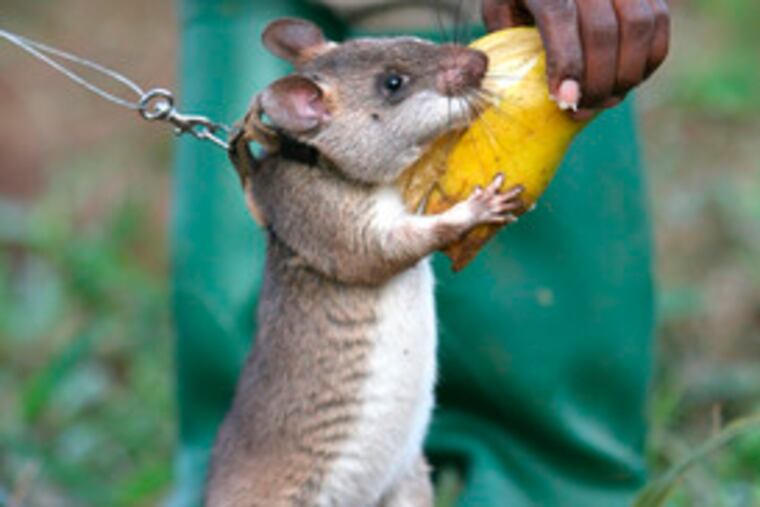
MOROGORO, Tanzania - The workday is in full swing for a giant African rat named Henrietta.
Her pink nose twitches as she snuffles through damp grass at the end of a leash. Metal tea infusers filled with explosive chemicals are buried in the ground. It's Henrietta's job to sniff them out.
A novice, she misses the first mock land mine. But the four-pound female catches a whiff of the next one and begins to scratch madly at the red soil.
Her trainer signals approval by snapping a metal clicker. Henrietta trots over to collect her reward: a bite of banana.
"They're very keen to work, as long as they get food," said Bart Weetjens, a former industrial designer from Belgium. It was his idea to enlist one of mankind's most ancient pests in solving some of the modern world's more vexing problems.
Henrietta and the dozens of other whiskered students scouring this field in eastern Africa are being trained to detect land mines.
In a nearby lab built with World Bank money, other rats are learning to diagnose tuberculosis by sniffing sputum samples.
Both tasks capitalize on the animals' keen sense of smell and zest for food.
"The training is very simple," said Weetjens, 41. "We associate a food reward with a target scent."
More difficult is getting people to take his rat pack seriously.
"When I first suggested it," he said, "everyone laughed at me."
That was shortly after Weetjens came to Africa, disillusioned with designing ski boots and seeking more meaningful work. He decided to delve into the land-mine problem.
He visited minefields and saw German shepherds sniffing for buried explosives. The dogs are effective, but expensive and vulnerable to tropical disease. Occasionally, one will trigger a mine.
A lightbulb went on in Weetjens' head. When he was a child, his room was crammed with cages of mice, rats and guinea pigs.
"I thought: 'Why not rats?' " he said, snapping his fingers.
But not just any rat.
Working with a rodent biologist, Weetjens settled on Cricetomys gambianus. Also known as the Gambian or African giant pouched rat, it can reach the size of a small cat.
The species is native to much of Africa and resistant to local diseases. Its life span of six to eight years provides a good return on training time. And with a top weight of six pounds, the animals are too light to set off land mines.
Minefields are customarily cleared by a person with a metal detector.
"You've got to go really slow, and every time you hit a bottle cap or nail, you have to stop and probe," said Dennis Barlow, director of the Mine Action Information Center at James Madison University in Virginia.
Once a mine is located, it's detonated with a small explosive charge. At current rates, it would take a century or more to clear the tens of millions of land mines that litter former conflict zones. By one estimate, 50 people a day are killed or maimed by land mines. Valuable land goes unused.
Bees, wasps and even roaches have been trained to detect explosives, Barlow pointed out.
"These types of technology are proving helpful, and the rats show the same kind of promise," he said.
But rats have their shortcomings, Weetjens acknowledged.
They obsessively groom themselves when wet or muddy. On Mondays, after being allowed to feast all weekend on "free" food, their motivation to work for a bite of banana plummets.
Weetjens estimates the rats are 70 to 80 percent effective at sniffing out mines. When multiple rats work the same area, they're nearly perfect.
Twenty-three rat graduates recently aced international certification tests and are working in Mozambique, where explosive legacies of a 17-year civil war mar the countryside. So far, they've cleared about 100 acres, and the program is preparing to expand into Sudan and Angola.