1987 flight helped end the U.S.S.R.
Mathias Rust buzzed into Moscow - and gave Gorbachev an excuse to sack hard-liners.
MOSCOW - The single-engine Cessna aircraft, flying just 10 yards off the ground, buzzed Red Square three times as the pilot looked for a place to land.
But too many people were on the square that May evening. So the plane pulled up and circled the Kremlin walls before setting down on the nearby Moskvoretsky Bridge and taxiing to St. Basil's Cathedral to park.
Twenty years ago, Mathias Rust, a 19-year-old dreamer from West Germany, pierced the Soviet Union's air defenses on what seemed like a delusional mission to unite East and West.
But in one of the Cold War's most iconic footnotes, he handed Soviet leader Mikhail S. Gorbachev an excuse to purge his defense minister and other military hard-liners opposed to his reforms, an important step toward the fall of communism.
"When I look back, I am of two minds about what I did," said Rust, now a wealthy investor and high-stakes poker player who divides his time between Germany and the former Soviet republic of Estonia. "I caused myself a lot of problems, but it was my destiny, and you have to live your destiny."
In 1987, Rust was upset over the continuing U.S.-Soviet standoff and deeply disappointed with the failure the previous year of the Reykjavik summit between Gorbachev and President Ronald Reagan. The two leaders had seemed on the verge of a historic breakthrough on nuclear arms control, but the talks collapsed at the last minute.
"I was full of dreams then, and I believed everything was possible," Rust said in a telephone interview from Hamburg, where he has an apartment. "My intention with the flight was to build a kind of imaginary bridge between East and West."
Rust began his adventure on May 28, 1987, in Helsinki, Finland. The avid amateur pilot filed a flight plan to Stockholm, but once he was airborne, he turned off his communications equipment and veered east into Soviet airspace.
The pilot of a MiG jet saw him but did not force him to land, and Soviet air-defense officers chose to ignore the blip on their radar screens.
Once in the sky over Moscow, he found it huge and confusing, Rust recalled. He first flew to the Foreign Ministry, a landmark skyscraper, before seeing the Kremlin towers and the nearby Hotel Rossiya.
He landed.
"When I got out of the plane, there were about 200 people around me," he said. "When they saw I didn't speak Russian, some of them spoke English, and I told them I was on a mission of peace."
Rust spent more than an hour on Red Square, he said, before the KGB showed up. Some of the ordinary police and soldiers on the square didn't know what to make of him when he landed, he said.
The KGB officers asked to see his passport and were at first bewildered that he had no visa, thinking he must have commandeered the plane inside Russia.
"I said I wanted to meet Gorbachev," Rust recalled. The KGB agents took him to a police station for interrogation.
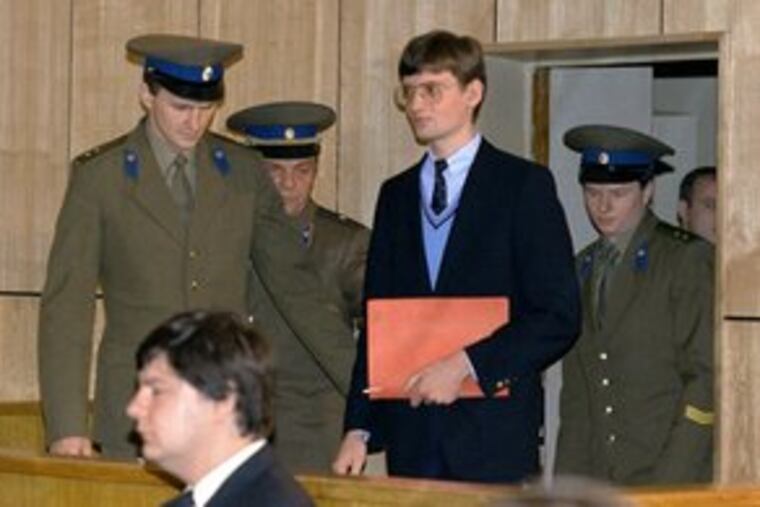
Rust was later sentenced to four years in a Soviet labor camp for illegally entering the Soviet Union and hooliganism. He served 14 months in Moscow's Lefortovo prison before he was paroled.
"I was treated very well," he said, recalling that he shared a cell with an English-speaking prisoner.
Rust said that he invested money earned from his notoriety in property and other businesses and that he was now independently wealthy.
Rust has returned to Russia once, for a three-week visit in 1994. But he has not met Gorbachev despite various efforts over the years.
The former Soviet leader, in East Germany when Rust landed by Red Square, described the event as a "national shame." Gorbachev quickly seized the opportunity to move against Defense Minister Sergei Sokolov and the commander of Soviet air defense forces, Alexander Koldunov.
"I made them look funny around the world, but I helped Gorbachev in some way," Rust said. "I only did it because of my love for peace."