Hamas seizes posts in Gaza; Fatah strikes in West Bank
JERUSALEM - Hamas gunmen consolidated their hold over large swaths of the Gaza Strip yesterday after attacking military posts controlled by the rival Fatah movement, whose own fighters responded with a daylight raid in the West Bank, broadening the civil strife.
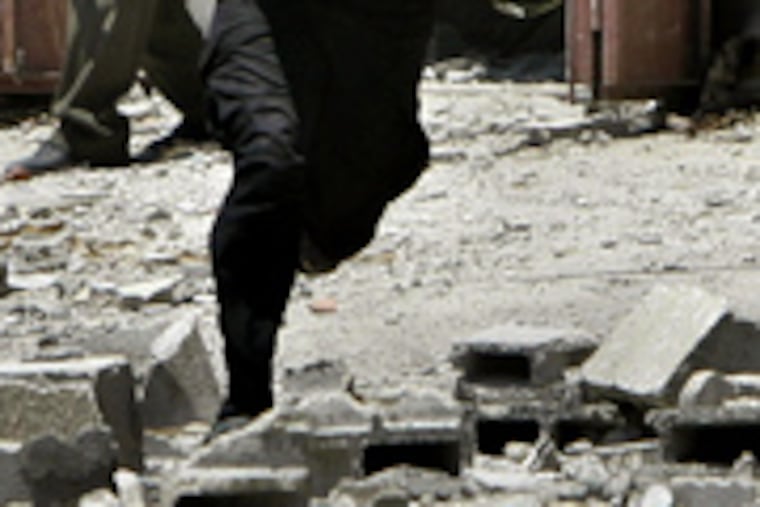
JERUSALEM - Hamas gunmen consolidated their hold over large swaths of the Gaza Strip yesterday after attacking military posts controlled by the rival Fatah movement, whose own fighters responded with a daylight raid in the West Bank, broadening the civil strife.
At least 21 Palestinians died yesterday in Gaza, driving up the four-day death toll to at least 63 in factional violence that both Palestinian parties described as civil war.
The Izzedine al-Qassam Brigades, the Hamas military wing that has begun referring to Fatah as the "Jew American Army," gave the Fatah-dominated Palestinian National Forces across northern Gaza until tomorrow evening to surrender their weapons and turn over their posts. The Hamas tactic, which has included broadcasting inaccurate claims from minarets that Fatah posts have fallen, has proven highly effective in prompting outgunned Fatah fighters to flee.
At least one battalion of the Fatah-dominated Palestinian National Forces was reported to have run out of ammunition, and others may be approaching the end of supplies. Israeli officials have warned for months that Hamas has been stockpiling ammunition, small arms and explosives.
Scores of Palestinians demonstrated in the streets of Gaza City calling for an end to the violence, to no apparent effect.
The volume and frequency of the clashes prompted the U.N. refugee agency in Gaza to scale back operations after two of its Palestinian employees were killed in crossfire.
"The situation there has never been more dire, and we must be able to get in to do our work," said Christopher Gunness, spokesman for the U.N. Relief and Works Agency, which has suspended all but emergency food distribution and medical service to the roughly one million Palestinians it serves in Gaza.
The two largest Palestinian parties, each with potent militias and affiliated security services, have fought periodically since Hamas ended Fatah's long monopoly on political power by winning parliamentary elections in 2006. The victory gave Hamas control of the ministries, while Palestinian Authority President Mahmoud Abbas of Fatah remains the titular head of the government.
Those previous periods of violence have been confined largely to Gaza, home to 1.4 million Palestinians. The fighting has generally lasted no longer than a week. But no period has been as intense or brutal as the current one, which has resisted Egyptian mediation attempts and fractured a power-sharing government formed in March.
Fatah and Hamas have fought for control of the various Palestinian security branches that each party claims the legal authority to run. Their broader ideological differences have made their struggle irreconcilable so far: Fatah, a secular movement that recognizes Israel, favors negotiations to achieve a Palestinian state; Hamas, which the United States, Israel and the European Union consider a terrorist organization, advocates Israel's destruction.
The Bush administration and Israel are openly backing forces loyal to Abbas, a relative moderate whose calls for an end to the fighting have been ignored by both sides. The Bush administration is sending $40 million to train and provide nonlethal equipment to forces loyal to Abbas, who said yesterday that it was "madness that is going on in Gaza." The West Bank, a more populous Palestinian region where Fatah is considered more powerful than Hamas, no longer appears immune from the factional strife.
Gunmen from the Al Aqsa Martyrs' Brigade, Fatah's armed wing, entered an Islamic film and music production company in the West Bank city of Nablus yesterday and seized 10 employees, witnesses said. Hamas gunmen arrived, and a 20-minute gunfight crackled across downtown Nablus. The brigade gunmen then returned to the Balata refugee camp with their hostages. Their fate is unknown.
For a fourth day, the fighting remained intense across much of Gaza as Hamas gunmen moved against select posts of the Palestinian security services controlled by Fatah.
In Khan Younis in central Gaza, Hamas gunmen tunneled beneath a post of the Fatah-dominated Preventive Security Service. They planted explosives in the tunnel and reduced the building to rubble, killing five officers and wounding more than 10 others inside.
"Our aim to control these military posts does not have any political implications," said Sami Abu Zouhri, a Hamas spokesman in Gaza, rebutting Abbas' assertion the previous day that Hamas was seeking to take full control of the government by force. "This is not a coup. After all, we are the ones responsible for the legitimate institutions."