Time capsule with fins
TULSA, Okla. - A concrete vault encasing a 1957 Plymouth Belvedere buried a half-century ago may have been built to withstand a nuclear attack, but it couldn't beat back the onslaught of moisture.
TULSA, Okla. - A concrete vault encasing a 1957 Plymouth Belvedere buried a half-century ago may have been built to withstand a nuclear attack, but it couldn't beat back the onslaught of moisture.
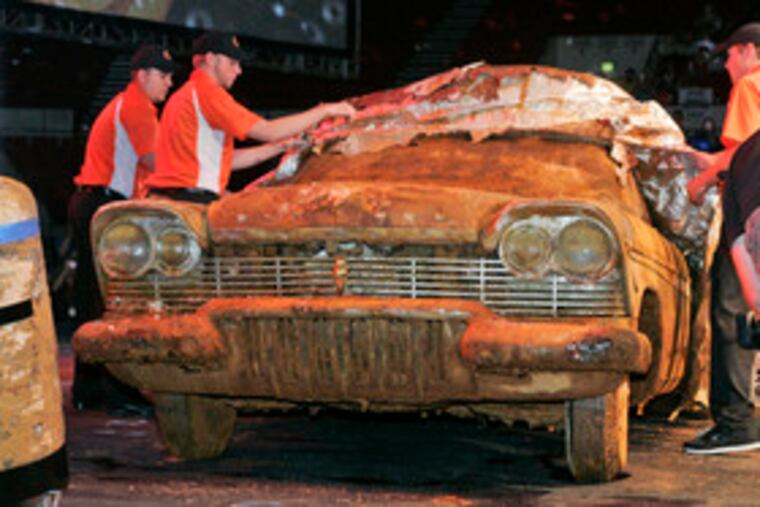
At a ceremony yesterday complete with a couple of drum rolls, crews removed a multilayered protective wrapping caked with red mud, revealing a vintage vehicle that was covered in rust and wouldn't crank.
There were a few bright spots, literally: Shiny chrome was still visible around the doors and front fender, and workers were able to put air in the tires.
But the unveiling in front of thousands of people at the Tulsa Convention Center confirmed fears that the last 50 years had not been the kindest to Miss Belvedere.
Event organizer Sharon King Davis, a fourth-generation Tulsan whose grandfather helped bury the Plymouth, joked that the car needed a little Oil of Olay to help it out.
In the trunk, workers meticulously pulled out objects that had been buried with the two-door hardtop to celebrate Oklahoma's 50 years of statehood - a 5-gallon can of leaded gasoline, which went for 24 cents a gallon in those days, and rusted cans of Schlitz beer.
Workers also searched for a spool of microfilm that recorded the entries of a contest to determine who would win the car: The person whose guess was closest to what Tulsa's population would be in 2007 - 382,457 - would win.
That person, or his or her heirs, will get the car within a week, along with a $100 savings account, worth about $1,200 today with interest.
The elements could not penetrate a time capsule buried with the car. Its top was sawed off and organizers unfolded an American flag - still bright red, white and blue - sending a rousing cheer through the crowd.
Other historical documents, aerial maps of the city and postcards, also were in good condition.
Burying the car 50 years ago was the brainstorm of Frank X. Long, a groundbreaking public-relations executive who wound up in Philadelphia.
Long was working at the time for N.W. Ayer & Associates in New York, which had Plymouth as a client. He went to Philadelphia in 1964 to work for ARA Services (now Aramark).
Bill Cowen, president of Metrospective Communications, a Philadelphia PR firm, was assembling a time capsule of Philadelphia media and public-relations mementos in 1999, ahead of the millennium celebrations in the city.
When he complained about the challenges of that project, Long told him: "If you think that's tough, try burying a car."
Long died in 2000.
Thousands of people had watched as the car was placed on a flatbed truck about noon and driven to the Tulsa Convention Center for the evening event. Some had arrived downtown before 6 a.m. and endured torrential rain just to get a glimpse of the car.
By the time of the ceremony, people were standing on rooftops.
"Ladies and gentlemen, I present to you Miss Belvedere," King Davis said before the crane delicately placed the car onto the flatbed.
Only the car's trademark fins were exposed as it came out of the ground, and it was unclear if they were caked with rust or mud.
The suspense was what Pittsburgh car enthusiast Dave Stragand came for.
"It's our King Tut's tomb," Stragand said. "It's like a fairy tale."