Russians ponder Putin's next role
MOSCOW - Russian President Vladimir V. Putin is widely expected to give up office next year as dictated by the constitution. But will he give up power?
MOSCOW - Russian President Vladimir V. Putin is widely expected to give up office next year as dictated by the constitution. But will he give up power?
Many Russians expect Putin to run the country from the sidelines once he steps down after his second consecutive term - and there is a growing view that he'll return to the presidency after a period of rule by a hand-picked loyalist.
Fyodor Lukyanov, editor of Russia in Global Affairs magazine, said in an interview that it was difficult to think of Putin in any role other than as Russia's leader.
"He will stay in politics as a very powerful person" even after he leaves office following the March 2008 election, said Lukyanov.
Andrew Kuchins, director of the Russian and Eurasian program at the Center for Strategic and International Studies in Washington, agreed that Putin would likely try to step down without relinquishing most, or any, of his power.
"What he's proposing to do is walk out of the Kremlin and remain a very influential guy," Kuchins said. "Most guys don't walk out of the Kremlin, and if they do they don't have any major influence on politics. What he's proposing to do is entirely novel in Russian history."
At 54, Putin shows no signs of tiring, and he is so popular - with approval ratings above 70 percent - that he would likely have no trouble changing the constitution to allow him to run for a third consecutive term. But he has repeatedly said he would oppose that.
Such a blatant power play would only seem to validate Western criticism of Putin as a foe of democracy and political pluralism. Worse, perhaps, it could reduce his role on the world stage to that of strongman or aspiring president-for-life, rather than the elected leader of one of the world's largest economies.
Putin is widely expected to name his successor, and then throw the weight of the Kremlin-controlled media behind that candidate. After he leaves office, experts expect him to become the leader of some new or relatively insignificant body that suddenly will be transformed into a center of power.
Putin has not ruled out running for the presidency after his successor's term ends in 2012, and there is nothing preventing him from serving a third and fourth nonconsecutive term.
His chance to return to the presidency could come sooner if his replacement retired for reasons of health or to spend more time with family, or if there were a change in the constitution that triggered earlier elections.
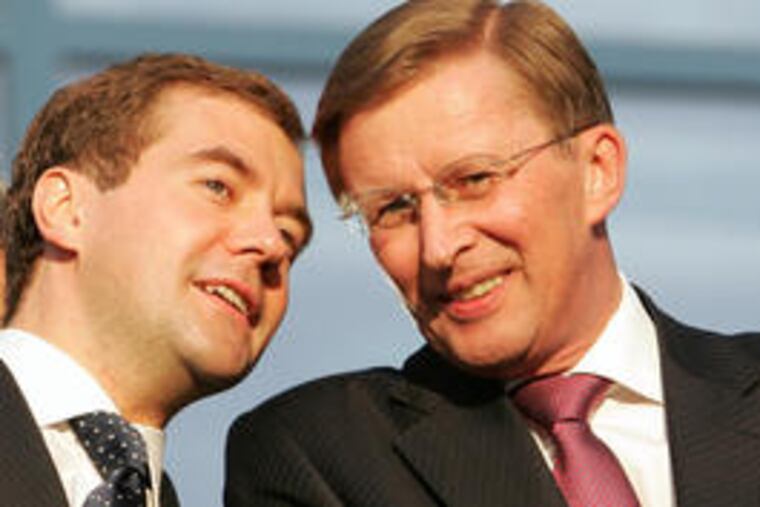
Currently, Putin's two first deputy prime ministers - the stern KGB veteran Sergei Ivanov and the boyish lawyer Dmitry Medvedev - are featured on state-run television every night, and appear to be the chief contenders for the presidency.
But if Putin's successor is only meant to be temporary, it seems likely that some more obscure figure will emerge late in the campaign season.