SILVER CITY, Idaho - High on scaffolding beneath the front gable of Our Lady of Tears Catholic Church, David Wilper applies a final coat of paint to the window arch.
He is installing new stained glass in the church, built in 1898 and still host to one Mass every summer month when members of 50 families live in Idaho's best-known ghost town. November through June, there's a watchman to keep vandals on snowmobiles in check.
"That window has been boarded up for 50 years," said Wilper, the church sexton, whose renovations are part of a broader effort to preserve a delicate balance.
It's an effort to prevent Silver City from dying out, while keeping it from becoming just another tourist trap huckstering frontier kitsch to ATV-riding hordes streaming into Idaho's once gold-rich hills from the growing Boise suburbs.
It's the same challenge faced by its ghost-town brethren across the northern Rocky Mountains, including Bannack and Virginia City in Montana, or Berlin in Nevada, all of which eventually shifted to state ownership to help preserve them.
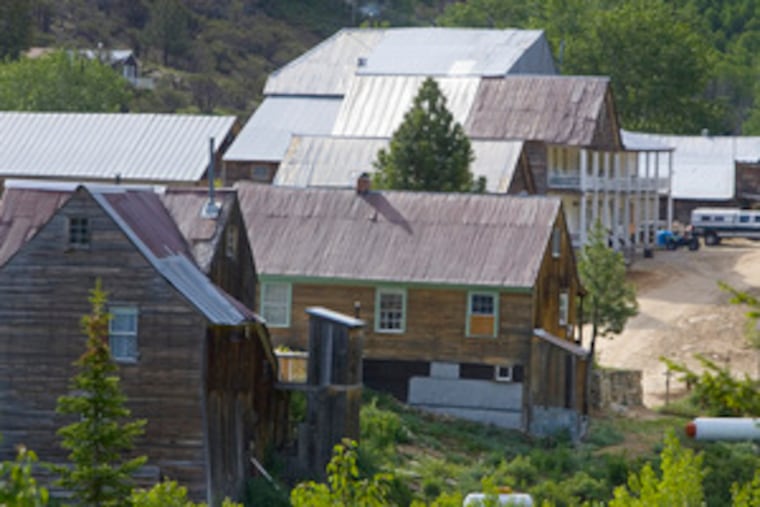
The Bureau of Land Management owns much of the Silver City townsite, but its 70 structures remain in private hands. Because the town is on the National Register of Historic Places, residents can't build new and they can't alter exteriors except for repairs. A new law is in the works to keep the surrounding 10,000 acres looking much as they did a century ago.
Thom Couch heads the Owyhee County Historical Society in Murphy, 28 miles down a dirt road where the county seat moved in 1934 as Silver City's mining fortunes waned. He calls the region "the real thing."
"The Oregon Trail is just across the highway. We had stagecoach robbers, gunfights, Indian attacks," Couch said of Owyhee County, which is two-thirds Belgium's size but has just 11,000 residents. "The Wild West happened here."
In 1863, the West was in gold fever, and a party exploring southwestern Idaho's Jordan Creek found some; Silver City and the region's other mining towns were born. Census reports show a population of about 1,000 in 1870. By then, a stamping mill to crush ore had been hauled overland from California. Photos show the hillsides bare of foliage.
"They took anything they could build with, and what they couldn't build with they burned as fuel," said Roger Nelson, who bought Silver City's 1866 Idaho Hotel in 2000. The hotel's 18 rooms are often filled on weekends.
His lobby was once the stage depot. By 1868, Wells Fargo ran daily from the railroad at Winnemucca, Nev., 200 miles to the south. Nelson concedes it's not easy keeping alive a hotel erected when Andrew Johnson was president.
Today, when one of Silver City's 70 remaining structures is sold, it happens quietly, often between family or friends. But the properties weren't always in demand.
Jim Hyslop's grandfather was prosecutor in Owyhee County from 1916 to 1919; family records show he bought his house for $275 empty, and sold it three years later for the same amount - but with all the family's furniture.
"That indicates the decline of the town during World War I," Hyslop said.
Much of Silver City's decay has been arrested now. Change is under way. Along with the church upgrades, the 1868-era water system was rebuilt a few years ago. Eighteen months ago, residents also reestablished a volunteer fire department.
As the Boise Valley to the north fills up with more than 500,000 people, Silver City has been rediscovered.
"Greenhorns" peer into the windows of the Getchell Drug Store where dust collects on period concoctions, or imagine an evening of raucous dancing in the nearby 1868 Masonic Hall.
The town, surrounded by trails, is also besieged by all-terrain vehicles whose riders rumble past like post-apocalyptic cowboys.
"When we started coming here, the kids could go out and play in the streets," said Barbara Carr, who first came in 1954. "Now, with the traffic, you've got to keep an eye out."
Carr and her husband, Gayland, own the old livery stable, as well as the Hoffer & Miller Meat Market.
Next door is Deadman's Alley, where mining magnate W.H. Dewey emerged from the adjacent Sommercamp Saloon one August night in 1884 and shot bartender Joseph Koenig in a duel.
Once, brothels outnumbered churches in Silver City. Of the churches that were here, only Our Lady of Tears survives.