At least 2 bodies found in wreckage
A third body may also have been found more than a week after the Minneapolis collapse.
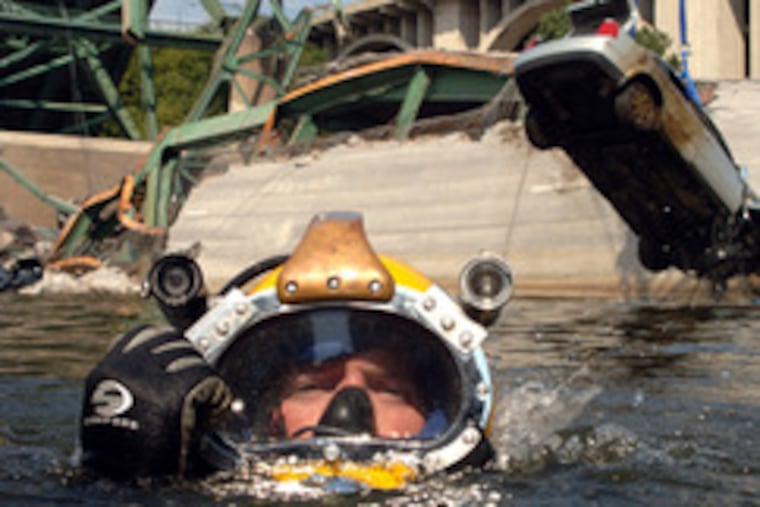
MINNEAPOLIS - Divers pulled at least two more bodies yesterday from the wreckage of the collapsed Interstate 35W bridge, more than a week after the span crumbled into the Mississippi River.
Later, authorities said that one of the sets of remains might actually include those of an additional victim, which would bring the total number of bodies recovered from the disaster to eight if confirmed.
The first victim recovered yesterday was identified as Peter Joseph Hausmann, 47, a computer security specialist from Rosemount.
Andrew Baker, chief medical examiner for Hennepin County, said authorities think they know the identities of those believed to be one or two other victims found yesterday, and that they were on the list of eight missing in the Aug. 1 collapse. They were not immediately identified.
Hausmann had been crossing the bridge while headed to the suburb of St. Louis Park to pick up a friend for dinner. He had called home while sitting in traffic, but the line had gone dead.
As searchers combed the river for victims, federal officials looking into the cause of the collapse issued an advisory for states to inspect the metal plates that hold girders together on bridges nationwide.
Investigators said the plates, or gussets, on the failed Minneapolis bridge were originally attached with rivets, old technology that is more likely to slip than the bolts used in bridges today.
Some plates also may have been weakened by welding work over the years, and some may have been too thin, engineering experts said yesterday.
Questions about the gussets prompted Transportation Secretary Mary Peters to caution states about stress placed on bridges during construction projects.
Investigators are also looking at whether extra weight from construction work could have affected the bridge. An 18-person crew had been working with heavy equipment on the I-35W span when it collapsed during the evening rush hour.
Bruce Magladry of the National Transportation Safety Board said the agency would use a computer to simulate how the bridge might have behaved with different loads, and with different parts of the bridge failing. He said there were infinite combinations to test, so the simulation might have to be run 50 times or 5,000 times.
"Then we compare what the [simulated] collapse looks like to what we actually see out there on the ground," Magladry said, and repeat the simulation until it matches what happened.
Other engineering experts said failure of the plates in a critical spot could have brought down the whole bridge, although no one has pinpointed a gusset as the cause of the failure.
"What they'll be looking for is to see whether one of the gusset plates may have fractured," said W. Gene Corley, a forensic engineer with the engineering firm CTL Group.
The bridge's builders in the mid-1960s riveted the plates together, which required many more holes than bolts would have. More holes weaken steel, said Abolhassan Astaneh-Asl, a professor of structural engineering at the University of California-Berkeley.
Welding work on some gussets - at temperatures of 2,600 degrees or more - could also have caused tiny cracks to form as superheated steel cooled, which may have developed fatigue cracks.
Astaneh-Asl reviewed 1965 construction drawings of the Minneapolis bridge that showed varying thicknesses of the gussets. Some in key spots over the Mississippi River were only a half-inch thick.
A cracked gusset is visible in photos taken after the collapse, he said, but it is unclear what role that might have played in the bridge's failure.
State transportation officials say damage seen on the bridge's gussets might have been caused by the collapse. Or various problems in the bridge may simply have added up over the years, Astaneh-Asl said. For instance, at least one expansion joint locked up, possibly pulling one of the bridge's piers out of alignment and leading to undetermined pressures on other parts of the bridge.
Inspectors who completed the bridge's last full inspection in June 2006 noted problems - "section loss, pitting, heavy flaking rust" - on several of the plates.
Bush Opposes Gas Tax
President Bush said he'd oppose any steps by Congress to increase the gas tax for national bridge repairs in the wake of last week's collapse in Minneapolis.
"Before we raise taxes, which could affect economic growth, I would strongly urge the Congress to examine how they set priorities," he said yesterday.
"My suggestion would be that they revisit the process by which they spend gasoline money in the first place," he added, accusing lawmakers of focusing on their own parochial concerns - or plum projects - above such national concerns as bridge conditions.
Rep. Jim Oberstar (D., Minn.), chairman of the House Transportation Committee, has proposed a 5-cent increase in the 18.3 cents-a-gallon federal gasoline tax to establish a new trust fund for repairing or replacing structurally deficient highway bridges. More than 70,000 of the nation's spans are rated structurally deficient.
About $24 billion, or 8 percent of the last $286 billion highway bill, was devoted to highway and bridge projects singled out by lawmakers. The balance is distributed through grants to states, which decide how it will be spent.
- Inquirer wire services
EndText
Updated coverage of the bridge collapse in video, photos and more via http://go.philly.com/collapse
Hear Bush speak against an increased gas tax,
at his news conference, via http://go.philly.com/gastaxEndText