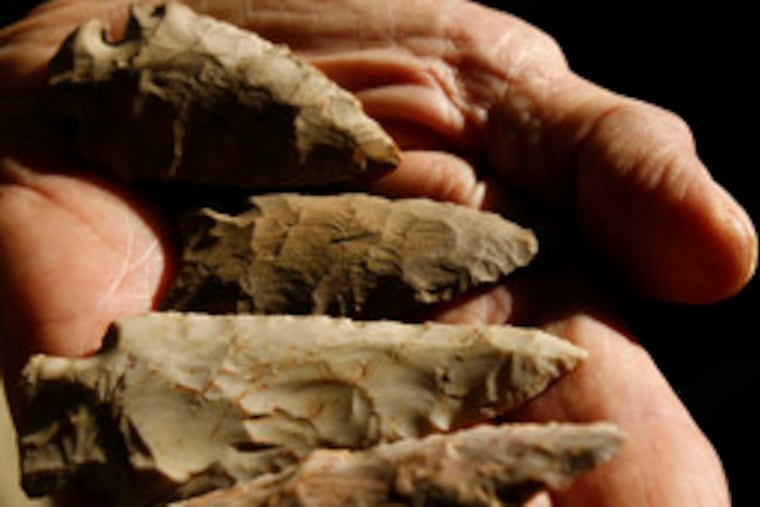
WINCHESTER, Ky. - After a while, the Rev. James Clark's kitchen table started to look like a museum exhibit.
One by one, he laid out the arrowheads, delicately notched and chipped, the bounty of childhood afternoons and grown-up work in the fields where the retired minister and farmer has lived his life. Even more rare were the rocks that had been carefully shaped for grinding corn, or the dark hard stones shaped like tomahawks.
Every year after plowing, the Native American artifacts would appear, working their way to the surface from the depths of thousands of years of dirt and history.
"These are just ones I'd see looking off the truck," Clark said.
Clark's farm sits in the middle of a lush plain in eastern Clark County called the Indian Old Fields. Known as the site that Daniel Boone saw when he reached nearby Pilot Knob, the 3,500 acres had been inhabited for thousands of years before by Native Americans who lived off the ample game, clean waterways, and flat land for crops.
Now, interchange construction planned to begin in 2009 off the Mountain Parkway in the middle of Indian Old Fields has brought a new urgency to those who want to preserve and investigate more than 50 significant prehistoric and historic archaeological sites that have been identified by scholars in the area.
They include burial mounds and sacred circles, some of which are on the National Register of Historic Places.
"There is a huge potential to learn so much," said Harry Enoch, a retired University of Kentucky professor and historian who has studied the Indian Old Fields.
A very late Shawnee village known as Eskippakithiki was shown on a surveyors map in 1755. Pioneers reported extensive remains of buildings, forts and cultivated fields in the area, according to documents found in the courthouse.
But most of the land, still in private hands, has never been properly excavated. No one knows for sure exactly where the village of Eskippakithiki sat. No one knows the extent of Native American habitation.
An archaeological survey done by the Transportation Department found few significant remains. But Enoch and others worry that secondary development, such as hotels and gas stations, from the new road could harm historical remains.
The new construction could provide the impetus to finally document the depth and breadth of Clark County's Native American past.
"We're not interested in stopping the interchange," said Enoch. "We want to make it an opportunity to get this archaeological work done, so that some sites can be studied," including the possible site of Eskippakithiki.
A. Gwynn Henderson, an archaeologist with the Kentucky Archaeological Survey, calls Indian Old Fields a "microcosm of Kentucky's frontier heritage" because it holds so much evidence of early Native American culture.
"It's unique - and it's very important," said Henderson.
Nearly every branch of James Clark's family was involved in the settlement of Clark County, and many generations passed down stories about Indian Old Fields. Because they were always finding evidence of Native American life, they knew it was a pioneer myth that Native Americans had never actually lived in Kentucky.
Clark's mother, Lucille Goff Clark, wrote extensively about the area for local historians. It's not hard when you have a burial mound - built by an early Native American group between 1000 B.C. and 700 A.D. - in the field behind the barn. Clark says an early aerial photograph shows the outline of a sacred circle carved out of the ground, a feature often found near burial mounds.
From the mound on Clark's farm, you can gaze at the neighboring farm over Upper Howard's Creek, where a much larger mound overlooks the water. Clark says he thinks a chief was buried there because of the size of the embedded stones.
"I'd say we've just scratched the surface of what's here," Clark said.