The youngest victims
Ethnic violence has displaced thousands of children. Some have been killed.
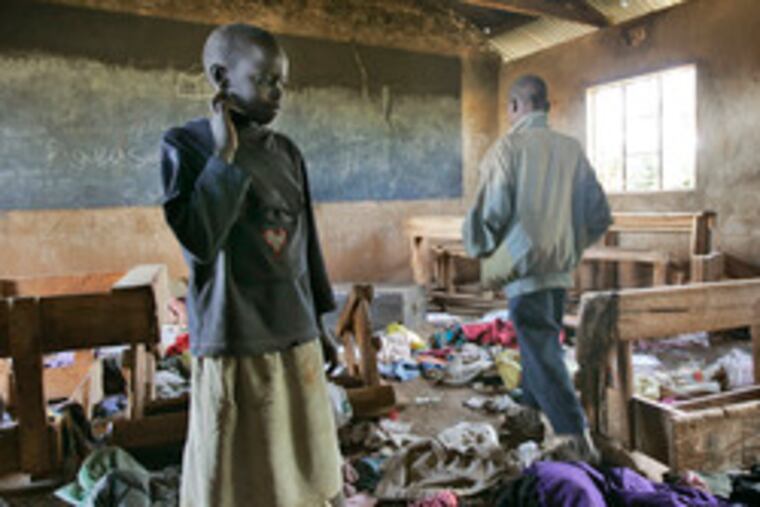
NGARUA, Kenya - When 13-year-old Nelly Chepchumba returned to school last week, she found charred walls where her classroom used to be and two corpses half-buried in the garden.
The violence that has followed Kenya's disputed presidential election means thousands of children cannot go back to school, their classrooms burned, looted or now home to refugees.
Poking through rubble littered with school uniforms and shoes, Nelly sighed as she stepped over ripped-up spelling books, her bare feet caked with dirt.
Old attendance sheets and a blackboard with the message "Don't hesitate to discipline children. A good spanking won't kill them!" served as reminders of the students who used to gather there.
"I'm jealous of other children who get to return to their classes," said the eighth grader, standing where her front-row desk used to be. "I fear I will forget all my lessons."
The Ministry of Education, which ordered schools to reopen last week, had no immediate estimate of how many children were still out of school. But the U.N. children's agency said the conflict had displaced 100,000 children, and some 75,000 are still living in camps that have sprung up in churches, police stations, schools and show grounds.
The Dec. 27 election returned President Mwai Kibaki to power for a second five-year term, with official results putting Raila Odinga second in the closest presidential race in Kenya's history. But foreign and local election observers have said the vote count was deeply flawed. Although the electoral chief pronounced Kibaki the victor, he later said he had been pressured to do so and did not know who won.
Efforts at international mediation have so far failed.
More than 600 people have died in the riots and ethnic killings that have erupted in the wake of the disputed vote. Children were among the victims: In one ethnic attack, a 4-year-old girl was set ablaze and burned to death as she slept in Nairobi's Kibera slum soon after the election.
In the western city of Kisumu, morgue attendants said a 10-year-old boy was shot through the chest and killed Wednesday. The week before, a woman with a child on her back was shot when an ethnic militia attacked displaced people in western Kenya, and both died.
The bloodshed across Kenya, from Nairobi to the coast and the rural highlands, has marked some of the darkest times since Kenya's independence from Britain in 1963. Much of the fighting has degenerated into riots pitting other ethnic groups against Kibaki's Kikuyu, long dominant in Kenyan politics and the economy.
Ngarua, some 200 miles from the capital in western Kenya, is in the heart of opposition territory, where people have turned on their Kikuyu neighbors, torching their homes and attacking them.
Hundreds of Kikuyus were hiding in Nelly's school when a mob set it ablaze Dec. 30, the day election results were announced. Most escaped, according to witnesses, who said six people died, including the two whose bodies Nelly saw.
The region, native to members of the Kalenjin and Luo tribes, was flooded by Kikuyu settlers when white farmlands were returned to Kenyans after independence in 1963, during the presidency of a Kikuyu, Jomo Kenyatta.
Resentment against the Kikuyus resurfaces every time there are political problems in Kenya.
Nicholas Arusei, 28, was among those who stormed the school in Ngarua, armed with arrows, machetes and flaming torches.
He said that Kikuyus had attacked him in the past, and that they didn't deserve shelter because their candidate had stolen the vote.
But "it's painful now, because I can see the losses," Arusei added. "The regret, it comes later."
Local officials said they plan to raze Nelly's looted school. District education officer Sylvester Mulambe said officials were working to set up temporary schools in displacement camps, or to register students at schools in other towns.
Nelly plans to walk six miles to another school, starting tomorrow.
"My mother told me I will have to walk to that school," said the girl, fidgeting nervously, her eyes downcast. "And I will walk that distance, even if it's far."
Opponents Urge More Protests
Kenya's opposition
party, determined to bring down President Mwai Kibaki's government, called yesterday for another day of "peaceful rallies" despite the deaths of more than 20 people in last week's demonstrations.
Police took forceful
action at rallies Wednesday through Friday protesting the Dec. 27 election, but opposition party chairman Henry Kosgey said "we will use each and every means to bring down Kibaki's government."
Five more people
died in ethnic clashes yesterday as tribesmen fought one another with bows and arrows and machetes in villages around a monastery near Nairobi, where hundreds of people have sought refuge.
More than 600 people
have been killed in Kenya's election violence, according to a government commission.
U.S. Ambassador
Michael Ranneberger said Friday that there had been "cheating on both sides" in elections that pitted Kibaki against opposition leader Raila Odinga. The United States maintains that the improprieties have not been properly investigated.
- Associated Press