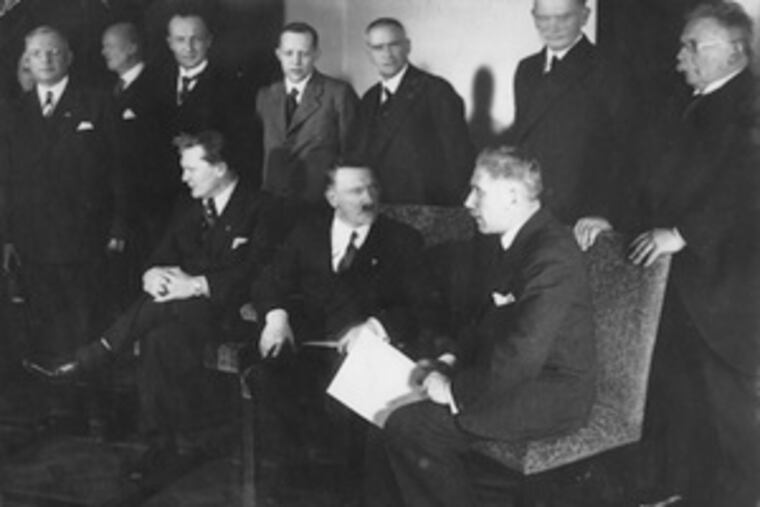
BERLIN - Today's 75th anniversary of Adolf Hitler's elevation to German chancellor is one the country would prefer to forget, but the ignominious event that ultimately led to the deaths of millions remains part of Germany's weighted history.
Hitler's accession to the post gave the Nazi party its "in" to consolidate absolute control over the country in the months soon after, setting it on the path to World War II and the Holocaust.
The Holocaust remains "for us Germans an indelible part of our history," Foreign Minister Frank-Walter Steinmeier said Sunday, as the country marked the 63d year since the liberation of the Auschwitz death camp in annual Holocaust remembrance ceremonies.
"The memory of the genocide committed by the Germans serves to keep us alert and fight anti-Semitism and racial hatred around the world," he said.
Few public events are planned to mark today's anniversary, though many schools received letters from state governments asking them to hold special sessions in class.
German students spend at least half a school year learning about Hitler's rise to power and the Third Reich, part of a concerted effort by modern Germany to prevent history from repeating itself.
"It is a very important day in German history, but of course it's not as easily remembered as, for example, Kristallnacht on November 9, because nobody was hurt on January 30," said Frank Rudolph, 44, a history teacher at a Berlin high school.
The rise of Hitler and the Nazis is viewed with a national shame and horror, but its reasons for happening were complex, said Hans Ottomeyer, director of Berlin's German Historical Museum.
Ottomeyer cited World War I, the rampant inflation in the postwar years, the world economic collapse of 1929, and Germany's massive unemployment as factors that led people to vote for extremist parties.
"The general fear of social and economic decline was stirred from both the left and the right," he said. "They all tried to consolidate their positions with violence, and that opened the flank to this seizure of power."
About a month after being appointed chancellor, Hitler used the torching of the Reichstag parliament building - blamed on a Dutch communist, Marinus van der Lubbe - to strengthen his grip on power by suspending civil liberties and cracking down on opposition parties.
Van der Lubbe, a bricklayer, was convicted of arson and high treason in December 1933 and executed Jan. 10, 1934. Earlier this month - in evidence that Germany's rehabilitation is still going on 75 years later - German prosecutors formally overturned van der Lubbe's conviction.
Other prosecutors are still trying to track down Nazis believed to be hiding out in other corners of the world and bring them to justice.
A spokesman for the federal ministry of justice confirmed yesterday the existence of an informal request for extradition regarding war criminal Aribert Heim, believed to be in Brazil. A court in the southwestern city of Baden-Baden has had a case open on Heim for several decades.
In accepting responsibility for the Nazi Holocaust - in which about six million European Jews, and possibly several million people in other groups, were killed, Germany has established scores of memorials and museums.
Two new memorials are planned for the capital near the Reichstag building: one commemorating Roma and Sinti, or Gypsy, victims of the Nazis and another remembering homosexual victims.
The Reichstag building - which again became the seat of the lower house of parliament after reunification - already hosts a memorial to political victims of the Nazis. The much bigger Memorial to the Murdered Jews of Europe - 2,711 concrete slabs in undulating rows that opened in 2005 - sits nearby on the other side of the landmark Brandenburg Gate.